Category: Lisbon Summer School for the Study of Culture

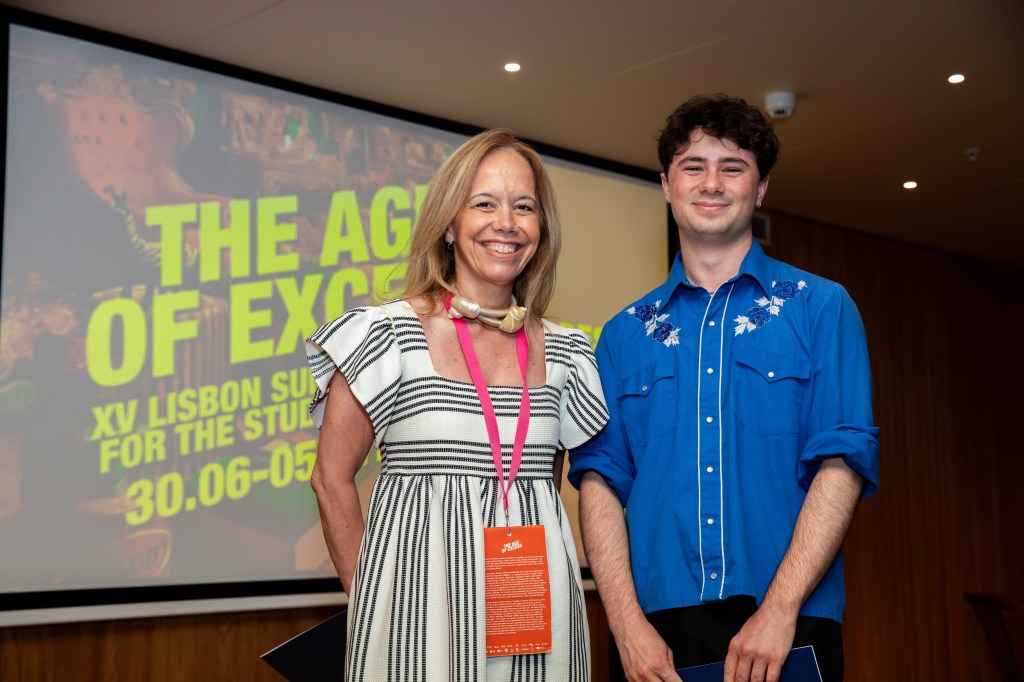
  • And the Award goes to…

    And the Award goes to…

    Once again, the Lisbon Summer School for the Study of Culture welcomed participants from around the world and offered a great variety of insights to this year’s topic, “The Age of Excess”.

    The members of the Assessment Committee read all the papers and took part in the MA Corner in which the Master’s students presented their posters. As the result, the Lisbon Summer School gave awards for the best achievements:

    Silas Edwards

    (Justus-Liebig-University, Giessen)

    Excess and Extinction: Butterfly collecting and environmental ethics in Germany 1900-1938 

    Matthew Mason

    (Universidade Católica Portuguesa)

    The (In)Discreet Charm of Bourgeois Excess, or (the Limits of) Cinema as Social Critique: A Comparative Consideration of Jean-Luc Godard’s Weekend (1967) and Ruben Östlund’s Triangle of Sadness (2022) 

    Miriam Salib

    (Universidade Católica Portuguesa)

    The Representations of Excess as Compensation for Lack of Materiality

    Congratulations to the winners!

  • The Summer School is approaching – register now!

    The Summer School is approaching – register now!

    The XV Lisbon Summer School for the Study of Culture will again welcome international researchers and specialists to Lisbon between June 30 and July 5, 2025. The Summer School offers a great variety of sessions; keynote lectures, paper sessions, master classes, workshops and visits to exhibitions.

    This edition of the Lisbon Summer School for the Study of Culture is also the ESSCS (European Summer School in Cultural Studies) Summer School, welcoming students from the University of Copenhagen (Copenhagen Doctoral School of Cultural Studies), Amsterdam School for Cultural Analysis, University of Giessen (International Graduate Centre for the Study of Culture), Université de Paris VIII (École Doctorale Esthétique, sciences e technologies des arts), Institutum Studiorum Humanitatis Ljublana, University of Trondheim (PhD Programme in Humanities and the Arts) and University of Bern (Graduate School of the Arts and Humanities). 

    KEYNOTE SPEAKERS

    Bárbara Coutinho (MUDE-Design Museum)
    Barbara Vinken (LMU Münich)
    Brooke Harrington (Dartmouth College)
    Claudia Salamanca (Pontificia Universidad Javeriana)
    Désiré Feuerle (art collector, curator and consultant)
    Ghassan Moussawi (University of Illinois-Urbana Champaign)
    Nanna Bonde Thylstrup (University of Copenhagen)
    Sophia Rosenfeld (University of Pennsylvania)
    Paulo Campos Pinto (Universidade Católica Portuguesa)

    MASTER CLASSES

    Ilios Willemars (Leiden University): Racializing statistics: machine learning and semiotic excess

    Rita Faria (Universidade Católica Portuguesa): The new Newspeak: when the excess of words makes lies sound truthful and murder respectable

    WORKSHOPS

    Linda Koncz and Eduardo Prado Cardoso (Universidade Católica Portuguesa): “One-Take” Filmmaking Workshop: Countering Today’s Excess

    Deborah de Muijnck (Justus Liebig University Giessen): Storying the Self in an Age of Excess: Cultural Models of Narrative Identity  

    Luísa Santos (Universidade Católica Portuguesa): The Excess of/in Art Institutions


    You can find more information on the website https://theageofexcess.wordpress.com/.

    The Summer School is open and completely free for the Lisbon Consortium students. For external participants, the daily fee is 80€ (please contact lxsummerschool@gmail.com).

    Registration: https://fch.lisboa.ucp.pt/xv-lisbon-summer-school-study-culture

  • XV Lisbon Summer School is approaching!

    XV Lisbon Summer School is approaching!

    The XV Lisbon Summer School for the Study of Culture will be held June 29 – July 5, 2025, with the topic “The Age of Excess”. As always, this Summer School will bring together researchers, master and doctoral students and post-docs from around the world. 

    The Keynote Speakers feature Bárbara Coutinho (MUDE), Barbara Vinken (Ludwig-Maximilians-Universität Munich), Brooke Harrington (Dartmouth College), Claudia Salamanca (Pontifícia Universidad Javeriana), Désiré Feuerle (Art collector, curator and consultant), Nanna Bonde Thylstrup (University of Copenhagen), Sophia Rosenfeld (University of Pennsylvania), and Paulo Campos Pinto (Universidade Católica Portuguesa).

    Masterclasses will be held by Ilios Willemars (Leiden University), and Rita Faria (Universidade Católica Portuguesa).

    You can find more information about the event here:

    https://theageofexcess.wordpress.com/

  • The Age of Excess – deadline extended!

    The Age of Excess – deadline extended!

    The deadline for the XV Lisbon Summer School for the Study of Culture – The Age of Excess, that will take place between June 30 and July 5 has been extended. Abstracts can be submitted until February 17, 2025.

  • CfP | The Age of Excess – XV Lisbon Summer School for the Study of Culture

    CfP | The Age of Excess – XV Lisbon Summer School for the Study of Culture

    XV Lisbon Summer School for the Study of Culture

     THE AGE OF EXCESS

     Lisbon, June 30 – July 5, 2025

    Deadline for submissions: February 9, 2025

    After years of financial crisis and politics of austerity, as well as a pandemic that brought ordinary life to a halt, culture today is laden with excess. This excess can take many different shapes and foster diverse readings, some of them positive, focusing on excess as an opportunity, while others reflect on its pernicious effects.

    On the one hand, excess can be viewed both as a result from and a driver to a better life. Economic stability – i.e. having more than enough money – can be equated with peace, happiness, education, health, and healthier human relationships. It helps turn plans and dreams into reality, while making worrying about day-to-day circumstances futile. Excess can also lead to a wider range of choices and possibilities: from more career options to broader access to goods and services. It is also worth mentioning the recent technological advances that have made resources and knowledge more readily available. As a result, many processes and decisions, powered by digital transformation and ubiquitous connectivity, have become much easier and quicker, as well as more collaborative, open, and democratic.

    On the other hand, excess is also a “problem” (Abbott 2014) and is at the core of some of the most important and urgent contemporary issues: overpopulation, the overexploitation of natural resources, overconsumption, information overflow and information overload, etc. All these phenomena have in common the prefix “over-”, which indicates superfluity. As explained by J.R. Slosar, “we take in more than we need, or engage in behavior without thinking it through” (2009, xviii). Everything becomes overwhelming or “too much”– in volume, quantity, and reach – but also more extreme: more wealth is counterbalanced by more poverty; more accounts of eating disorders are accompanied by bigger obesity rates; more movements and calls for peace and solidarity are offset by more and bigger wars fueled by more and deadlier weapons; more necessary and useful products encourage the creation and commercialization of redundant and wasteful objects and systems.

    Things in excess, many of which are initially conceived to improve people’s lives and generate more free time, end up, conversely, greatly reducing time and attention. Mobile devices are a great example. Constant access to the internet and social media, for instance, may trigger a sense of temporal dissociation and addictive behaviors that cause anxiety and social detachment. Moreover, the copious amount of content to post, watch, and comment on functions as a source of distraction and, simultaneously, shortens the user’s attention span to make everything more manageable.

    The fear of missing out pushes people to spend more time in touch, “tethered to our ‘always-on/always-on-us’ communication devices and the people and things we reach through them” (Turkle 2023, 122). Being pressured to work longer and faster is the other side of the coin to always being “on”. Recent discussions within academia are challenging this “culture of speed” and stressing the importance of taking control back and slowing down (Berg and Seeber 2016).

    In the fast pace of our contemporary times, things are usually short-lived. They are deemed unwanted and discarded more rapidly. Falling victim to the alluring idea of shiny and new, once valuable items are quickly turned into waste. A Leavisian interpretation of the mass production and consumption of things can propel us to think about things produced in excessive quantities as lacking in quality. In this case, the original and unique are deeply compromised by repeatability, which replaces the rare with the ordinary, the expensive with the cheap, the durable with the flimsy, the tasteful with the gaudy and kitsch – the substitute almost always painted in a bad light.

    The repeatability, or the proliferation of things, generated by excess is also evident in the multiple and varied events and activities that demand our attention and participation. A proven formula – be it a show, a genre, a festival concept, among others – is copied ad nauseum. The novelty dissipates and excess becomes constricting: instead of variability, it promotes alikeness. We see the same things over and over again and what stands out in the desert of similitude is, usually, what offers something “extra” or exceeds the norm(al).

    The XV Lisbon Summer School for the Study of Culture is dedicated to the study of the notion of excess in contemporary culture. Papers are welcome on the following topics, amongst others: 

    • Culture and excess 
    • Excess across the ages
    • The aesthetics of excess
    • Representations of excess
    • The rhetoric of excess in literature, arts and politics
    • Excessive styles and fashion
    • Kitsch
    • Discourses of spectacle and excess
    • Minimalism and simplicity
    • Abundance and/or scarcity
    • Usefulness and/or redundancy
    • Excess of meanings and interpretations
    • Overabundance of communication and translation
    • Translatability and excess
    • Saturated readings and (re)writings
    • Social and cultural overreaction
    • Causes and symptoms of excessive behavior
    • Decadence and self-indulgence
    • Immediacy and impulsivity
    • The culture of waste
    • Loss in a culture of excess
    • Inequality in times of excess
    • Theory in times of excess
    • Mental health and excess
    • Alienation, fascination, and other responses to excess

    We encourage proposals coming from the fields of culture studies, film and the visual arts, literary and translation studies, history, anthropology, media, and psychology, among others.

    Paper proposals

    Proposals should be sent to lxsummerschool@gmail.com no later than February 9, 2025, and include paper title, abstract in English (max. 200 words), name, e-mail address, institutional affiliation, and a brief bio (max. 100 words) mentioning ongoing research.

    Applicants will be informed of the results of their submissions by February 28, 2025.

    Full papers submission

    Presenters are required to send in full papers no later than April 30, 2025.

    The papers will then be circulated amongst the participants. In the slot allotted to each participant (30’), only 10’ may be used for a brief summary of the research piece. The Summer School is a place for networked exchange of ideas, and organizers wish to have as much time as possible for a structured discussion between participants. Therefore, in each slot, 10’ will be used for presentation, and 20’ for discussion.

    Registration fees

    Participants with paper [for the entire week – includes lectures, master classes, doctoral sessions, lunches and closing meal]

    Early bird [March 1-31] – 350€
    Regular [April 1-June 1] – 450€

    Participants without paper [per day – closing meal not included]

    Early bird [March 1-31] – 60€
    Regular [April 1-June 1] – 80€

    Fee waivers

    For The Lisbon Consortium students and CECC researchers, there is no registration fee.

    For other UCP students, students from institutions affiliated with the European Summer School in Cultural Studies (ESSCS), members of the European PhD-Net in Literary and Cultural Studies, and members of the Critical Theory Network the registration fee is 120€ [early bird – March 1-30]; 200€ [regular – April 1-June1].

    Organizing Committee

    • Isabel Capeloa Gil
    • Peter Hanenberg
    • Alexandra Lopes
    • Adriana Martins
    • Diana Gonçalves
    • Paulo de Campos Pinto
    • Rita Faria
    • Annimari Juvonen

    Assessment Committee

    • Ana Margarida Abrantes
    • Rita Bueno Maia
    • Paulo de Campos Pinto
    • Sara Eckerson
    • Rita Faria
    • Diana Gonçalves
    • Peter Hanenberg
    • Annimari Juvonen
    • Luísa Leal de Faria
    • Verena Lindemann Lino
    • Alexandra Lopes
    • Adriana Martins
    • Joana Moura
    • Sofia Pinto
    • Luísa Santos
  • Culture at War – Deadline for submissions March 14!

    Culture at War – Deadline for submissions March 14!

    CULTURE AT WAR

    Lisbon, June 24 – 29, 2024

    We are living in times of war. Now, more than ever, war occupies a central role in both national and international affairs and pervades various spheres of our societies and cultures. 

    The 21st century has been marked by violence of different varieties and levels. Having started with a massive terrorist event, the attacks of September 11, 2001, the last two decades have witnessed many examples of aggression that have come to dominate both the media and public discussion. Acts of terrorism of various kinds, revolutions and wars, with the conflicts in Ukraine and the Middle East among the most recent, are illustrative of contemporary warfare, its characteristics, and challenges. While new military technology such as high-tech weapons and attack drones promote more remote, noncontact operations, the ever-present media strive for immediacy and proximity and thus contribute to a new and distinctive experience of war. Their continuous, play-by-play coverage promotes the illusion of a 360º view and allows audiences to follow the events in near-real time. However, their omnipresence has also turned them into desirable instruments of warfare. They not only inform about the war but also have the ability to mobilize for/against it. Furthermore, the rise of social media and its pivotal role in both documenting conflicts and generating and disseminating misinformation cannot be disregarded. As military conflicts unfold, a parallel war is also fought between communication mechanisms. It can even be argued, with Paul Virilio (War and Cinema, 1989), that war, or its experience, is becoming increasingly a product of visual media construction.

    Wars are not circumscribed to military conflicts, though. Contention has become an intrinsic part of everyday life, leading to social and cultural movements that call out misguided practices, injustices, and violations of basic laws and rights. On the one hand, bottom-up mobilizations such as #MeToo, the gilets jaunes, or Fridays for Future, reveal a world in crisis, responding to systemic violence with dissent. On the other hand, the dismantling of structures of oppression by means of decolonizing processes clashes with the incapacity to effectively deal with past wrongdoings and the tendency to forget or avoid uncomfortable discussions. These movements may, at times, also represent a dynamic of destruction based on the collective readiness to criticize, denounce, hold accountable, and ultimately cancel what or who is considered to have behaved in an unacceptable way. 

    This culture of war, of diverging opinions and interests, extends also to the relationship between man and nature, and more specifically the ongoing environmental emergency. One rhetorical device used to stress the escalating effects of climate change is precisely the war metaphor (employed also in the context of the COVID-19 pandemic). The use of military language and the idea of a war against climate change, widely used in public speeches and in the media, is meant to spark a fighting spirit and incite action. There is, however, the risk of having the opposite effect if the enemy remains abstract, the message is not made understandable, and governments and individuals fail to take responsibility for the current situation. 

    The XIV Lisbon Summer School for the Study of Culture is dedicated to the study of the relationship between culture and war. Papers are welcome on the following topics, amongst others:

    • Culture and conflict 
    • Ancient and modern warfare 
    • Culture in modern warfare
    • War and the creation of modernity
    • The cultural construction of terror/terrorism
    • Rules of war and humanitarian law
    • The ethics of war
    • The forensics of war
    • Rituals of the fallen
    • Battlefields and landscapes of war
    • Media and war, media at war: (mis)communication, (mis)information, and fake news 
    • Representations of war 
    • Art and artists at war
    • Art and reparations
    • (De)Colonizing discourses and practices/asymmetric conflict
    • Conflict escalation and conflict resolution 
    • Cultural wars and language
    • Dialogue and tolerance/Soliloquy and intolerance 
    • Culture of violence 
    • Warrior culture: between heroes and villains 
    • War as metaphor 
    • Environmental emergency and war against climate change 
    • War-induced uncertainty and instability 
    • Epistemologies at war/theories at war

    We encourage proposals coming from the fields of culture studies, film and the visual arts, literary and translation studies, history, anthropology, media, and psychology, among others.

    Paper proposals

    Proposals should be sent to lxsummerschool@gmail.com no later than than February 29 March 14, 2024, and include paper title, abstract in English (max. 200 words), name, e-mail address, institutional affiliation, and a brief bio (max. 100 words) mentioning ongoing research.

    Applicants will be informed of the results of their submissions by by March 29 April 8, 2024.

    Full papers submission

    Presenters are required to send in full papers no later than May 31, 2024.

    The papers will then be circulated amongst the participants. In the slot allotted to each participant (30’), only 10’ may be used for a brief summary of the research piece. The Summer School is a place for networked exchange of ideas, and organizers wish to have as much time as possible for a structured discussion between participants. Therefore, in each slot, 10’ will be used for presentation, and 20’ for discussion.

    Registration fees

    Participants with paper – 300€ for the entire week (includes lectures, master classes, doctoral sessions, lunches and closing dinner)

    Participants without paper – 60€ per day (lunches and closing dinner not included)

    Fee waivers

    For The Lisbon Consortium students and CECC researchers, there is no registration fee.

    For other UCP students, students from institutions affiliated with the European Summer School in Cultural Studies (ESSCS), members of the European PhD-Net in Literary and Cultural Studies, and members of the Critical Humanities Network the registration fee is 80€.

    This edition of the Lisbon Summer School for the Study of Culture will function as the 2024 Critical Humanities Network Summer School.

    Organizing Committee

    • Isabel Capeloa Gil
    • Peter Hanenberg
    • Alexandra Lopes
    • Adriana Martins
    • Diana Gonçalves
    • Paulo de Campos Pinto
    • Rita Faria
    • Annimari Juvonen

    Assessment Committee

    • Peter Hanenberg
    • Alexandra Lopes
    • Adriana Martins
    • Diana Gonçalves
    • Paulo de Campos Pinto
    • Rita Faria
    • Ana Margarida Abrantes
    • Luísa Leal de Faria
    • Joana Moura
    • Rita Bueno Maia
    • Verena Lindemann Lino
    • Sofia Pinto
    • Luísa Santos
  • Cfp: XIV Lisbon Summer School for the Study of Culture – Culture at War

    Cfp: XIV Lisbon Summer School for the Study of Culture – Culture at War

    CULTURE AT WAR

    Lisbon, June 24 – 29, 2024

    Deadline for submissions: February 29, 2024

    We are living in times of war. Now, more than ever, war occupies a central role in both national and international affairs and pervades various spheres of our societies and cultures. 

    The 21st century has been marked by violence of different varieties and levels. Having started with a massive terrorist event, the attacks of September 11, 2001, the last two decades have witnessed many examples of aggression that have come to dominate both the media and public discussion. Acts of terrorism of various kinds, revolutions and wars, with the conflicts in Ukraine and the Middle East among the most recent, are illustrative of contemporary warfare, its characteristics, and challenges. While new military technology such as high-tech weapons and attack drones promote more remote, noncontact operations, the ever-present media strive for immediacy and proximity and thus contribute to a new and distinctive experience of war. Their continuous, play-by-play coverage promotes the illusion of a 360º view and allows audiences to follow the events in near-real time. However, their omnipresence has also turned them into desirable instruments of warfare. They not only inform about the war but also have the ability to mobilize for/against it. Furthermore, the rise of social media and its pivotal role in both documenting conflicts and generating and disseminating misinformation cannot be disregarded. As military conflicts unfold, a parallel war is also fought between communication mechanisms. It can even be argued, with Paul Virilio (War and Cinema, 1989), that war, or its experience, is becoming increasingly a product of visual media construction.

    Wars are not circumscribed to military conflicts, though. Contention has become an intrinsic part of everyday life, leading to social and cultural movements that call out misguided practices, injustices, and violations of basic laws and rights. On the one hand, bottom-up mobilizations such as #MeToo, the gilets jaunes, or Fridays for Future, reveal a world in crisis, responding to systemic violence with dissent. On the other hand, the dismantling of structures of oppression by means of decolonizing processes clashes with the incapacity to effectively deal with past wrongdoings and the tendency to forget or avoid uncomfortable discussions. These movements may, at times, also represent a dynamic of destruction based on the collective readiness to criticize, denounce, hold accountable, and ultimately cancel what or who is considered to have behaved in an unacceptable way. 

    This culture of war, of diverging opinions and interests, extends also to the relationship between man and nature, and more specifically the ongoing environmental emergency. One rhetorical device used to stress the escalating effects of climate change is precisely the war metaphor (employed also in the context of the COVID-19 pandemic). The use of military language and the idea of a war against climate change, widely used in public speeches and in the media, is meant to spark a fighting spirit and incite action. There is, however, the risk of having the opposite effect if the enemy remains abstract, the message is not made understandable, and governments and individuals fail to take responsibility for the current situation. 

    The XIV Lisbon Summer School for the Study of Culture is dedicated to the study of the relationship between culture and war. Papers are welcome on the following topics, amongst others:


    • Culture and conflict 
    • Ancient and modern warfare 
    • Culture in modern warfare
    • War and the creation of modernity
    • The cultural construction of terror/terrorism
    • Rules of war and humanitarian law
    • The ethics of war
    • The forensics of war
    • Rituals of the fallen
    • Battlefields and landscapes of war
    • Media and war, media at war: (mis)communication, (mis)information, and fake news 
    • Representations of war 
    • Art and artists at war
    • Art and reparations
    • (De)Colonizing discourses and practices/asymmetric conflict
    • Conflict escalation and conflict resolution 
    • Cultural wars and language
    • Dialogue and tolerance/Soliloquy and intolerance 
    • Culture of violence 
    • Warrior culture: between heroes and villains 
    • War as metaphor 
    • Environmental emergency and war against climate change 
    • War-induced uncertainty and instability 
    • Epistemologies at war/theories at war

    We encourage proposals coming from the fields of culture studies, film and the visual arts, literary and translation studies, history, anthropology, media, and psychology, among others.

    Paper proposals

    Proposals should be sent to lxsummerschool@gmail.com no later than February 29, 2024, and include paper title, abstract in English (max. 200 words), name, e-mail address, institutional affiliation, and a brief bio (max. 100 words) mentioning ongoing research.

    Applicants will be informed of the results of their submissions by March 29, 2024.

    Full papers submission

    Presenters are required to send in full papers no later than May 31, 2024.

    The papers will then be circulated amongst the participants. In the slot allotted to each participant (30’), only 10’ may be used for a brief summary of the research piece. The Summer School is a place for networked exchange of ideas, and organizers wish to have as much time as possible for a structured discussion between participants. Therefore, in each slot, 10’ will be used for presentation, and 20’ for discussion.

    Registration fees

    Participants with paper – 300€ for the entire week (includes lectures, master classes, doctoral sessions, lunches and closing dinner)

    Participants without paper – 60€ per day (lunches and closing dinner not included)

    Fee waivers

    For The Lisbon Consortium students and CECC researchers, there is no registration fee.

    For other UCP students, students from institutions affiliated with the European Summer School in Cultural Studies (ESSCS), members of the European PhD-Net in Literary and Cultural Studies, and members of the Critical Humanities Network the registration fee is 80€.

    This edition of the Lisbon Summer School for the Study of Culture will function as the 2024 Critical Humanities Network Summer School.

    Organizing Committee

    • Isabel Capeloa Gil
    • Peter Hanenberg
    • Alexandra Lopes
    • Adriana Martins
    • Diana Gonçalves
    • Paulo de Campos Pinto
    • Rita Faria
    • Annimari Juvonen

    Assessment Committee

    • Peter Hanenberg
    • Alexandra Lopes
    • Adriana Martins
    • Diana Gonçalves
    • Paulo de Campos Pinto
    • Rita Faria
    • Ana Margarida Abrantes
    • Luísa Leal de Faria
    • Joana Moura
    • Rita Bueno Maia
    • Verena Lindemann Lino
    • Sofia Pinto
    • Luísa Santos
  • XIII Lisbon Summer School for the Study of Culture – FUTURE/FUTURES – extended deadline

    XIII Lisbon Summer School for the Study of Culture – FUTURE/FUTURES – extended deadline

    XIII Lisbon Summer School for the Study of Culture 

    FUTURE/FUTURES

    Lisbon, July 3 – July 8, 2023

    [extended] Deadline for submissions: February 28 March 17, 2023

    For centuries thinking about the future was basically an optimist and progress driven endeavor, aimed at advancing towards the best of possible worlds through the improvement of science and technology. 

    Throughout the 20th century, euphoria about progress slowly but steadily turned into discomfort, due to the growing awareness about scientific development’s immense capability to cause pain and infortune. The shortcomings and aporias of the present have strangely produced a new retrotopia, focused on reinventing the past and less on clearly conceiving of the future-to-be. This is caused by the globalization of indifference, the crisis of democratic states, the deepening of cultural and religious wars and the rising visibility of extreme violence, linked to terrorism and war. We are likewise faced with a resource crisis and an obvious planetary exhaustion, just as the fourth technological revolution forces us to question the future of work and hence of the very definition of the human as a homo laborans. 

    In view of the different rhythms, contexts and directions of our global communities, given the clear difference of access to basic commodities and even to the social and political right to have rights, given the uneven capability of individuals throughout the globe to shape the future to come, it is clear that future must be graphed in the plural, as futures that are culturally situated in distinct global realities. In addition, ‘futures’ has become a sort of a floating signifier swaying from prospective to finance, from science fiction to organizational theory, from anthropology to psychoanalysis.

    The XIII Lisbon Summer School for the Study of Culture is dedicated to the study of the representation of the future(s) as trope and idea. Papers are welcome on the following topics, amongst others:

    • Future or futures
    • Culture(s) of the future; culture(s) in the future
    • Imagining the future: representations in literature, cinema and the arts
    • Space and/in time
    • Science and technology: potential and risks for life in the future
    • Innovative tools, materials, systems and techniques
    • Cyberfutures
    • Memory and trauma: between past and future
    • (De)Colonizing the future
    • The future(s) of the Other
    • Speculation, prediction, anticipation and the production of possible futures
    • Futurist thought: ‘new’/’neo’, ‘re’
    • Dance of prefixes: from u- and dys-topia to retro-topia
    • The protractive or transformative quality of the future
    • The future of woke culture
    • Fear of the future and the fear of no future
    • Crisis, disaster, conflict, and the disruption of the future
    • Nostalgia, hope, and the promise of a brighter future
    • A more than human future: human, posthuman, nonhuman and other possibilities

    We encourage proposals coming from the fields of culture studies, film and the visual arts, literary and translation studies, history, anthropology, media and psychology, among others.

    Paper proposals

    Proposals should be sent to lxsummerschool@gmail.com no later than February 28 March 17, 2023 and include paper title, abstract in English (max. 200 words), name, e-mail address, institutional affiliation and a brief bio (max. 100 words) mentioning ongoing research.

    Applicants will be informed of the result of their submissions by March 31, 2023.

    Rules for presentation

    The organizing committee shall place presenters in small groups according to the research focus of their papers. They are advised to stay in these groups for the duration of the Summer School, so a structured exchange of ideas may be developed to its full potential.

    Full papers submission

    Presenters are required to send in full papers no later than May 31, 2023.

    The papers will then be circulated amongst the members of each research group.  In the slot allotted to each participant (30’), only 10’ may be used for a brief summary of the research piece. The Summer School is a place for networked exchange of ideas, and organizers wish to have as much time as possible for a structured discussion between participants. Therefore, in each slot, 10’ will be used for presentation, and 20’ for discussion.

    Registration fees

    Participants with paper – 300€ for the entire week (includes lectures, master classes, doctoral sessions, lunches and closing dinner)

    Participants without paper – 60€ per day (lunches and closing dinner not included)

    Fee waivers

    For The Lisbon Consortium students and CECC researchers, there is no registration fee.

    For students from institutions affiliated with the European Summer School in Cultural Studies (ESSCS), members of the Excellence Network in Cultural Studies and members of the Critical Humanities Network the registration fee is 80€.

    This Summer School is devised in close collaboration with the 2023 ESSCS on the topic “Bouncing Forward”. The ESSCS 2023 and the XIII Lisbon Summer School for the Study of Culture are intended as complementary Summer Schools investigating disparate elements of a common concern. Applicants, who wish to attend both Summer Schools, should indicate this in their application. A reduced participation fee will be available for those attending both events.

    Confirmed Speakers

    • Sandra Bermann (Princeton University)
    • Lucia Boldrini (Goldsmiths, University of London)
    • Marcelo Brodsky (Visual Artist)
    • Timothy Garton Ash (University of Oxford)
    • Richard Grusin (University of Wisconsin-Milwaukee)
    • William Hasselberger (Universidade Católica Portuguesa)
    • Daniel Innerarity (University of the Basque Country)
    • Adriana Martins (Universidade Católica Portuguesa)
    • Nuno Maulide (University of Vienna)
    • Kitty Millet (San Francisco State University)
    • Liedeke Plate (Radboud University)
    • Tiago Pitta e Cunha (Fundação Oceano Azul)
    • Anne Tomiche (Université Paris-Sorbonne)

    Organizing Committee

    • Isabel Capeloa Gil
    • Peter Hanenberg
    • Alexandra Lopes
    • Adriana Martins
    • Diana Gonçalves
    • Paulo de Campos Pinto
    • Rita Faria
    • Ana Margarida Abrantes
    • Joana Moura
    • Rita Bueno Maia
    • Sofia Pinto
    • Verena Lindemann Lino
  • IX Lisbon Summer School: CFP deadline extension

    IX Lisbon Summer School: CFP deadline extension

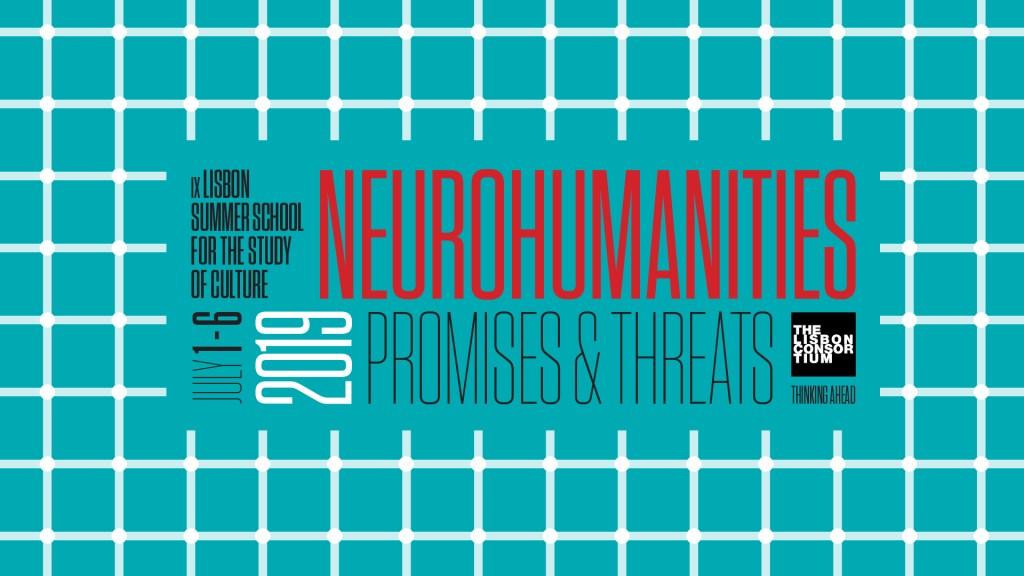
    IX Lisbon Summer School for the Study of Culture

    Neurohumanities

    Promises & Threats

    Lisbon, July 1-6, 2019


    CALL FOR PAPERS

    Deadline extension: March 15, 2019

    When the US government declared the 1990s “The decade of the brain”, it aimed at raising public awareness toward the use of neuroscience for the enhancement of life quality and as a way to better address the challenges of growing life expectancy. The initiative was further supported by substantial research funding, which not only impressed public opinion but appealed to many research fields. Finding a link to brain research and the processes of the human mind, many disciplines were repositioned and adopted the “neuro” prefix, promising new insights into age-old problems by reframing them from the angle of the brain-mind continuum.

    Neuroscience seeks to explain how the brain works and which neurophysiological processes are involved in complex cognitive abilities like sensation and perception attention and reasoning, memory and thought.

    One of the most striking and unique features of the human mind is its capacity to represent realities that transcend its immediate time and space, by engaging complex symbolic systems, most notably language, music, arts and mathematics. Such sophisticated means for representation are arguably the result of an environmental pressure and must be accounted for in a complex network of shared behaviors, mimetic actions and collaborative practices: in other words, through human culture. The cultural products that are enabled by these systems are also stored by means of representation in ever-new technological devices, which allow for the accumulation and sharing of knowledge beyond space and across time.

    The artifacts and practices that arise from the symbolic use, exchange and accumulation are the core of the research and academic field known as the Humanities. The field has been increasingly interested in the latest developments deriving from neuroscience and the affordances they allow about the conditions and processes of the single brain, embedded in an environment, in permanent exchange with other brains in an ecology that is culturally coded.

    This turn of the humanities to neuroscience is embraced by many and fiercely criticized by others. The promise of the Neurohumanities, the neuroscientifically informed study of cultural artifacts, discourses and practices, lies in unveiling the link between embodied processes and the sophistication of culture. And it has the somewhat hidden agenda of legitimizing the field, by giving it a science-close status of relevance and social acknowledgement it has long lacked. Here, though, lies also its weakness: should the Humanities become scientific? Can they afford to do so? Should they be reduced to experimental methodologies, collaborative research practices, sloppy concept travelling, transvestite interdisciplinarity? Is the promise of the Neurohumanities, seen by some as the ultimate overcoming of the science-humanities or the two cultures divide, in fact not only ontologically and methodologically impossible and more than that undesirable? And how will fields like Neuroaesthetics, Cognitive Literary Theory, Cognitive Linguistics, Affect Theory, Second-person Neuroscience, Cognitive Culture Studies or Critical Neuroscience relate to the emerging omnipresence and challenges of Artificial Intelligence?

    The IX Summer School for the Study of Culture invites participants to submit paper and poster proposals that critically consider the developments of the Neurohumanities in the past decades and question its immediate and future challenges and opportunities. Paper proposals are encouraged in but not limited to the following topics:

    • 4E Cognition: embodied, embedded, enacted and extended
    • performance and the embodied mind
    • spectatorship and simulation
    • from individual to social cognition
    • mental imagery
    • empathy
    • memory, culture and cultural memory
    • cognition and translatability
    • mind-body problem
    • life enhancement
    • neuro-power
    • (neuro)humanities and social change
    • AI, cognition and culture

    The Summer School will take place at several cultural institutions in Lisbon and will gather outstanding doctoral students and post-doctoral researchers from around the world. In the morning there will be lectures and master classes by invited keynote speakers. In the afternoon there will be paper presentations by doctoral students.


    Paper proposals

    Proposals should be sent to lxsummerschool@gmail.com no later than February 28, 2019 (new deadline: March 15, 2019) and include paper title, abstract in English (max. 200 words), name, e-mail address, institutional affiliation and a brief bio (max. 100 words) mentioning ongoing research.

    Applicants will be informed of the result of their submissions by March 15, 2019 (new date: April 1, 2019) .

    Rules for presentation

    The organizing committee shall place presenters in small groups according to the research focus of their papers. They are advised to stay in these groups for the duration of the Summer School, so a structured exchange of ideas may be developed to its full potential.

    Full papers submission

    Presenters are required to send in full papers by May 30, 2019.

    The papers will then be circulated amongst the members of each research group and in the slot allotted to each participant (30’), only 10’ may be used for a brief summary of the research piece. The Summer School is a place of networked exchange of ideas and organizers wish to have as much time as possible for a structured discussion between participants. Ideally, in each slot, 10’ will be used for presentation, and 20’ for discussion.

    Registration fees

    Participants with paper – 290€ for the entire week (includes lectures, master classes, doctoral sessions, lunches and closing dinner)

    Participants without paper – 60€ per session/day | 190€ for the entire week

    Fee waivers

    For The Lisbon Consortium students, there is no registration fee.

    For students from Universities affiliated with the European Summer School in Cultural Studies and members of the Excellence Network in Cultural Studies the registration fee is 60€.


    Confirmed Speakers:

    – Semir Zeki (University College London)

    – Fritz Breithaupt (Indiana University)

    – Alexandre Castro Caldas (Universidade Católica Portuguesa)

    – Gonzalo Polavieja (Champalimaud Foundation)

    – Per Aage Brandt (Case Western Reserve University)

    – Peter Hanenberg (Universidade Católica Portuguesa) 

    – Vera Nünning (Heidelberg University)

    – Ana Margarida Abrantes (Universidade Católica Portuguesa)


    Organizing Committee

    • Isabel Capeloa Gil
    • Peter Hanenberg
    • Alexandra Lopes
    • Paulo de Campos Pinto
    • Diana Gonçalves
    • Clara Caldeira
    • Rita Bacelar