Category: Programs

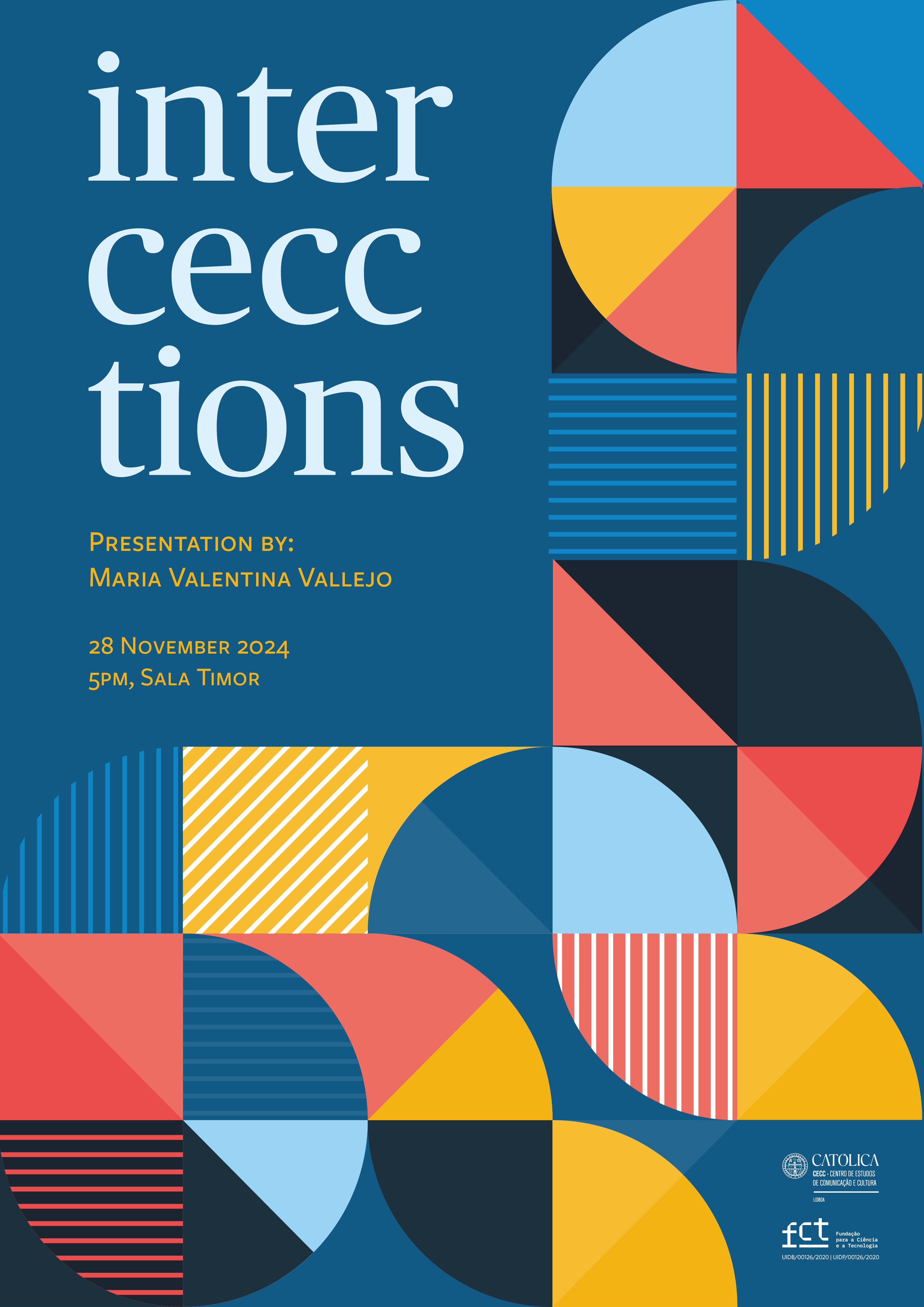
  • InterCECCtions | Maria Valentina Vallejo (MA) presents Arctic Routes, Southern Ways (28 November 2024, 5pm, Timor)

    InterCECCtions | Maria Valentina Vallejo (MA) presents Arctic Routes, Southern Ways (28 November 2024, 5pm, Timor)

    This month’s InterCECCtions will feature Maria Valentina Vallejo, MA student in Culture Studies, who will be discussing her study conducted as part of CECC‘s research project Arctic Routes, Southern Ways.

    Arctic Routes, Southern Ways is a joint research project implemented by CECC members which seeks to compare/contrast two different colonial legacies – the Portuguese and the Norwegian – and create alternative narratives and methods of knowledge production in art institutions and academia.

    Hegemonic narratives of the search for national unity in Norway, or the view of a “good” colonialism or “lusotropicalism”, in Portugal, bring these otherwise distant countries close in the way that such experiences have prevailed in many instances of public discourse, policies in institutional practices, in academia and in art institutions. The project will include online meetings, listening sessions in Lisbon and in Bergen, and research visits to Portugal and Norway.

    The project puts together two academic institutions (CECC-Universidade Católica Portuguesa and UiT-The Arctic University of Norway) and two contemporary art centres (HANGAR, from Portugal, and Bergen Kunsthall, from Norway), and will organize several scientific activities throughout its lifetime.

    Arctic routes was officially launched in 16 January 2024, is coordinated by CECC, financed by an EEA grant and supported by a Globus OpStart grant from the Nordisk Kulturfond.

  • Master’s degree in Culture Studies #2 in the world in Eduniversal ranking

    Master’s degree in Culture Studies #2 in the world in Eduniversal ranking

    Our Master’s degree in Culture Studies is now the second best program in “Cultural Management/Creative Industries Management” according to the prestigious Eduniversal ranking.

    In the words of Isabel Capeloa Gil, Rector of Universidade Católica Portuguesa and director of The Lisbon Consortium, “The Master’s degree in Culture Studies is the result of 14 years of fruitful work between the arts sector and academia at national and international levels. From Lisbon to the Venice Biennale, our students are present in the places where the best in art and culture is presented”.

    Diana Gonçalves, Coordinator of the Master’s in Culture Studies, says that this “is a singular program and a unique experience because it brings together excellent academic reflection and the vibrant practice of the cultural sector. The second place in the Eduniversal ranking in the area of Cultural Management/Creative Industries Management acknowledges the program’s innovative format and recognizes the merit of the Faculty of Human Sciences at Universidade Católica Portuguesa, the Lisbon Consortium, and its partners. We are very proud of this position, which also brings added responsibility. Following our motto, ‘thinking ahead’, we continue to move towards the future, always doing more and better”.

  • Protocol signed between The Lisbon Consortium and Brotéria

    Protocol signed between The Lisbon Consortium and Brotéria

    We are happy to announce that on November 28, 2023, a new protocol was signed between The Lisbon Consortium and Brotéria by Director of the Lisbon Consortium and Rector of Universidade Católica Portuguesa, Prof. Isabel Capeloa Gil, member of the Steering Committee of the Lisbon Consortium and Vice-Dean of the faculty of Human Sciences, Prof. Alexandra Lopes, and Director of Brotéria, Father Francisco Mota. We are very excited about this new partnership!

  • The LxC in O Jornal Económico

    Today, 21st April, in Jornal Económico, an article about the Lisbon Consortium, with statements by the Rector of UCP Isabel Capeloa Gil, professors and students.

    18073296_10155999491104409_1723145231_n


    18034989_10155999491109409_1687958139_n

  • Study trip to Porto and Guimarães

    Study trip to Porto and Guimarães

    Last weekend, February 11- 12 2017, some students and teachers of The Lisbon Consortium went on a study trip to Porto and Guimarães. The program included a Talk at Porto City Hall by Guilherme Blanc about the cultural politics of the city, a visit to Serralves Foundation to see Philippe Parreno’s exhibition “A Time Coloured Space”, Joan Miró’s “Materiality and Metamorphosis”, Novo Banco Revelation 2016- Andreia Santana, a choreography at Centro Cultural Vila Flor, in the context of GUIdance Festival – Speak Low if you Speak Love (Wim Vandekeybus) and a visit to José de Guimarães International Arts Centre.

    studytrip-prog-1study-trip-prog-2

    Check some photos of the weekend!

    This slideshow requires JavaScript.

  • International Doctoral program

    International Doctoral program

    Applications now closed for 2016-2017

    Admission to the FCT-International Doctoral Program in Culture Studies 2016, see here intdcs-results

    Download the Application handbooks: PhD_Application Guidelines_2016-2017

    The International Doctoral Program in Culture Studies is a 4-year and dual-degree programme in Culture Studies awarded by the Catholic University of Portugal, the University of Giessen and the University of Copenhagen. It builds from different disciplines in the humanities and the social sciences, thereby assuming the interdisciplinarity of contemporary modes of knowledge production focused on problem-oriented and practice-based research.

    Background – What is Culture Studies?

    Culture Studies have come of age over the last two decades. Within the framework of the crisis in the humanities and the growing call for renewed arts-based forms of knowledge production, the study of culture has changed from being a frame for humanities’ disciplines into gaining prominence in its own right. Two developments triggered this change. On the one hand, the rise of cultural studies in the 1960’s drew attention to the social-political dimension of culture, to its ordinariness and the many ways in which power was blended into creation. On the other, over the course of the 1980’s a new metadiscipline Kulturwissenschaft (science of culture) drew on the interpretative skills of the humanities and the growing attention to forms of mediation in media studies to look at the multiple ways in which culture matters as driver of artistic creation and also address how societies represent themselves and view others, look at the past and prepare the future. Bringing together the sociological methodology that is proper to British cultural studies with the interpretative qualitative approach of Kulturwissenschaft, Culture Studies is by definition transdisciplinary. It has risen to become a problem-oriented metadiscipline, representing a new paradigm of integrated reflection on the artistic forms of expression of individuals and societies, across the visual arts, literature, cinema and the media.

    Collaborative model
    The program is born out of the commitment to develop a doctoral program that promotes both high level research training at the forefront of scientific interest and responds to the cultural sector’s growing call for highly qualified professionals. It is inspired by the ‘collaborative turn’ on two levels: firstly as a model of advanced research training that draws from artistic practice and cultural management to reflect on theory and in turn embeds practice in theoretically informed premises; secondly as a form of doctoral training that is transnational by definition, because the study of culture inevitably deals with diversity.

    The programme works on a feed-back loop model, allowing the research methods and theories it devises to be tested in institutional practice by means of internships, curating and other applied projects (i.e. audience research, implementation of new strategies in museum services) while bringing artists, curators and cultural managers to reflect on their practice within scholarly work. These new training formats are specifically directed at tapping into the innovative potential of creative practices and combining these with research agendas that are challenge-based and object-based rather than discipline-based in a traditional sense.
    The program intends to inspire students to customize their curriculum and is committed to support work placement. It will provide doctoral students with methodological tools for cultural analysis, challenging them to revise phenomena that are either “invisible” or undervalued by contemporary societies while encouraging a look into the humanist tradition to deepen the understanding about the discourses and creations that have moulded cultural history. Consequently, it aims to promote original and internationally relevant research and to integrate doctoral students into multinational research teams. In addition, it will support knowledge transfer, urging students to take their work outside the seminar room and interact with professional realities other than academia.

    Mobility

    As part of a tri-national network, students will benefit from up to two semesters at one of the partner institutions in order to conduct empirical or theoretical research. The stay abroad is part of the co-tutelle agreement and will also allow the candidate to work with the second supervisor. A work programme will be established for the duration of the stay at the partner institution. Within the framework of the many exchange agreements between the three partners universities, CECC and their international counterparts, candidates may apply for an additional stay as a visiting researcher, specially if these agreements are of particular importance to the research project.

    Network

    The Lisbon Consortium – Catholic University of Portugal

    Program Director: Isabel Capeloa Gil

    Graduate Center for the Study of Culture – University of Giessen

    Program Director: Ansgar Nünning

    Copenhagen Doctoral School in Cultural Studies – University of Copenhagen

    Program Director: Frederik Tygstrup

    External advisory committee 

    Andreas Huyssen (Columbia University, Villiard professor of Comparative Literature)

    Mieke Bal (University of Amsterdam)

    George Yúdice (University of Miami)

    The program is entirely taught in English.

    STRUCTURE

    First Semester

    Metaculture I

    Elective 1

    Elective 2

    Elective 3

    Grad Labs

    -Publishing Strategies
    -Managing Bibliographies
    -Database Research
    -Academic English-Career Development

    Second Semester

    Metaculture II

    Elective 4

    Elective 5

    Lisbon Summer School for the Study of Culture

    Third and Fourth Semesters

    Research Colloquium I and II

    Dissertation Writing

    Fifth to Eight Semester

    Dissertation Writing

    Elective Courses:

    Methods for Cultural AnalysisWorld Literature •   Visual Culture • Asian Visual CulturesCultural Entrepreneurship • Cultural Economics  • Cultural & Creative IndustriesManagement of Cultural Projects  • Culture and Globalization • Cyberculture • History of Film   • Media, Society & Culture  • Translation & Globalization  • The Emergence of Asia and the Global Impact  • East Asia: Tourism & Cultural Industries amongst others availabe at http://www.fch.lisboa.ucp.pt

    Courses offered by the Department of Culture Studies are always offered in English. Coursed offered by other Departments are usually offered in Portuguese.

    Grad Labs

    Academic English • Strategies for Publishing in English • Database research • Managing Bibliographies •  Career Development

    REQUEST INFORMATION
    Go back

    Your message has been sent

    Warning
    Warning
    Warning
    Warning
    Warning

    Warning.

  • Master Degree

    Master Degree

    Applications now open for 2016-2017 ( February intakes)

    Application Guidelines

    Ranked #3 by the Eduniversal Worldwide Best Masters Ranking in Arts and Cultural Management, the Master Program in Culture Studies is aimed at graduate degree holders from the Humanities and Social Sciences, interested in a structured discussion of cultural phenomena in the global world.

    This 2-year program has three specializations and is organized around a core course of theory and practice-based seminars. The first year is curricular and requires the completion of 60 ECTS. The second year is dedicated to the final assignment: dissertation, project, or internship. During the second year students also have to take a research seminar each semester to monitor their progression.

    Please choose one specialization upon application.

    The program is entirely taught in English.

    SPECIALIZATIONS:

    a. Management of the Arts and Culture

    First Semester (30 ECTS)

    Metaculture

    Methods for Cultural Analysis

    Cultural Economics

    Grad Labs

    • Academic English
    • Managing Bibliographies
    • Database Research
    • Publishing Strategies
    • Career Development

    Elective 1

    Second Semester (30 ECTS)

    Culture and Globalization

    Culture, Production and Creativity

    Cultural Entrepreneurship

    Management of Cultural Projects

    Lisbon Summer School for the Study of Culture

    3rd and 4th Semesters

    Research Colloquium I and II

    Dissertation/Project/Internship


    b. Performance and Creativity

    First Semester

    Metaculture

    Methods for Cultural Analysis

    Cognition and Creativity

    Grad Labs

    • Academic English
    • Managing Bibliographies
    • Database Research
    • Publishing Strategies
    • Career Development

    Elective course 1

    Second Semester

    Contemporary Culture and the Environment

    Performance and Performativity

    Visual Culture

    Cultural Entrepreneurship

    Lisbon Summer School for the Study of Culture

    3rd and 4th Semesters

    Research Colloquium I and II

    Dissertation/Project/Internship

    c. Literary Cultures

    First Semester

    Metaculture

    Methods for Cultural Analysis

    Narrative and Culture

    World Literature

    Grad Labs

    • Academic English
    • Managing Bibliographies
    • Database Research
    • Publishing Strategies
    • Career Development

    Second Semester

    Discourse & Identity

    Culture and Literary Mediation

    Cultural Entrepreneurship

    Elective Course 1

    Lisbon Summer School for the Study of Culture

    3rd and 4th Semesters

    Research Colloquium I and II

    Dissertation/Project/Internship

    Elective courses:

    Choose from any course in the MA in Culture Studies or other MA Degrees at the School of Human Sciences.

    Courses in Culture Studies are always taught in English. Courses offered by other Departments are mostly offered in Portuguese

    REQUEST INFORMATION

    Go back

    Your message has been sent

    Warning
    Warning
    Warning
    Warning
    Warning

    Warning.