This slideshow requires JavaScript.
Blog
-

SAVE THE DATE: 4 Cs CONFERENCE
Conviviality and the Institutional is a two-day conference in the frame of 4Cs – From Conflict to Conviviality through Creativity and Culture, a cooperation project supported by the European Commission in the frame of Creative Europe – Culture Subprogramme. Coordinated by the Universidade Católica Portuguesa, 4Cs aims to explore how art and culture can constitute powerful resources to address the subject of conflict. A major focus will be on training and education. The programme includes exhibitions, artistic and research residencies, film screenings, mediation labs, workshops, conferences, publications, an online platform and a Summer School.
Check the program here
Free admission with registration and limited to the seats available.
Please contact: fabiola.mauricio@fch.lisboa.ucp.pt
-

Progress reports 2017
On November 13 and 14, the Phd international students discussed the progress reports with the international Steering Committee. “Cultural Analysis in the 21st Century” was the lecture presented by Professor Ansgar Nünning and Professor Frederik Tygstrup, in a session chaired by Professor Isabel Capeloa Gil.
(more…) -
José Carlos Teixeira at Lisbon Consortium
Last thursday, November 9, José Carlos Teixeira met the Lisbon Consortium students for an informal meeting. The visual artist, who also teaches at University of Wisconsin-Madison, talked about his background and the current exhibition at MAAT, “On Exhile”, tackling subjects like migration, displacement and identity.


 ????????????????????????????????????

-
LxC Inaugural Session
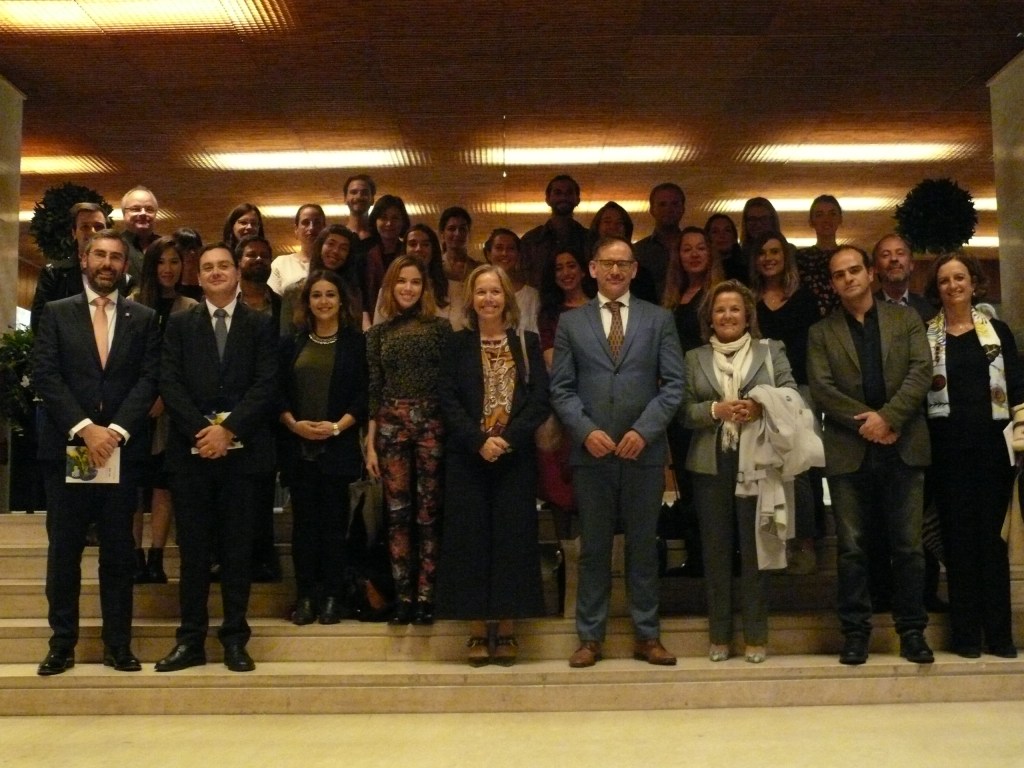
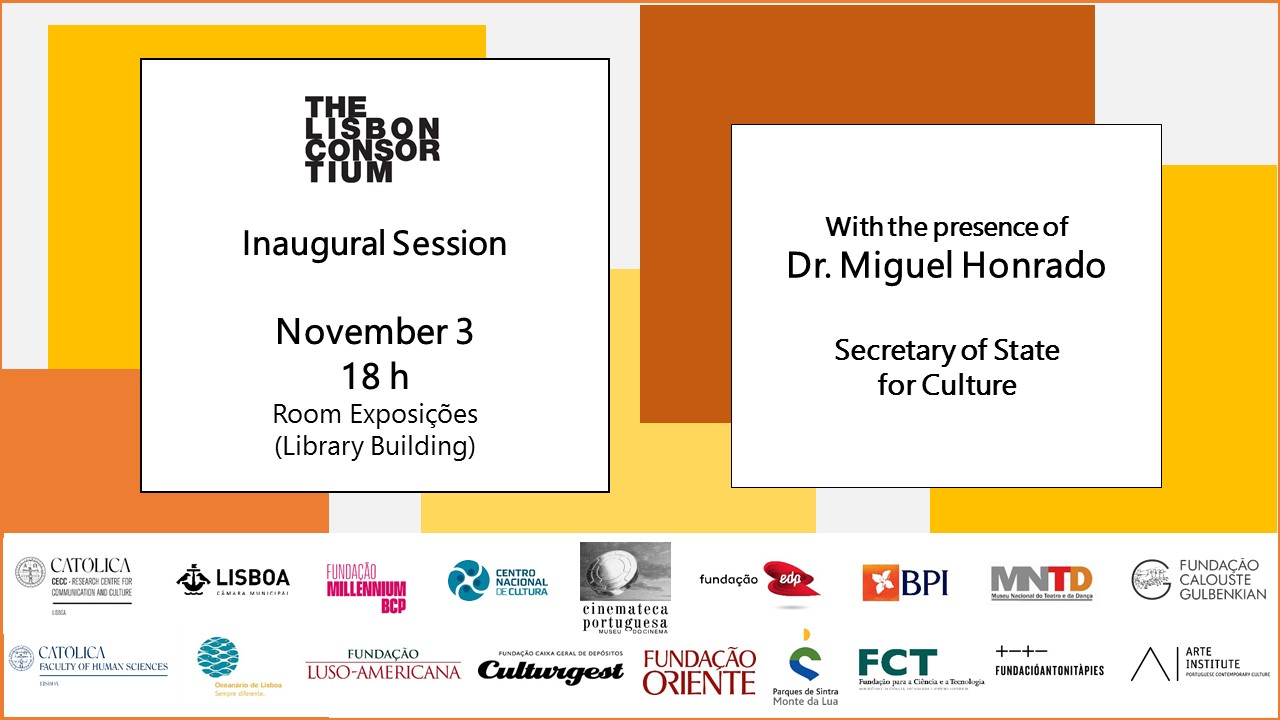
The inaugural session of the academic year of the Lisbon Consortium took place at Universidade Católica, last friday, November 3, with the presence of Prof. Isabel Capeloa Gil, Rector of UCP and Director of the Lisbon Consortium, Prof. Nelson Ribeiro, Dean of the School of Human Sciences, and the special guest and speaker, Mr. Miguel Honrado, Secretary of State for Culture, partners, students and faculty members of the program.
It was also time for the awarding of the Lisbon Consortium scholarships.
The Millennium bcp Foundation Grant was awarded by Ms. Fátima Dias to Diana Ferreira, second-year student of the Master’s Program in Culture Studies and Ana Rita Folgado, first-year student of the Master’s Program in Culture Studies. The Millennium BCP Foundation Scholarship for the Lisbon Consortium aims at funding Portuguese students in the Master’s program in Culture Studies through 2 scholarships. These scholarships consist in a tuition reduction, amounting to 4.020 euros (over 2 years).
The EDP Foundation International Granta was awarded by Mr. António Soares to Gregor Taul, second-year student of the Doctoral Program in Culture Studies. The EDP Foundation International Grant for the Lisbon Consortium aims at funding research conducted by an international PhD student in the Culture Studies program. The scholarship, in the amount of 5.000 (euros), is directed to tuition payment.
After the awards, Mr. Miguel Honrado gave a lecture about his professional life in the world of culture and shared his vision about the future challenges.
-

CECC Field Work: Call for Participation
Society of the Spectacle – 50 Years Later
CECC Fieldwork 2017 | November 23-24
“All life presents itself as an immense accumulation of spectacles,” writes Guy Debord in his 1967 book, The Society of the Spectacle. “Everything that was once directly lived has become mere representation.” In the theses that follow, Debord offers a revolutionary critique of contemporary capitalist society, a striking vision of a world reduced to the superficiality of images.
For Debord, the concept of the spectacle “unifies and explains a great diversity of apparent phenomena.” And today, in an era of so-called “post-truth,” a hyperreal, liquid modernity in which, as Marx once presciently wrote, “all that is solid melts into air,” the spectacle represents an enduringly valuable concept through which to interpret capitalist society. We live in an age saturated by social media, in which “selfies” hold more weight than actual lived experience, where our lives (both real and virtual) are dominated by advertisements at every turn. Images in urban environments mediate and commodify our social relations on a daily basis, while the 24-hour news cycle helps reduce “knowledge” to a series of vapid, sporadic flashing images. It is within such a context that The Society of the Spectacle finds its real relevance.
The book has stirred considerable controversy and debate. Michel Foucault, for one, insists that modern society is, in fact, “the exact reverse of the spectacle.” For him, “our society is one not of spectacle, but of surveillance.” Meanwhile, Jean Baudrillard builds upon the work, suggesting that the concept of spectacle has been superseded by a new, dystopian regime of simulation. And Sadie Plant shows how many of the ideas of the Situationist International, of which Debord was a member, have come to influence ideas of the postmodern, but in ways which mark a certain political “break.” The work has, arguably, been drained of its fundamental radical qualities, co-opted by the mainstream and repackaged as benign rhetorical theory. In The Society of the Spectacle, as Debord predicts himself, the concept might be reduced to “just another empty formula of sociologico-political rhetoric.”
To celebrate the 50th anniversary of its publication, this two-day symposium, as part of CECC’s annual Fieldwork meeting, will explore the impact and legacy of this pivotal work. In what sense does the spectacle unify or explain the contemporary world? How do individuals and communities produce, confront or challenge spectacle on a daily basis? How relevant is Debord’s spectacle thesis in a rapidly changing contemporary cultural and political landscape? This symposium welcomes contributors to address current local and global concerns through Debord’s ideas, from the increased influence of digital media, the portrayal of refugees and the risk of ecological disaster to gender performativity, urban development and nationalist discourse. We invite academic colleagues, artists and thinkers of all stripes, from Lisbon and beyond, to come together on November 23-24 and join us in a spectacular retrospective of this landmark text in political and cultural theory.
Workshop: Call for Participation
During this two-day symposium, we seek to (re)engage with Debord’s pivotal work and attempt to delve into not only its historical significance, but to also ask new questions about the book’s contemporary relevance. On the morning of November 24, we will organise a student-led workshop, a space for emerging researchers to share their thoughts, ideas and work related to The Society of the Spectacle.We invite proposals for short, 10-minute papers which engage with the notion of the ‘spectacle’ with both its contemporary and historical relevance and on its use as a theoretical or practical tool. Motivations for papers may include, but are not limited to, the following disciplinary themes, interests and topics:
- Literary theory and criticism
- Modernist and postmodernist philosophy
- Post-war French intellectual theory
- Media studies and the critique of media
- The critique of everyday life
- Migration and the centrality of the image in its contemporary portrayal
- Political theory
- Activism and the relationship of research to politics, policy and practice
- Visual culture and its epistemologies
- Urban topographies and political spaces
- Ethnographic approaches to the experience of spectacle
Abstracts (250 words) and a short biographical note should be sent via email to hello@reubenross.net and matt.mason87@outlook.com , including title, name, contact details and institutional affiliation.
The deadline for submission is 27 October 2017.For further information or questions, please contact one of the organisers:
Reuben Ross: hello@reubenross.net
Matt Mason: matt.mason87@outlook.com -
“Tension & Conflict”: visit to MAAT
September 21: the new MA and PhD students were at MAAT, to a guided tour at the exhibition “Tension and Conflict: Video Art after 2008” by Luísa Santos, professor of the Program and curator of the exhibition (with Pedro Gadanho).


-
Meet & Greet 2017-2018
September 18: the new Ma and PhD students gathered for the ‘Meet and Greet’ of the Lisbon Consortium, the start of the Induction Week.
Welcome! We wish you all a very successful and productive semester. -
Interview with Michael Cronin by Rita Bueno Maia
Michael Cronin was one of the keynote speakers of the VII Lisbon Summer School for the Study of Culture, on Global Translations. You can listen to his interview, on several subjects of his investigation and the fiel of Translation Studies, by Rita Bueno Maia.
-

Closing session – Lisbon Summer School


Last saturday, Michael Cronin gave the last lecture of the VII Lisbon Summer School for the Study of Culture on Global Translations, at the bookshop Ler Devagar.
In the closing session, chaired by Peter Haneberg, two prizes were selected by a juri and awarded by Isabel Capeloa Gil for the best paper to Jad Khairallah (Lisbon Consortium) and Laëtitia Saint-Loubert (University of Warwick).
The Lisbon Consortium would also like to thank and congratulate all participants and invite you all to participate in the next edition, from July 2 to July 7, 2018, under the topic “Cyber + Cypher + Culture”. See you soon!
-

Summer School preliminary program now online
The VII Lisbon Summer School, on Global Translations, is about to start! Check the preliminary program here.
-
UCP Project supported by European Comission
4Cs: From Conflict to Conviviality through Creativity and Culture supported by the European Commission in the frame of Creative Europe – Culture Sub-programme.
Europe: a site of hospitality and conviviality is one of the headlines of 4Cs: From Conflict to Conviviality through Creativity and Culture, a European Cooperation project which has been awarded a Grant of approximately 1.8 million euros by the European Commission through Creative Europe – Culture Sub-programme.
Coordinated by the Universidade Católica Portuguesa, 4Cs aims to explore how art and culture can constitute powerful resources to address the subject of conflict. A major focus will be on training and education. The programme will include exhibitions, artistic residencies, film screenings, mediation labs, workshops, conferences, publications, an online platform and a Summer School. These will be the means by which new audiences will be brought together in intercultural dialogue and collaboration, mutual recognition and equal participation. The programme will include a response to the challenges of migration, security, and freedom of expression.
The European Commission praised the project particularly for the quality of the partnership, with a team combining theory and practice, and its intent to foster citizenship in the EU.
Eight partners from eight different countries (Portugal; Sweden; Germany; UK; Spain; Lithuania; Denmark; and France) will work together in this project, which will be active from July 2017 to July 2021: the School of Human Sciences and The Lisbon Consortium at the Universidade Católica Portuguesa; Tensta Konsthall; SAVVY Contemporary – Laboratory of Form-Ideas; Royal College of Art; Fundació Antoni Tápies; Vilnius Academy of Fine Arts; Museet for Samtidskunst; and ENSAD, as well as a series of associate partners including Culture+Conflict; MIMA; Klaipėda University; Gulbenkian Foundation; Rua das Gaivotas 6; Plataforma de Apoio aos Refugiados; PEROU, and Refugees at home.
-
Photo essay on Rua do Benformoso, by Reuben Ross
Reuben Ross, Phd student of the Lisbon Consortium, published a photo essay on Rua do Benformoso, in Lisbon, on Public Books, a site founded in 2012 by Sharon Marcus , a literary critic, and Caitlin Zaloom, an anthropologist, “to create a diverse new home for intellectual debate online”
Check the photo essay here:
The Street and the World: Rua do Benformoso, Lisbon
-
New deadline BLR/ESSCS ‘Living Together’
BLR/ESSCS
August 14th-18th 2017 – BERGEN, NORWAY
“LIVING TOGETHER”
Website: http://www.folk.uib.no/hlils/te17/
New deadline for paper proposals : May 26
”Living Together” is the joint venture of the European Summer School in Cultural Studies (ESSCS) and of the Norwegian nationwide researcher-training school TBLR (Tekst Bilde Lyd Rom = Text Image Sound Space), in Bergen, August 14th-18th, 2017. (See also ”Background” in our website’s topbar.) The TBLR has seven member universities, and is since the turn of the millenium Norway’s largest nationally networking PhD researcher-training school within literary, aesthetic and cultural studies. The ESSCS is a network-based seminar for interdisciplinary-research training in the fields of art and culture, and it consists of eight European university partners.
14th through 18th of August 2017, ESSCS and TBLR’s tandem efforts aim for a truly international inter-aesthetic and cultural-study event for PhD students, keynotes and participating faculty. Venue is Bergen: Norway’s second largest city, founded in 1070. Bergen is a beautiful city, internationally connected, bustling with life, trade and culture, and centuries of living together. It is situated on the West Coast with its amazing archipelago towards the North Sea, and it is at the same time the gateway to the fjords.
Under the heading ”Living Together”, this Call for Papers is anchored broadly in some of the work of Roland Barthes, Giorgio Agamben and Jacques Derrida. You are cordially invited to apply for participation with papers bearing some relation to the following wide plethora of topics. (On PhD student-paper topics, however, see also further specifics under ”Practical details” below.)
Roland Barthes:
Originally, Roland Barthes gave “Comment vivre ensemble? Sur l’idiorrythmie” as a Cours at Collège de France from January through May in 1977. In the Comment vivre ensemble manuscripts (published in English as How To Live Together: Novelistic Simulations of Some Everyday Spaces (2013)), Barthes uses five main literary references to isolate five perspectives – or topoi. His literary references are Palladius’ The Lausiac History, Defoe’s Robinson Crusoe, Mann’s The Magic Mountain, Zola’s Pot Luck and Gide’s “The Confined Woman of Poitiers”. Barthes’ five perspectives call for closer investigation in many specific directions, as the list of related issues and extrapolated concepts shows. The five topoi are the desert, the island, the sanatorium, the city and the home.
These five perspectives function as part of the framework for organising the activities of the TBLR and the ESSCS in Bergen. The PhD students are invited to participate in the plenary sessions where invited keynotes present their talks followed by ensemble discussions, and in one of three groups where the students’ pre-submitted papers are discussed. Keynotes will be given according to the issues.
There are numerous connections between the five topoi; they complement each other, create differences and show the complexity of the issues of living together in human societies:
(1) DESERT. As a concept, the “desert” is generally thought of as a desolate and emptylandscape, interpreted by writers, philosophers, composers, film-makers, artists and critics as a place of extremes. As the landscape of the desert contains dryness, silence, margins and, with some exceptions, lack of fauna and flora, it may serve as a metaphor for anything from death, poverty or religion, to the primitive past, desolate future and nomad culture, but also retirement, withdrawal and acedia (a mental state characterised by indifference, boredom, fear, loss of desire etc.). Since Bishop Palladius’ Lausiac History there is an extensive literature on the subject of deserts. As the American poet Robert Frost writes in his poem “Desert Places”, the desert is among other things related to loneliness and sorrow, the feeling of bearing a void: “I have it in me so much nearer home/To scare myself with my own desert places”. This platform invites to think the idiorrhythmic and idiorrhythmic life as vulnerable and exposed to death. Suggestive key words for PhD student-paper topics and perspectives: death, religions, rules, margins, poverty, silence, acedia/melancholy, nomads, withdrawal, retirement, refusal.
(2) ISLAND. In the history of literature and of myths, the island is a metaphor for isolation, individuality, strandedness, forsakenness, but also independence, new life and creativity based on reduced circumstances. The number of fictional islands is great, from Avalon (Arthurian legend) and Neverland (Barrie) to Treasure Island (Stevenson) and Kokovoko (Melville); from New Atlantis (Bacon) and Utopia (More) to Fraxos (Fowles) and Isla Nublar (Jurrassic Park). As in John Donne’s phrasing, “No man is an island”, the metaphor is obviously open for a questioning of the very essence of idiorrhythmic life. For the summer course, the topos of the island also opens up for reflection on immigration. Bhabha points to the unmappable spaces – in-betweens and liminalities – which appear as archipelagos of or on the outer and inner margins of nations and metropoles: they are produced today primarily by global flows of migration and established diasporic cultures, in which hybrid identities flourish in contemporary cosmopolitan societies.Suggestive key words: isolation, boundaries, independence, individuality, civilisation, migration.
(3) SANATORIUM. The sanatorium is a now outmoded concept for health care institutions or places of recreation for people suffering from tuberculosis until the TB epidemic died down in the 1940s, thanks to antibiotics, as well as for places treating nervous disorders. The life of the sanatorium is described in literature: in novels, short stories and poems, especially from the 19thand 20th Centuries (e.g. Skram, Hamsun, Mann, Plath, Solzjenitsyn), as well as in our time, where it occupies an important place in films (Forman’s One Flew Over the Cuckoo’s Nest), television (von Trier’s Riget), and theatre (Verdensteatret’s The Hourglass Sanatorium). On the other hand, the sanatorium as institution is described in documents and literature concerning public health systems (public accounts and reports on hospital organisation etc.). The particular essence of the sanatorium is that it is closed, but at the same time submitted to public direction. At the summer school, the sanatorium as institution, idea and metaphor may include an exploration of the telos and the the idiorrhythmic of the life at institutions. The sanatorium can be taken as exemplary of various institutions in which people spend parts of their lives living together, such as retirement communities, cruise ships, colleges and prisons. Suggestive key words: health, death, institutions, institution analysis, illness and identification.
(4) CITY. While the city may be regarded as the opposite of the desert, it has affinities to the island metaphor as well as to the topos of the home. The topos of the city invites reflections on various modern life forms, analyses that are focused on idiorrhythmics. In literary studies the modern city has been described as a mythological heterogeneous space for fascination and imagination (e.g. Benjamin, Stierle, Berman). It has also been regarded as a place for anonymity, consisting of alienated literary heroes (Dostoyevsky, Hamsun, Kafka). Cities have been recognized as sites for innovation and for speeding up technological solutions, infrastructure and social relations (Virilio). While they are places for activity and exhaustion, yet city planners have always acknowledged the need for resting places as necessary conditions for a well-functioning city. Cities can thus be seen as places where rhythms of activity and rest, engagement and isolation, become crucial questions. The topos of the city is characterised by paradoxical dynamics: the crowd/loneliness, interaction/anonymity, speed/rest. The city has further been recognised as a place where feudal family structures are challenged, and for experimenting with a huge variety of ways of living together, a major theme in 19th, 20th, and 21st Century fiction (e.g. Dickens, Balzac, Zola, Dostoyevsky, Döblin, Joyce, Cole, Auster).Suggestive key words: urbanity, food, media, ecology, rhythms, finance, information, digital life, recreation, anonymity, single life, dating.
(5) HOME. The topos of home is wideranging, covering the everyday routines, family life yet also, as metaphor, a place that provides a guarentee for identity, health, nutrition, shelter and security. In this sense, home is close to the topoi of island and sanatorium, and as metaphor it is also opposite to city and desert. Traditional food is one of the products of the home, and may be studied as a specific sort of the idiorrhythmic, linked to the notion of taste as both physical and cultural phenomenon. In Barthes’ research the home is also, in his reading of Gide, a place that may be the scene of a crime, that is, characterised by the Freudian notion of the Unheimlich. In the center of home is the idiorrhythmic of shared life as well as the individual, single life forms. Suggestive key words: the everyday, routines, food, rest, taste, solidarity.
Giorgio Agamben; Jacques Derrida:
The summer course’s broadly inclusive topic of Living Together also raises the question of the status of the ’singularities’ that in some form or way actually did, do or may live together. Whether individuals, human persons, members of a community; or bodies, biological entities or other forms of bare life; or linguistically communicating interlocutors, or linguistic beings performatively speech-acting, etc. – the question of the status of the “singularities” also actualises their being’s relation to language and to the law and the subject positions endorsed, allotted or produced by the rights of law, and by language. This makes some of Giorgio Agamben’s work highly topical and inspirationally relevant for our event, as well as some of Jacques Derrida’s work.
Among the works by Agamben that bear particular relevance for the summer school event, are The Coming Community ([1990] 1993); Homo Sacer: Sovereign Power and Bare Life ([1995] 1998); State of Exception ([2003] 2005); and The Highest Poverty: Monastic Rules and Form-of-Life ([2011] 2013).
Similarly, there is a series of works by Jacques Derrida that come to mind in the perspective of the summer course’s topic, Living Together. Some of these might also prepare the ground for exciting comparison, as is the case with Agamben’s works. What has been referred to as an ’ethical’ turn in Derrida’s production, introduced a period of fifteen years plus, during which time Derrida was particularly concerned with problems and promises related to living together. At a closer look, and as has also been contented, both an ’ethical’ and a ’political’ strand may prove to traject through all of his production.
At any rate, Derrida during the latter part of his life, and still ’deconstructively’, was highly concerned with topics such as violence, subjection and extinction, death, loss, memory, mourning; furthermore, globalization and cosmopolitanism; and not least, with topics such as forgiveness, responsibility, friendship (as opposed to brotherhood), hospitality, the gift, as well as with a sustained thinking of the ’democracy to come’. All of which are thought in radical fashion, and which seem to reverberate with topoi, topics and perspectives in both Barthes’ and Agamben’s work actualised here, and with the summer school’s main heading, Living Together.
Among the works by Derrida that seem to bear particular relevance for the summer school event, are The Work of Mourning (1981; in which is included ”The Deaths of Roland Barthes”); Memoires: For Paul de Man (1989); The Gift of Death ([1991] 1995); The Other Heading: Reflections on Today’s Europe ([1991] 1992); The Politics of Friendship (1994); Given Time: I. Counterfeit Money (1994); Of Hospitality (2000); On Cosmopolitanism and Forgiveness(2001); Rogues: Two Essays on Reason (2005; in which is included “The Last of the Rogue States: The ‘Democracy to Come’, Opening in Two Turns”).
A note on suggestive key words for possible PhD student-paper topics: For the work of Georgio Agamben and for that of Jacques Derrida, our CfP does it the other way round with regard to the possible scope of inspiration: Beyond referring to relevant works by Agamben and Derrida, the CfP does not list specified, suggestive topoi, perspectives and key words on a par with the level of detail as in the case of Roland Barthes’ book. The idea is to attempt to productively mingle ’two modi of inspirational suggestivity’ – that of the organisers (’detailing’ Barthes) and that of the enlisted participants (’detailing’ Agamben and Derrida).
Therefore, you yourselves are encouraged to productively select, work out and specify ’living-together perspectives’ on relevant work by Agamben and Derrida.
Suggested Reading List
Agamben, Giorgio. The Coming Community. Transl. Michael Hardt. Minneapolis: University of Minnesota Press, [1990] 1993.
–––––––. Homo Sacer: Sovereign Power and Bare Life. Transl. Daniel Heller-Roazen. Stanford: Stanford University Press, [1995] 1998.
–––––––. State of Exception. Transl. Kevin Attell. Chicaho and London: University of Chicago Press, [2003] 2005.
–––––––. The Highest Poverty: Monastic Rules and Form-of-Life. Transl. Adam Kotsko. Stanford: Stanford University Press, [2011] 2013.
Anyuru, Johannes. En Storm kom från paradiset (2012). Stockholm: Norstedts, 2013.
Bakhtin, M. “Forms of time and of the chronotope in the novel”. In The Dialogic Imagination. Austin: Univ. Texas Press, 1981.
Barthes, Roland. Comment vivre ensemble. Simulations romanesques de quelques espaces quotidiens. Cours et séminaires au Collège de France (1976-1977). Paris: Seuil, 2002.
–––––––. How to Live Together: Novelistic Simulations of Some Everyday Spaces. New York: Colombia UP, 2013.
Bourdieu, Pierre. La distinction. Critique sociale du jugement. Paris: Minuit, 1979,
Baudelaire, Charles. “Le Spleen de Paris”, in: Œuvres Complètes, Tome 1. Paris: Gallimard/Bibliothèque de la Pléiade, 1975.
Bauman, Zygmunt. Liquid Modernity. Cambridge: Polity Press, 2000.
Benjamin, Walter. The Writer of Modern Life. Essays on Charles Baudelaire. Cambridge Mass.: Belknap Press, 2006.
Berman, Marshall. All That is Solid Melts Into Air. The Experience of Modernity. Penguin Books, 1988.
Bhabha, Homi K. The Location of Culture. London: Routledge, 1994.
Certeau, Michel de. L’invention du quotidien II, habiter, cuisiner. Paris: Gallimard,1994.
Canguilhem, Georges. Le normal et le patologique, Paris: PUF 1966; The Normal and the Pathological. New York: Zone,1991.
Coles, Teju. Open City. London: Faber & Faber, 2011.
Defoe, Daniel. Robinson Crusoe [1719]. London: Penguin 1994.
Derrida, Jacques. The Work of Mourning. Ed. Pascale-Anne Brault and Michael Mann. Chicago: Chicago University Press, 1981.
–––––––. ”The Deaths of Roland Barthes”. In The Work of Mourning. Ed. Pascale-Anne Brault and Michael Mann. Chicago: Chicago University Press, 1981. 31-68.
–––––––. Memoires: For Paul de Man. Transl. Lindsay, Culler, Cadava, and Kamuf. New York: Columbia University Press, 1989.
–––––––. The Other Heading: Reflections on Today’s Europe. Transl. Pascale-Anne Brault, Michael B. Naas. Bloomington and Indianapolis: Indiana University Press, [1991] 1992.
–––––––. Given Time: I. Counterfeit Money. Transl. Kamuf. Chicago: Chicago University Press, 1992.
–––––––. The Politics of Friendship. Transl. George Collins. London and New York: Verso, 1994.
–––––––. The Gift of Death. Transl. Wills. Chicago: University of Chicago Press, [1991] 1995.
–––––––. Of Hospitality. Transl. Rachel Bowlby. Stanford, SUP, 2000.
–––––––. On Cosmopolitanism and Forgiveness. London: Routledge, 2001
–––––––. Rogues: Two Essays on Reason. Transl. Pascale-Anne Brault and Michael Naas. Stanford: Stanford University Press, 2005.
–––––––. “The Last of the Rogue States: The ‘Democracy to Come’, Opening in Two Turns”. In:Rogues: Two Essays on Reason. Transl. Pascale-Anne Brault and Michael Naas. Stanford: Stanford University Press, 2005. 78-94.
Foucault, Michel. Naissance de la clinique. Paris: Gallimard, 1963.
Gide, André. “La Séquestrée de Poitiers” [1930], in Ne jugez pas, Paris: Gallimard/NRF, 1969.
Goffman, Erving. Asylums: Essays on the Social Situation of Mental Patients and Other Inmates. New York: Anchor Books, 1991.
Lefebvre, Henri. Critique de la vie quotidienne. Paris: L’Arche, 1947.
Mann, Thomas. Der Zauberberg [1929]. Frankfurt am Main: Fischer, 1998.
Palladius. The Lausiac History [AD 423]. New York: Newman Press, 1998.
Pfaller, Robert. On the pleasure principle in Culture: Illusions without owners. London: Verso 2014.
Rabinowich, Julya. Spaltkopf: Roman. Wien: Deuticke Verlag, 2008.
Sassen, Saskia. The Global City. New York: Princeton Univ. Press, 2001.
Selvon, Sam. The Lonely Londoners. London: Penguin, 2006.
Stene-Johansen, Knut et al. (eds.). Å leve sammen. Roland Barthes, individet og fellesskapet. Oslo: Spartacus, 2016.
Taïa, Abdellah. L’Armée du Salut. Paris: Seuil, 2006.
Ugresic, Dubravka. The Ministry of Pain. London: Telegram, 2011.
Zola, Émile. Pot-Bouille [1882], in Les Rougon-Macquart, Vol 3. Paris: Gallimard/Bibliothéque de la Pleiade, 1964. –––––––––. Pot Luck, Oxford University Press, Oxford 1999.
Practical details
See the “Living Together” course website, which will be updated continuously; keep checking back for updates. – Here are the most important details:
–– Course layout: We start the summer course with luncheon at 13:00 on Monday 14th Aug., then go on with a half-day (afternoon and early evening) programme that day; and then continue with full-day programmes both Tuesday, Wednesday, and Thursday 17th Aug. Festive dinner offered on Thursday evening (on the organisers). Good-byes and departures after breakfast and before noon on Friday 18th.
–– Programme: “Living Together” is a combined keynote topic/plenary-discussion event, and a PhD paper-discussion course. There will be five Scandinavian/international keynotes on the programme, whose names and topics will be disseminated on the webiste as confirmations are in. Already now, though, we are happy to announce the first keynote, prof. Knut Stene-Johansen (Comparative Literature, University of Oslo), with whom the scholarly idea about “Living Together” originated, and who – with his Oslo-based research group – has already published a first project anthology: Knut Stene-Johansen et al. (eds.): Å leve sammen. Roland Barthes, individet og fellesskapet. Oslo: Spartacus, 2016 (to be transl. into and publ. also in English). – For the PhD paper-discussion sessions, the participants will be organised into relevant thematic groups, composed of PhD students as well as of TBLR/ESSCS-faculty and keynotes.
The detailed programme will be posted and disseminated when fully confirmed.
–– Time frames/duration/length: Keynotes are set up with 45-minute lectures, and the same amount of time allotted to the ensuing discussion. – PhD student-paper discussions are set up with a total time frame of 1 to 1,5 hours for each single one, in the course of which time up to 20 introductory minutes are allotted to the PhD student’s oral presentation/contextualisation of her/his paper, and the remaining time to a rich discussion between the PhD-student author, student peers, TBLR/ESSCS faculty, and keynotes, with comments, questions, further suggestions, etc. This structure – while all student papers are mandatory beforehand reading for all participants, thus leaving ample time for a rich discussion of the papers.
–– PhD student-paper topics: (1) a paper bearing a relation to some aspect or problem detailed or suggested in the ”Living Together” Call for Papers (Barthes; Agamben; and/or Derrida); (2) a paper stemming from the PhD student’s ongoing dissertation work, like a chapter, a section, an excerpt, a focus on a special problem, theoretical or other, lifted out of the dissertation-writing process for particular, critical attention, etc. – all of which with or without a relation to the CfP; (3) a paper presenting and critically discussing one or more of the works on the course’s reading list. – Bear in mind that inter-aesthetic and comparative as well as disciplinary papers are welcome. – Max length of paper: about 15 pp, 1,5 line spacing, Word: Times New Roman.
ECTS points for PhD students: 5 ECTS with a paper; 2 ECTS without.
–– Venue for the course as well as for all participants’ hotel rooms 14th-18th Aug. will be Hotel Scandic Neptun, downtown Bergen, one street removed from the historic wharf and the quayside. The hotel rooms (covered by the organisers throughout the duration of the summer-course), will be spacious double rooms, housing two PhD students in each (a summer-school room-mate system, which also creates an extra and contact-facilitating atmosphere).
–– Travel costs will have to be covered by the PhD students themselves or through the PhD-trajectory means that they themselves have at their disposal. Other than that, hotel rooms and full board (three meals a day) from Monday 14th at noon through Friday 18th Aug. at noon will be covered by the TBLR/ESSCS (the dinner on Wednesday is the exception: Wed’s dinner is open for each and every one to find another restaurant in the city, and on that particular evening pay their dinner themselves).
–– Application deadline (extended till late May) will be 26th May 2017 (to lars.saetre@uib.no), with max. 300 words paper abstract submitted at the same time. In your application, please state whether you require vegetarian or vegan meals.
–– Paper-submission deadline: 1st August 2017 (as attachment, to lars.saetre@uib.no).
–– Options for prolonged individual (tourist) stays in Bergen: This is a possibility – yet then, expressly, at the personal expense of the participant her/himself. This could be either during the week-end prior to, or during the week-end immediately following the “Living Together”-event: In the case that such prospective individual wishes would be for our venue hotel (Hotel Scandic Neptun), these queries should be directed to lars.saetre@uib.no, who will then handle them vis-à-vis our Hotel (Neptun). – All other private-stay sojourns before and/or after the summer course – i.e. outside of Hotel Scandic Neptun – should be arranged by – and in that case, too: paid for by – the individual course participant her/himself.
Welcome to Bergen!
-
Call for papers: Graduate Conference 2018
ALTERITY AND THE RESEARCH IMAGINATION
VII Graduate Conference in Culture Studies
25–26 January 2018
School of Human Sciences ׀ Universidade Católica Portuguesa, Lisbon
Preoccupation with theories and practices of representation and othering, across the breadth of various genres and disciplines, has moved forward debates about positioning in research and modes of constructing and producing knowledge. In Meatless Days (1989), a vivid memoir of her girlhood in postcolonial Pakistan, Sara Suleri Goodyear deplores being regarded as an “otherness machine” — a concern Kwame Anthony Appiah (1991) shares in his famous critique of postcolonial literature, culture and critical studies. A host of scholars who tend to conflate the post-isms as such contend that postcolonial theory and praxis are embedded in Western institutions that shape the field. Aijaz Ahmad (1992) and Arif Dirlik (1994) have argued that, owing to its reliance on poststructuralist approaches, postcolonial thought excludes questions of economic and political power structures. A staunch Derridean who uses deconstruction to uncover and disrupt such inevitable hegemonic relations of power in the academy or elsewhere, Gayatri Chakravorty Spivak (1999) has likewise dissociated herself from the postcolonial mainstream. Edward Said (1983), whose groundbreaking book Orientalism (1978) sets out a toolbox for colonial discourse analysis, has grown more and more dissatisfied with the untenable apolitical nature of the theoretical insights of Derrida, Foucault and others. Yet, some scholars, and Said himself, have pointed to the geocultural limitations of his theoretical model. In considering discourses of orientalism and balkanism, for instance, Maria Todorova (1997) argues that, unlike the Orient, the Balkans is a concrete entity that is peripheral, but not completely other, to Europe. Paul Gilroy has challenged the racial and ethnocentric biases inherent within British cultural studies in his first major work There Ain’t no Black in the Union Jack (1987). His discussion of diasporic hybridity (1993), however, has been censured for being gender-neutral. In his seminal essay The New Cultural Politics of Difference (1990), Cornel West locates his polemic on the emergence of the new black (or African-American) cultural worker in a critical historical juncture that might be comparable to what Stuart Hall calls “the end of the innocent notion of the essential black subject” (1988). More recently, Arjun Appadurai (2006) has made the case for research as a human right — an exercise of the imagination that is intrinsic to knowledge citizenship in the era of globalization.
This conference considers the theoretical and methodological conundrums researchers and creative practitioners in the Humanities, Arts and Social Sciences face when encountering sites of alterity. We invite proposals that engage with the concept of alterity and subject it to a searching critique through the lenses of multiple academic disciplines. Themes of interest include, but are not limited to, the following:
- Representations of alterity in film, literature, architecture, the visual and performing arts, etc.
- Alternative media, politics and creativity
- Multicultural, intercultural and transcultural communication
- Critical human geography
- The everyday — its antecedents and simulacra
- Sociality and the ethics of care
- Hybrid modalities of identity and difference
- Ethnographic translations of radical alterity
The working language of the conference is English.
Individual paper presentations will be allocated 20 minutes for presentation and 10 minutes for questions. Proposals for panels of 3 papers (90 minutes) or roundtables of 3–5 participants (60 minutes) related to the theme of the conference are welcome. We aim to integrate an ambitious range of perspectives. Proposals incorporating practice as research, or other creative work, are encouraged.
Please send an abstract (250 words) and a brief biographical note (150 words) to alterityresearchimagination@gmail.com. All proposals should include a title, your name(s), contact details and, if relevant, institutional affiliation(s). The deadline for submission of proposals is 31 August 2017. Notifications of acceptance or rejection will be sent on 1 October 2017.
Keynote Speakers
Jess Auerbach ׀ Assistant Professor of Social Science, African Leadership University
Jeremy Gilbert ׀ Professor of Cultural and Political Theory, School of Arts and Digital Industries, University of East London
Margherita Laera ׀ Lecturer in Drama and Theater, School of Arts, University of Kent
Katarzyna Murawska-Muthesius ׀ Associate Lecturer, Department of History of Art, Birkbeck College, University of London
Organizing Committee
- Amani Maihoub (CECC-UCP)
- Gregor Taul (CECC-UCP)
The Graduate Conference in Culture Studies is an annual meeting organized by Doctoral students of the Programme in Culture Studies of The Lisbon Consortium, based at the School of Human Sciences (Universidade Católica Portuguesa).
E-mail: alterityresearchimagination@gmail.com
Website: www.alterityresearchimagination.wordpress.com
-

Isabel Capeloa Gil: keynote speaker at CLE 2017
“Emotional Necropolitics from Antigone to bin Laden” is the title of the lecture by Professor Isabel Capeloa Gil, at the Second Biennial Culture Literacy conference in Warsaw, 10-12 May 2017, a meeting under the subject of “(E)motion” hosted by Institute of Literary Research of the Polish Academy of Sciences.
Burials are unquestionably rituals where private passions and public zones of intimacy come together, where private memorialization scenes interact with the organization of public sentiment, where affect is effectively ushered into the promotion of socially organized mourning practices. The talk looks at the cultural impact of burial denial on the affective experience of those other bodies who interact with the dead, the logistics of affect that organize or are organized by the social structure of feeling and the ways in which they promote a pedagogic or resistant affectivity. By addressing two representative case studies, Sophocles’ Antigone and the bin Laden affair, I wish to probe the manifold ways in which burial affects effectively matter. At stake are issues such as the governamentalization of the organic, the modalization of mourning, the mode of affect production and its interaction with the public technologies of affect. The production of an emotional necropolitics around the non-existing burial has social-political implications, negotiates cultural memory practices and articulates non-intentional modes of experience in their dealings with dominant ‘machinic assemblages’ of power (Grossberg). Of particular interest in this regard is the articulation of affective investment with erasure and the questioning of the role of aesthetics in the grey zone where burial prohibition is placed.
“Emotional Necropolitics from Antigone to bin Laden”, Isabel Capeloa Gil
More information about the conference HERE
-
Isabel Capeloa Gil in Macau
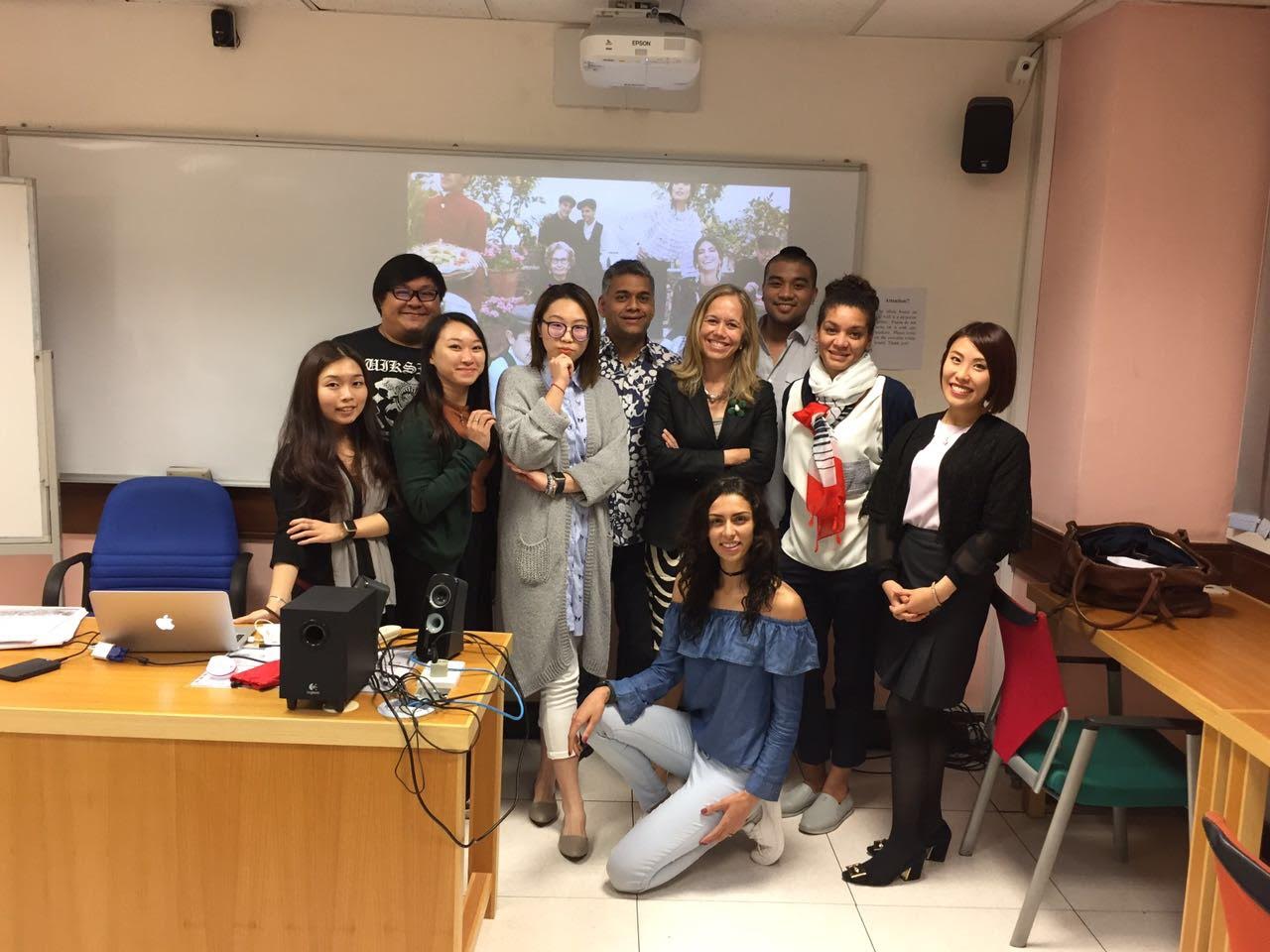
Professor Isabel Capeloa Gil, Rector of UCP and Director of The Lisbon Consortium, was in Macau last week to teach a seminar in Visual Culture at University of Saint Joseph.
-
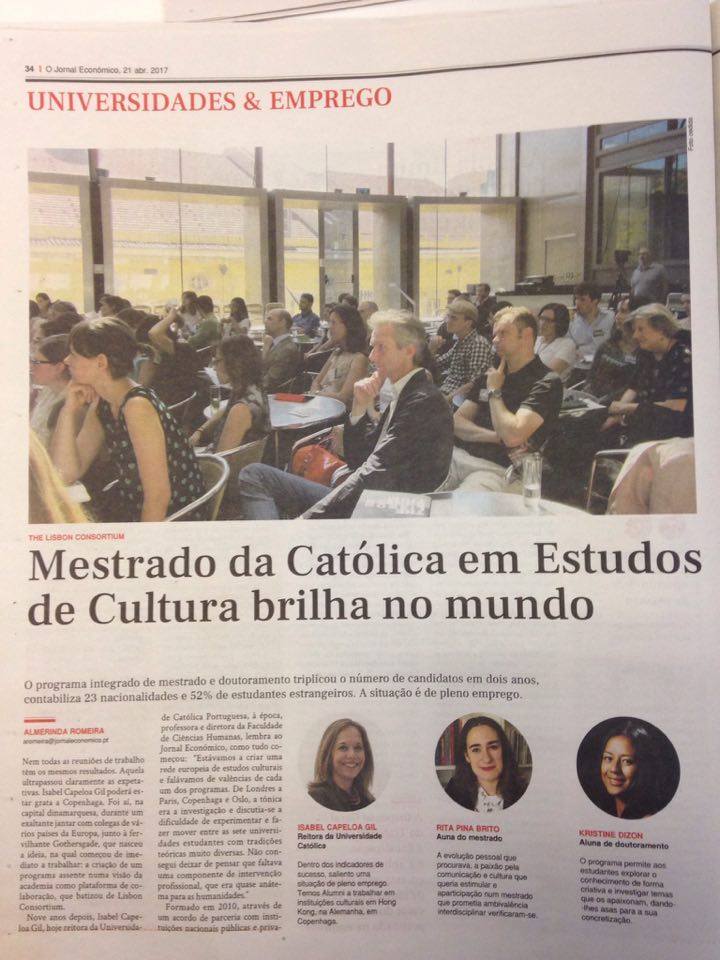
The LxC in O Jornal Económico
Today, 21st April, in Jornal Económico, an article about the Lisbon Consortium, with statements by the Rector of UCP Isabel Capeloa Gil, professors and students.

-

MA in Culture Studies ranked #3
For the third year in a row, the Lisbon Consortium MA in Culture Studies was ranked #3 by Eduniversal Worldwide Best Masters Ranking in Arts and Cultural Management.

-
Reading circle open to students and professors: ‘The politics of Trump’s politics, A Politics of Surroundings Special’
The PhD students in Culture Studies at the Lisbon Consortium that organize the reading circle are preparing a special session, date to be announced.
The politics of Trump’s politics, A Politics of Surroundings Special
In his recent book Scatter 1. The Politics of Politics in Foucault, Heidegger, and Derrida, 2016, Geoffrey Bennington poses the following question: “What if political rhetoric is unavoidable, an irreducible part of politics itself?”
We would like to invite the corpus of The Lisbon Consortium, students and professors, to join us in a close reading of Bennington’s book and to participate in the discussion of the main ideas presented in it. Our intention is to see how the author responds to his question, and to use his conceptual framework to critically engage with the state of contemporary politics.
More HERE
-

VII Lisbon Summer School now online
The VII Lisbon Summer School on Global Translations (26 June-July 1, 2017) will gather doctoral students and post-doctoral researchers from all around the world. In the morning there will be lectures by invited keynote speakers, except on Tuesday, June 27, when there will be parallel master classes.
All the updates will be posted at http://globaltranslationssummerschool.weebly.com/
-
“Risk and Crisis Communication in the Digital Age”: Call for papers
“Risk and Crisis Communication in the Digital Age”
Universidade Católica Portuguesa, 19 – 21 October 2017
Crisis Communication research emerged as a response to the need of conceiving emergency plans to deal with events that have a negative effect on stakeholders’ perception of organizations. However, researchers soon demonstrated that crisis communication is more than a reaction, and it should be perceived as a strategic tool to plan organizational life. The absence of a strategic crisis management thinking and discourse, besides posing a risk to organizations also limits response to societal challenges such as natural disasters, terrorist attacks and wars. In addition to this, the Digital Age poses new risks to the typical planning methods, while making available new sorts of tools that can be used to plan, implement and evaluate crisis management.
Departing from this context, the 5th International Crisis Communication Conference aims to discuss how crisis communication can be used by business and the public sector in a strategic fashion. Which theories and case studies can help better plan and implement crisis communication plans? How do organizations learn from the past, i.e. how do they evaluate previous crisis and order to be better prepared for the future? How did the digital challenge traditional strategies of crisis communication? Which sorts of new risks are brought by digital media and how can one learn from previous online crisis? Are corporate and non-corporate organizations ready to face online crisis communication?
While seeking answer for these questions, the conference will deepen and extend the exchange of ideas and approaches across disciplines and between Crisis Communication theories and researches.
Objectives:- To examine the role and practices of communication professionals in relation to internal and external aspects of crisis communication,
- To reflect about and to expose new roles and practices of strategic approaches to internal and external crisis communication,
- To contribute to knowledge development about crisis communication cases of public and nongovernmental organizations,
- To discuss and reflect about crisis communication theories and research,
- To present case studies based on empirical material,
- To clarify the importance of a strategic crisis communication plan.
The conference includes a panel for corporate discussion and cases presentation, which will contribute to the industry crisis management debate. The conference will also include Young Scholars activities – YECREA.
Submissions should deal with one of the following sub-themes:
- Corporate Crisis Communication;
- External Crisis Communication;
- Internal Crisis Communication;
- Non-Corporate Crisis Communication;
- Public and Nongovernmental Organizations Crisis Communication;
- Integrated Communication;
- Crisis Communication Management;
- New Media Crisis Communication;
- Strategic Crisis Communication Management;
- Media/Journalism (crisis reporting).
Presentation proposals in English language are to be submitted as meaningful extended abstracts (max. 500 words, references excluded). Abstracts should state the title of the presentation, purpose, theoretical approach, methodology, (expected) findings, implications, relevance, and originality of the study. Include contact information for all authors (name, organization, address, email address and phone). Abstracts must be presented in Word format, in 1.5 line spacing and 12 point Times New Roman font size.
Deadline for submissions
The deadline for submissions is April 17, 2017. Please send the abstract to: crisis5@fch.lisboa.ucp.pt. Notifications of acceptance will be sent by e-mail by June 9, 2017.The Registration Fees are:
- 70€ lunch and coffee-breaks included;
- 95€ Conference dinner included;
- 35€ non-presenting.
Keynote speakers
Professor W. Timothy Coombs – Texas A&M University (confirmed)
More to be announced soon
Organizing Committee
Professor Carla Ganito
Professor Nelson Ribeiro
Professor Maria Inês RombaThe 5th International Crisis Communication Conference will take place at Universidade Católica Portuguesa, in Lisbon (Portugal), on October 19 – 21. The conference is organized by the ECREA Crisis Communication Section, and hosted by the Research Centre for Communication and Culture (CECC), Universidade Católica Portuguesa (UCP).
Submissions: crisis5@fch.lisboa.ucp.pt
MORE INFO: http://crisis5-ecrea.com
-
CALL FOR PAPERS. Mnemonics 2017: The Social Life of Memory
The sixth Mnemonics: Network for Memory Studies summer school will be hosted by the Frankfurt Memory Studies Platform from September 7-9, 2017 at Goethe University Frankfurt. Confirmed keynote speakers are Aleida Assmann (University of Konstanz), Andreas Huyssen (Columbia University, New York) and Anna Reading (King’s College London).
This year’s Mnemonics summer school addresses the ‘social life of memory’. Memory studies is based on the premise that memories emerge (as Maurice Halbwachs argued) within ‘social frameworks’. But this is just the first stage of memory’s social dynamics. Those memories which have an impact in culture don’t just stand still, but lead a vibrant ‘social life’: They are mediated and remediated, emphatically welcomed and harshly criticized, handed on across generations, they travel across space, become connected with other memories or turn into a paradigm for further experience. Conversely, books about the past that are not sold and read, oral stories that are not passed on to grandchildren, history films that are not screened and reviewed, monuments that nobody visits, public apologies that do not engender heated debates – all these will fail to have an effect in memory culture. Memory ‘lives’ only insofar as it is continually shared among people, moves from minds and bodies to media and back again, is performed, remediated, translated, received, discussed and negotiated.
Once we conceive of objects and media as part of memory culture, we realize that these are not stable entities, containing unalterable meanings, but that they unfold their mnemonic significance only within dynamic and transitory social processes. This insight entails methodological consequences. It creates the need to use more complex theory/methodology-designs in order to do justice to the moving constellations we study. This may also mean connecting humanities- and social sciences-approaches. Reception theories, reader response theories, audience studies, performance studies, sociological and political science-methods, museum visitor studies, social history, social psychology, ethnography, or actor-network theory – these all belong to the long list of approaches that we may want to draw on in order to study what our research group here in Frankfurt calls ‘socio-medial constellations’ of memory.
The metaphor of the ‘social life of memory’ is not yet a clear-cut concept. However, it resonates with existing ideas, from Mikhail Bakhtin’s ‘social life of discourse’ to Arjun Appadurai’s ‘social life of things’ or Alondra Nelson’s ‘the social life of DNA’. It also brings to mind the ‘afterlife’ of artworks as it was addressed by Aby Warburg and Walter Benjamin. More recently, and within the new memory studies, Astrid Erll and Stephanie Wodianka have addressed the life of ‘memory-making films’ by studying their embeddedness in social contexts and in ‘plurimedial constellations’. In her study of Walter Scott, Ann Rigney has theorized the social (after-)lives of texts and authors in cultural memory.
The summer school welcomes paper proposals that display a keen interest in the dynamic interplay of medial and social aspects of memory culture and that suggest ways to explore ‘the social life of memory’ – from the perspectives of contemporary memory cultures across the globe as well as from historical viewpoints. Possible topics include, but are emphatically not restricted to, the following:
- What social practices and networks bring (and have historically brought) memory to life (or fail to do so)?
- How are media of memory socially framed and reframed?
- How can we study the social reception of media of memory (e.g. via discursive remembering, in interpretive communities, by historical audiences etc.) ?
- What are the social dynamics of memory-translation (the ‘cultural translation’ of memories, but also ‘literal translations’ of memory texts)?
- Which performances express and foster the social life of memory, or inhibit it?
- How do memory objects ‘travel’, what are their trajectories (or mnemonic ‘object biographies’)?
- What are the economics and politics of mnemonic objects (in the sense of Appadurai’s ‘social life of things’)?
- How do space and movement influence the social life of memory?
- How does time factor in the social life of memory (when do memories emerge, circulate or become inert)?
- How does politics enable or interfere with the social life of memory?
- What types of ‘social life’ can we distinguish (lives as ‘monumental memory’, as ‘countermemory’, ‘agonistic lives’ etc.)?
- How can we critically assess the logic of the metaphor of ‘social life’ (and its possible religious, biologistic etc. overtones) and find concepts that fine-tune, substitute or complement it?
MORE INFORMATION HERE
-

LXC Film Sessions, March 15
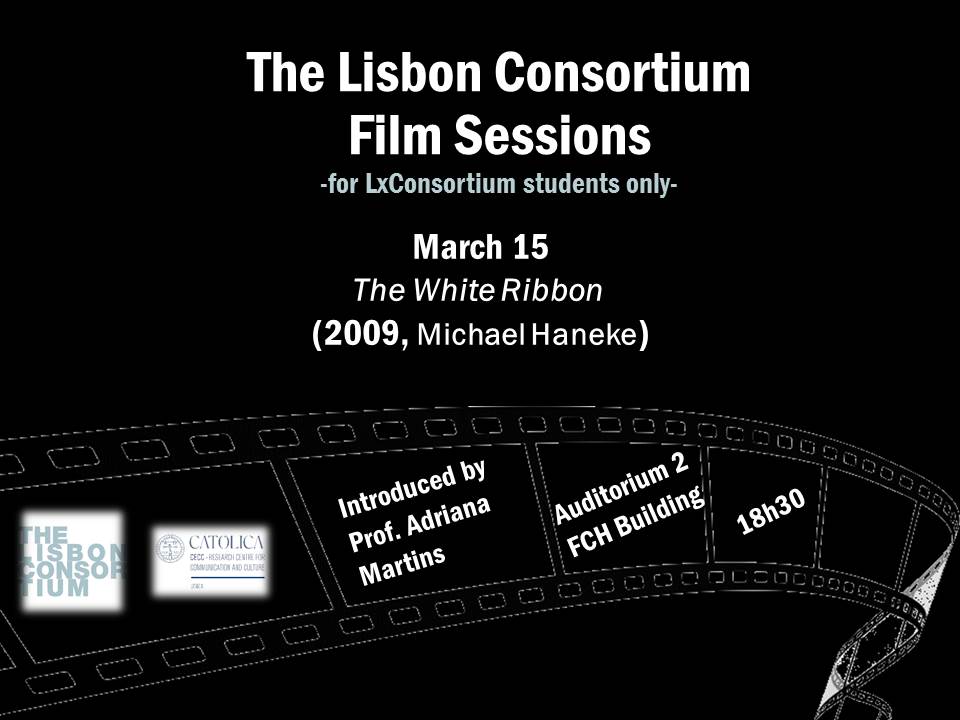 The White Ribbon by Michael Haneke from 2009, introduced by Prof. Dr. Adriana Martins
is the second movie that will be screened, in the context of a student led activity of cinema and debate.
Until the end of May, there will be two more sessions, with movies that somehow are related to the MA and PhD seminars.
We hope you can join us!
-

Ana do Carmo: PhD Defense

The Lisbon Consortium congratulates Ana do Carmo for successfully defending,on March 10 2017, her doctoral thesis on “ Literary representations of forced migrations – Cross-cultural Portuguese and German memoryscapes.” with the final result of Magna Cum Laude by unanimous decision. Congratulations!
-
Gaspare Trapani: PhD defense
The Lisbon Consortium congratulates Gaspare Antonino Trapani for successfully defending,on March 7 2017, his doctoral thesis on “Silvio Berlusconi e o Berlusconismo. Uma proposta de leitura” with the final result of Magna Cum Laude by unanimous decision. Congratulations!


-

Roundtable 5/5
TOMORROW, March 7, it will take place the Roundtable in the context of 5 Artists/5 Project Rooms, with Lourenço Egreja (Carpe Diem Arte & Pesquisa); Gregor Taul (The Lisbon Consortium); Chloé Nicolas (La Box), Delfim Sardo (Culturgest e Laboratório de Curadoria), Susana Gomes da Silva e Rita Fabiana (Museus Gulbenkian); Cláudia Camacho (Antiframe).

-
Public defenses: PhD thesis and PhD project
PhD Thesis Defense
Gaspare Trapani | March 7 – 10h30 | Room Expansão Missionária
PhD Thesis: Silvio Berlusconi e o Berlusconismo. Uma proposta de leitura.
Ana do Carmo | March 10 – 15h00 | Room Expansão Missionária
PhD Thesis: Literary representations of forced migrations – Cross-cultural Portuguese and German memoryscapes.
PhD Project Defense (PT)
Alexandra Balona | March 7 – 14h30 | Room Timor
PhD Project: Choreographing Openness. Speculations Beyond the Self in Contemporary Choreography
 The Lisbon Consortium