Category: Calls

  • CfP | Diffractions: Visual Poetics and Gender: Rendering Absence and Error

    CfP | Diffractions: Visual Poetics and Gender: Rendering Absence and Error

    Diffractions – Graduate Journal for the Study of Culture has launched the Call for Papers for Issue 11: Visual Poetics and Gender: Rendering Absence and Error. The deadline for abstracts is May 31, 2025.

    Visual Poetics and Gender: Rendering Absence and Error

    Editors-in-chief: Emily Marie Passos Duffy and Amadea Kovič

    Absences, both as a verbal phenomenon and textual/visual strategy, are evocative. They can convey even more than what is included in a work—pointing to the unsaid, the unexpressed, redacted, or censored. A space, an error, or an errant form can be seen as a collision between semiotic systems, lending itself to ekphrastic consideration, braiding together the verbal and the visual. History until this day is punctuated with gendered absences, and the visual mode has the potential to underscore them by making them visible; as noted by Elisabeth Frost (2016), there are “specifically feminist possibilities of a visually-oriented poetics” (339). Glitch feminism, for example, builds itself on the notion of the ‘glitch-as-error,‘ a term seeping from the digital world to claim and embrace the fluidity of the material against the dominance and normativity of the binary (Russell 2020). This call finds itself at an intersection between visual poetics as an approach/ philosophy and visual poetry as one of its genre outputs, engaging with both the visual and verbal to explore gender and absence.

    Visual poetics are defined through a number of perspectives: as an approach described by Mieke Bal (1988), it denies the “word-image” opposition and explores possibilities of a poetics of the visual and the visual dimensions of the written word, calling for mutual collaboration between and across mediums (178), while Frost (2016) defines it “as writing that explores the materiality of word, page, or screen” (339). Within the genre output of visual poetry—a genre umbrella that may include concrete poetry, asemic (“wordless”) poems, choreopoems, erasures, and redactions—there are countless examples of artists working on “visual compositions precisely to question the gendered politics of the history of poetry, material culture, and reading or performance” (Frost 2016, 339).

    Within the context of this call, we are specifically interested in the potential of visual poetics to render visibility to absences, engage with error, and convey histories of silence, censorship and erasure. What happens when certain narratives lack visibility, and present blank spaces within public visual language? Works by 21st century women poets Anne Carson and Gabrielle Civil demonstrate a poetic engagement with absence, as well as the material and visual aspects of both language and translation. In a note following “errances: an essay of errors after Jacqueline Beaugé-Rosier,” performance artist, poet, and writer Gabrielle Civil (2020) describes her ongoing work of translating A vol d’ombre by Haitian poet Jacqueline Beaugé-Rosier as “a trial of wandering,” “a shadow lineage” and “a timeline of discarded choices.” The essay´s visual dimensions—namely, white space, brackets, and cross-outs— constitute an archive of doubt, possibility, absence, and trials.

    Absences and errors can convey meaning and possibilities for reading and interpretation—in Civil’s case, they indicate a grappling with the language itself, and the challenges translation presents with “false friends, language, meaning, and memory” (Civil 2020). In Carson’s case, the brackets and white space in If Not, Winter: Fragments of Sappho perform and engage with the loss—an elegy for the missing pieces of the source text itself in its entirety, and an engagement with what remains.

    This call is interested in how gender-based concerns can be expressed through visual language and its absences, resulting in visual poetics in their varied and multilayered manifestations—and how these intersections may illuminate the bounds and possibilities of genre, form, and semiotic system.

    We invite explorations and examples of artistic productions which utilise the interplay between the verbal, visual, and gender—in particular, the use of visual poetics to highlight absence, invisibility and erasure, considering:

    • How can visual language be used to convey narratives that are beyond the verbal?
    • How might an absence be translated into visual language?
    • What is the role of error in visual poetics, and how does it connect to gender?

    Proposals for thematic articles in response to this call are welcome, including but not limited to the following topics:

    • The translation of visual or concrete poetry
    • Visual poetics and gender
    • (In)visibility
    • Expressions of error in visual poetry
    • Visual rendering/annotation of speech-based poetics
    • Absence as evocative, absence as resistance strategy
    • Ekphrastic writing—writing in response to visual art
    • Collaborations between visual artists and poets
    • Street art/graffiti as a form of visual poetics
    • Intertextuality/Intersemiotic translation and gender
    • Visual poetics, AI and technology
    • Visual poetics and theory

    For artistic submissions, we are interested in the following:

    • Visual essays
    • Interviews
    • Graphic or visual storytelling
    • Memes (original or curated with attribution)
    • Poetry that engages with erasure or redaction
    • Translated poetry with a translator’s note
    • Collaborations between text-based and image-based artists

    As with thematic articles, the artistic contributions should not exceed the length of 9000 words, in English or Portuguese. With artistic submissions, authors may also include an optional short (150-200 words) synopsis of the work in lieu of an abstract.

    Submissions and review process

    Abstracts will be received and reviewed by the Diffractions editorial board who will decide on the pertinence of proposals for the upcoming issue. After submission, we will get in touch with the authors of accepted abstracts in order to invite them to submit a full article. However, this does not imply that these papers will be automatically published. Rather, they will go through a peer-review process that will determine whether papers are publishable with minor or major changes, or they do not fulfill the criteria for publication.

    Please send abstracts of 150 to 250 words, and 5-8 keywords by May 31st 2025, to info.diffractions@gmail.com with the subject “Diffractions 11”, followed by your last name.

    The full papers should be submitted by August 31th 2025, through the journal’s platform: https://revistas.ucp.pt/index.php/diffractions/about/submissions.

    Every issue of Diffractions has a thematic focus but also contains special sections for non- thematic articles. If you are interested in submitting an article that is not related to the topic of this particular issue, please consult the general guidelines available at the Diffractions website at https://revistas.ucp.pt/index.php/diffractions/about/submissions. The submission and review process for non-thematic articles is the same as for the general thematic issue. All research areas of the humanities are welcome.

    See full call with bibliography here: https://revistas.ucp.pt/index.php/diffractions/announcement

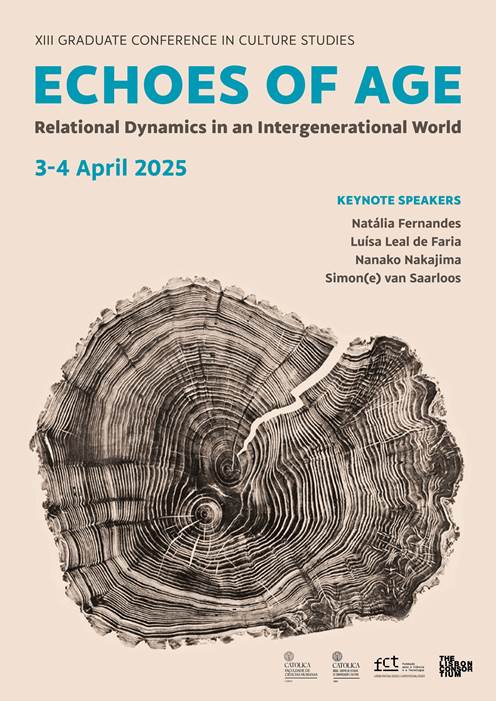
  • CfP| Echoes of Age: Relational Dynamics in an Intergenerational World (3-4 April 2025)

    CfP| Echoes of Age: Relational Dynamics in an Intergenerational World (3-4 April 2025)

    The Call for Papers for the next Graduate Conference in Culture Studies is out!

    Organized by students from the PhD program in Culture Studies, the XIII Graduate Conference in Culture Studies – Echoes of Age: Relational Dynamics in an Intergenerational World will take place 3-4 April 2025.

    Abstracts for individual or joint papers and presentations as well as alternative interventions including artistic interventions, co-creative workshops, reading groups are welcome!

    https://echoesofage.wordpress.com/

    echoesofage.conference@gmail.com

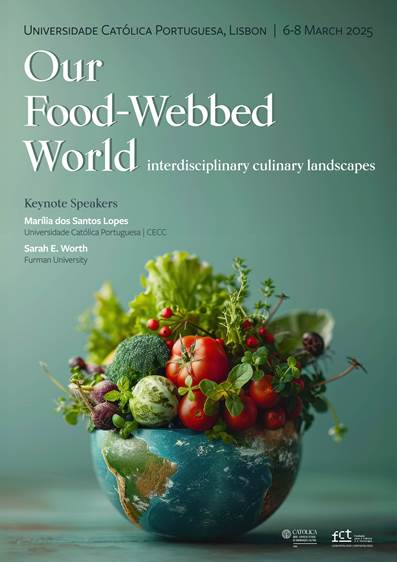
  • CfP: Our Food-Webbed World: interdisciplinary culinary landscapes

    CfP: Our Food-Webbed World: interdisciplinary culinary landscapes

    Our Food-Webbed World: interdisciplinary culinary landscapes

    Universidade Católica Portuguesa, Lisbon, 6-8 March 2025

    This event brings together researchers from different scientific areas to generate cross-disciplinary debate on how food shapes our everyday lives at various levels of society and culture. Food practices such as production, consumption, and intangible food culture together form what is the most intricately connective web of human experience. Beginning from the primal need of an individual body while simultaneously demanding inter-reliance and community, we are undeniably in a food-webbed world. Despite this, food-related studies have traditionally been delegated to strictly separate academic spheres, which is why this conference aims to offer an opportunity for truly interdisciplinary dialogue.

    Our Food-Webbed World: interdisciplinary culinary landscapes runs for three days (March 6-8, 2025) at Universidade Católica Portuguesa and other venues in Lisbon, Portugal, and includes a series of keynote lectures, panel discussions, interactive workshops, and off-site excursions with curated culinary programming.

    At this multi-disciplinary and international forum, we address the essential role of food for communication and transmission of traditions, and the (re)establishment of peoples and communities throughout time. We are particularly interested in the relationship between food and processes of cultural transformation and change, as well as the centrality of food to/the impact of food on technology, migration, media and communications, political and economic development, social initiatives, and cultural and artistic expressions.

    Through this conference, we hope to share and discuss food practices with the awareness that all food-related studies can and should benefit from shared perspectives on how food is both an instrument and a vehicle of culture.

    We welcome contributions for paper sessions, interactive workshops, or presentation of case studies related to food studies from researchers with different backgrounds. The aim of this conference is to offer a shared experience through a unique approach based on bringing together theory and practice.

    Possible topics (although not exclusive):

    • Culinary histories on recipes or menus
    • Cookbooks and menus as narrative text / in translation
    • Food writing and journalism/ food in the news
    • Food in film, literature and fine arts
    • Food policies/ the politics/economics of food
    • Food and the senses
    • Food and memory or cognition
    • Industrial food practices production
    • Food and the environment
    • Food and social media/ food and influencers
    • Food and migration/ as vehicle for hospitality
    • Food and human rights and/or activism
    • Food with social impact/ the social impact of food
    • Food, health and nutrition
    • Food in/ and institutions (ex. Schools, hospitals, prisons)
    • Food and community
    • Food and religion/ food and ritual
    • Food and tourism

    Keynote speakers

    Marília dos Santos Lopes (Universidade Católica Portuguesa/ CECC)
    Sarah E. Worth (Furman University)

    Interactive Tasting Workshops

    Olive Oil: production, consumption, socio-ecological cultures in the Mediterranean
    Johnny Madge, olive oil and honey sommelier, gustatory educator and author  

    Wine:  Socio-political and cultural systems of consumption in Ancient Greece
    Sarah E. Worth, full professor of aesthetics, philosophy of food  

    Interdisciplinary Workshop

    CellAgri Portugal – the Portuguese Association for Cellular Agriculture

    Joaquim Cabral, distinguished full professor of bioengineering and biosciences (Instituto Superior Técnico), and President of CellAgri Portugal
    Carlos Rodrigues, coordinator of the Bioreactor and Biomaterial Technologies for Stem Cell Manufacturing Lab (Instituto Superior Técnico)

    Roundtable: “Food in Migration: diasporic cooking and futures of fusion”

    Speakers TBA

    Paper proposals

    Proposals should be sent to foodconf2025@gmail.com no later than October 31, 2024, and include:

    • Paper title
    • Abstract in English (max. 250 words)
    • Name, email address, institutional affiliation
    • Brief Bio (100 words)

    Applicants will be informed of their submission results by December 2, 2024.

    The registration is open only to those with an accepted abstract. Deadline to register is December 31, 2024.

    Paper sessions will run 1.5 hours. Each participant will have 20 minutes for speaking, followed by 10 minutes for Q&A. 

    All participants are expected to attend the full conference, for the benefit of knowledge-production and knowledge-exchange.

    Fees*

     Early birdNormal
    Senior researchers200€240€
    PhD researchers100€130€
    CECC full researcher20€
    CECC PhD researcher10€

    * The fees include coffee breaks, lunch, and conference materials. Early bird fees are valid until December 15, 2024.

    Organizing Committee

    Annimari Juvonen
    Márcia Dias Sousa
    Rissa Miller
    Verena Lindemann Lino

    Scientific Committee

    Adriana Martins | UCP
    Ana Margarida Abrantes | UCP
    Isabel Drumond Braga | FLUL
    Ana Isabel Buescu | NOVA de Lisboa
    Luísa Santos | UCP
    Sofia Pinto | UCP
    Peter Hanenberg |UCP
    Rissa Miller | UCP
    Márcia Dias Sousa | UCP
    Maria Graça da Silveira | Univ. dos Açores

  • Cfp: XIV Lisbon Summer School for the Study of Culture – Culture at War

    Cfp: XIV Lisbon Summer School for the Study of Culture – Culture at War

    CULTURE AT WAR

    Lisbon, June 24 – 29, 2024

    Deadline for submissions: February 29, 2024

    We are living in times of war. Now, more than ever, war occupies a central role in both national and international affairs and pervades various spheres of our societies and cultures. 

    The 21st century has been marked by violence of different varieties and levels. Having started with a massive terrorist event, the attacks of September 11, 2001, the last two decades have witnessed many examples of aggression that have come to dominate both the media and public discussion. Acts of terrorism of various kinds, revolutions and wars, with the conflicts in Ukraine and the Middle East among the most recent, are illustrative of contemporary warfare, its characteristics, and challenges. While new military technology such as high-tech weapons and attack drones promote more remote, noncontact operations, the ever-present media strive for immediacy and proximity and thus contribute to a new and distinctive experience of war. Their continuous, play-by-play coverage promotes the illusion of a 360º view and allows audiences to follow the events in near-real time. However, their omnipresence has also turned them into desirable instruments of warfare. They not only inform about the war but also have the ability to mobilize for/against it. Furthermore, the rise of social media and its pivotal role in both documenting conflicts and generating and disseminating misinformation cannot be disregarded. As military conflicts unfold, a parallel war is also fought between communication mechanisms. It can even be argued, with Paul Virilio (War and Cinema, 1989), that war, or its experience, is becoming increasingly a product of visual media construction.

    Wars are not circumscribed to military conflicts, though. Contention has become an intrinsic part of everyday life, leading to social and cultural movements that call out misguided practices, injustices, and violations of basic laws and rights. On the one hand, bottom-up mobilizations such as #MeToo, the gilets jaunes, or Fridays for Future, reveal a world in crisis, responding to systemic violence with dissent. On the other hand, the dismantling of structures of oppression by means of decolonizing processes clashes with the incapacity to effectively deal with past wrongdoings and the tendency to forget or avoid uncomfortable discussions. These movements may, at times, also represent a dynamic of destruction based on the collective readiness to criticize, denounce, hold accountable, and ultimately cancel what or who is considered to have behaved in an unacceptable way. 

    This culture of war, of diverging opinions and interests, extends also to the relationship between man and nature, and more specifically the ongoing environmental emergency. One rhetorical device used to stress the escalating effects of climate change is precisely the war metaphor (employed also in the context of the COVID-19 pandemic). The use of military language and the idea of a war against climate change, widely used in public speeches and in the media, is meant to spark a fighting spirit and incite action. There is, however, the risk of having the opposite effect if the enemy remains abstract, the message is not made understandable, and governments and individuals fail to take responsibility for the current situation. 

    The XIV Lisbon Summer School for the Study of Culture is dedicated to the study of the relationship between culture and war. Papers are welcome on the following topics, amongst others:


    • Culture and conflict 
    • Ancient and modern warfare 
    • Culture in modern warfare
    • War and the creation of modernity
    • The cultural construction of terror/terrorism
    • Rules of war and humanitarian law
    • The ethics of war
    • The forensics of war
    • Rituals of the fallen
    • Battlefields and landscapes of war
    • Media and war, media at war: (mis)communication, (mis)information, and fake news 
    • Representations of war 
    • Art and artists at war
    • Art and reparations
    • (De)Colonizing discourses and practices/asymmetric conflict
    • Conflict escalation and conflict resolution 
    • Cultural wars and language
    • Dialogue and tolerance/Soliloquy and intolerance 
    • Culture of violence 
    • Warrior culture: between heroes and villains 
    • War as metaphor 
    • Environmental emergency and war against climate change 
    • War-induced uncertainty and instability 
    • Epistemologies at war/theories at war

    We encourage proposals coming from the fields of culture studies, film and the visual arts, literary and translation studies, history, anthropology, media, and psychology, among others.

    Paper proposals

    Proposals should be sent to lxsummerschool@gmail.com no later than February 29, 2024, and include paper title, abstract in English (max. 200 words), name, e-mail address, institutional affiliation, and a brief bio (max. 100 words) mentioning ongoing research.

    Applicants will be informed of the results of their submissions by March 29, 2024.

    Full papers submission

    Presenters are required to send in full papers no later than May 31, 2024.

    The papers will then be circulated amongst the participants. In the slot allotted to each participant (30’), only 10’ may be used for a brief summary of the research piece. The Summer School is a place for networked exchange of ideas, and organizers wish to have as much time as possible for a structured discussion between participants. Therefore, in each slot, 10’ will be used for presentation, and 20’ for discussion.

    Registration fees

    Participants with paper – 300€ for the entire week (includes lectures, master classes, doctoral sessions, lunches and closing dinner)

    Participants without paper – 60€ per day (lunches and closing dinner not included)

    Fee waivers

    For The Lisbon Consortium students and CECC researchers, there is no registration fee.

    For other UCP students, students from institutions affiliated with the European Summer School in Cultural Studies (ESSCS), members of the European PhD-Net in Literary and Cultural Studies, and members of the Critical Humanities Network the registration fee is 80€.

    This edition of the Lisbon Summer School for the Study of Culture will function as the 2024 Critical Humanities Network Summer School.

    Organizing Committee

    • Isabel Capeloa Gil
    • Peter Hanenberg
    • Alexandra Lopes
    • Adriana Martins
    • Diana Gonçalves
    • Paulo de Campos Pinto
    • Rita Faria
    • Annimari Juvonen

    Assessment Committee

    • Peter Hanenberg
    • Alexandra Lopes
    • Adriana Martins
    • Diana Gonçalves
    • Paulo de Campos Pinto
    • Rita Faria
    • Ana Margarida Abrantes
    • Luísa Leal de Faria
    • Joana Moura
    • Rita Bueno Maia
    • Verena Lindemann Lino
    • Sofia Pinto
    • Luísa Santos
  • XIII Lisbon Summer School for the Study of Culture – FUTURE/FUTURES – extended deadline

    XIII Lisbon Summer School for the Study of Culture – FUTURE/FUTURES – extended deadline

    XIII Lisbon Summer School for the Study of Culture 

    FUTURE/FUTURES

    Lisbon, July 3 – July 8, 2023

    [extended] Deadline for submissions: February 28 March 17, 2023

    For centuries thinking about the future was basically an optimist and progress driven endeavor, aimed at advancing towards the best of possible worlds through the improvement of science and technology. 

    Throughout the 20th century, euphoria about progress slowly but steadily turned into discomfort, due to the growing awareness about scientific development’s immense capability to cause pain and infortune. The shortcomings and aporias of the present have strangely produced a new retrotopia, focused on reinventing the past and less on clearly conceiving of the future-to-be. This is caused by the globalization of indifference, the crisis of democratic states, the deepening of cultural and religious wars and the rising visibility of extreme violence, linked to terrorism and war. We are likewise faced with a resource crisis and an obvious planetary exhaustion, just as the fourth technological revolution forces us to question the future of work and hence of the very definition of the human as a homo laborans. 

    In view of the different rhythms, contexts and directions of our global communities, given the clear difference of access to basic commodities and even to the social and political right to have rights, given the uneven capability of individuals throughout the globe to shape the future to come, it is clear that future must be graphed in the plural, as futures that are culturally situated in distinct global realities. In addition, ‘futures’ has become a sort of a floating signifier swaying from prospective to finance, from science fiction to organizational theory, from anthropology to psychoanalysis.

    The XIII Lisbon Summer School for the Study of Culture is dedicated to the study of the representation of the future(s) as trope and idea. Papers are welcome on the following topics, amongst others:

    • Future or futures
    • Culture(s) of the future; culture(s) in the future
    • Imagining the future: representations in literature, cinema and the arts
    • Space and/in time
    • Science and technology: potential and risks for life in the future
    • Innovative tools, materials, systems and techniques
    • Cyberfutures
    • Memory and trauma: between past and future
    • (De)Colonizing the future
    • The future(s) of the Other
    • Speculation, prediction, anticipation and the production of possible futures
    • Futurist thought: ‘new’/’neo’, ‘re’
    • Dance of prefixes: from u- and dys-topia to retro-topia
    • The protractive or transformative quality of the future
    • The future of woke culture
    • Fear of the future and the fear of no future
    • Crisis, disaster, conflict, and the disruption of the future
    • Nostalgia, hope, and the promise of a brighter future
    • A more than human future: human, posthuman, nonhuman and other possibilities

    We encourage proposals coming from the fields of culture studies, film and the visual arts, literary and translation studies, history, anthropology, media and psychology, among others.

    Paper proposals

    Proposals should be sent to lxsummerschool@gmail.com no later than February 28 March 17, 2023 and include paper title, abstract in English (max. 200 words), name, e-mail address, institutional affiliation and a brief bio (max. 100 words) mentioning ongoing research.

    Applicants will be informed of the result of their submissions by March 31, 2023.

    Rules for presentation

    The organizing committee shall place presenters in small groups according to the research focus of their papers. They are advised to stay in these groups for the duration of the Summer School, so a structured exchange of ideas may be developed to its full potential.

    Full papers submission

    Presenters are required to send in full papers no later than May 31, 2023.

    The papers will then be circulated amongst the members of each research group.  In the slot allotted to each participant (30’), only 10’ may be used for a brief summary of the research piece. The Summer School is a place for networked exchange of ideas, and organizers wish to have as much time as possible for a structured discussion between participants. Therefore, in each slot, 10’ will be used for presentation, and 20’ for discussion.

    Registration fees

    Participants with paper – 300€ for the entire week (includes lectures, master classes, doctoral sessions, lunches and closing dinner)

    Participants without paper – 60€ per day (lunches and closing dinner not included)

    Fee waivers

    For The Lisbon Consortium students and CECC researchers, there is no registration fee.

    For students from institutions affiliated with the European Summer School in Cultural Studies (ESSCS), members of the Excellence Network in Cultural Studies and members of the Critical Humanities Network the registration fee is 80€.

    This Summer School is devised in close collaboration with the 2023 ESSCS on the topic “Bouncing Forward”. The ESSCS 2023 and the XIII Lisbon Summer School for the Study of Culture are intended as complementary Summer Schools investigating disparate elements of a common concern. Applicants, who wish to attend both Summer Schools, should indicate this in their application. A reduced participation fee will be available for those attending both events.

    Confirmed Speakers

    • Sandra Bermann (Princeton University)
    • Lucia Boldrini (Goldsmiths, University of London)
    • Marcelo Brodsky (Visual Artist)
    • Timothy Garton Ash (University of Oxford)
    • Richard Grusin (University of Wisconsin-Milwaukee)
    • William Hasselberger (Universidade Católica Portuguesa)
    • Daniel Innerarity (University of the Basque Country)
    • Adriana Martins (Universidade Católica Portuguesa)
    • Nuno Maulide (University of Vienna)
    • Kitty Millet (San Francisco State University)
    • Liedeke Plate (Radboud University)
    • Tiago Pitta e Cunha (Fundação Oceano Azul)
    • Anne Tomiche (Université Paris-Sorbonne)

    Organizing Committee

    • Isabel Capeloa Gil
    • Peter Hanenberg
    • Alexandra Lopes
    • Adriana Martins
    • Diana Gonçalves
    • Paulo de Campos Pinto
    • Rita Faria
    • Ana Margarida Abrantes
    • Joana Moura
    • Rita Bueno Maia
    • Sofia Pinto
    • Verena Lindemann Lino
  • Call for Articles: Diffractions Graduate Journal for the Study of Culture

    Call for Articles: Diffractions Graduate Journal for the Study of Culture

    Call for Articles

    (Dis-)covering ciphers: objects, voices, bodies.

    Deadline for submissions: October 31, 2018

    To analyze the ways in which cultural objects acquire meaning can also be understood as looking at the technologies by which those objects have become enciphered. In this issue of Diffractions we aim to look at the concept of the cipher in its myriad ways of appearing, be they cultural, social, political, technological, linguistic or economic in nature.

    To give an example of that last category, one merely needs to point towards Marx’s theory on the fetishization of commodities. There, the process through which the material existence of products of labor can become invisible behind their exchange value, is formulated as a process of hiding what is central to the object; its material existence and its use value. In other words, the Marxist theory of fetishization can be understood as the discovery of a cipher, the cipher of exchange value.

    But the concept of the cipher travels easily, and can be situated in many locations. In Adriana Cavarero’s work on the voice, she considers the ways in which the bodily aspects that are associated with the vocal are often hidden behind its semiotic, linguistic, and signifying capacities. That is to say, speech functions as a cipher for the materiality of the vocal. The vocal needs to be deciphered.

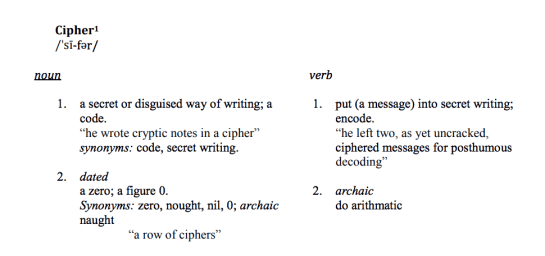
    But what is a cipher? And how to know if we are dealing with a cipher to begin with? The cipher raises questions. In technologico-linguistic terms, a cipher calls for a key. A password. A way to de-cipher what was first en-ciphered. Perhaps a text that appears as a cipher is a plain text after all. The cipher’s call is not always obvious. Ciphers can conceal their act of concealing; hide not only what they are hiding, but that they are hiding as well; steganography.

    Ciphers cut. And, as Jacques Derrida writes, they produce an inside and an outside, insides and outsides.  In order to protect what is behind the cipher, the cipher has to function as a passageway, letting some through while excluding others. In order to be allowed to enter, something must already be known. The cipher marks the limits of something hidden. But some measure of knowledge is nevertheless presupposed. It marks the boundaries of a relationship. It conceals and shows at the same time. It covers and uncovers.

    If, for someone like Marx, the material manifestation of any object precedes its encipherment, others might submit, instead, that the cipher operates as the occasion for materialization to first take place. Mediation comes first, and materializes the body, someone like Judith Butler would argue. Following such accounts of the performative nature of subjection, one may suggest that the very materiality of the body is a product of a process that relies on cultural, linguistic, affective, and discursive, ciphers. And if the cipher conditions processes of materialization and subjectivation, one can ask if there is anything that escapes its logic. Is there an excess of meaning that remains neither enciphered, nor decipherable? To trace that excess would be to situate the cipher more precisely. It would be an attempt to recognize ciphers where they are, and to isolate those places where they remain absent.


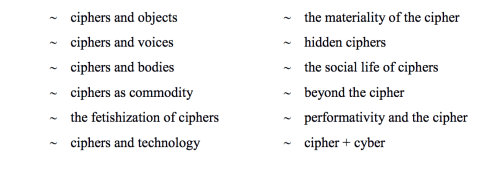
    For the upcoming issue of Diffractions we would like to make the cipher speak. To allow it to be heard, perhaps against its will. To ask where the cipher begins, and what exceeds its limits. In doing so, we aim to connect the cipher to objects, to values, to voices, and to the body. Our goal is to investigate the ways in which these concepts can be made useful for the study of cultural objects. How objects of study might help us to make the cipher speak, and how the cipher might engage these objects in return.

    We look forward to receiving proposals of 5.000 to 9.000 words (excluding bibliography) and a short bio of about 150 words by October 31st, 2018 to be submitted at our website: https://diffractions.fch.lisboa.ucp.pt/Series2.

    Diffractions also accepts book reviews related to the issue’s topic. If you wish to write a book review, please contact us through the e-mail address below.

    We aim to be as accessible as possible in our communication. Should you have any questions, remarks, or suggestions, please do not hesitate to contact us through the following address: info.diffractions@gmail.com.

  • CALL FOR PAPERS: VIII Graduate Conference in Culture Studies

    viii graduate conference.png

    REPLACEMENT AND REPLACEABILITY IN CONTEMPORARY CULTURE

    VIII Graduate Conference in Culture Studies

    6–7 December 2018 | Universidade Católica Portuguesa – Lisbon


    Call for Papers

    We call for papers for the 8th Graduate Conference in Culture Studies. This edition will be on the theme of “Replacement and Replaceability in Contemporary Culture” and takes place in Lisbon on the 6th and 7th of December 2018. The conference is organized by The Lisbon Consortium in conjunction with the Research Centre for Communication and Culture at the Universidade Católica Portuguesa.

    We aim to discuss the ways in which the concept of ‘replacement’ can be understood and productively used for the study of contemporary culture. Replacement has been one of the central concepts in the study of culture for quite some time, and, at the risk of overstating this claim, one could say that replacement is a concern in all fields of knowledge dealing with the study of culture today. It is, however, rarely the central focus in academic discussion and this event aims to contribute to a more detailed analysis of the uses, misuses, and usefulness of this particular concept for the study of cultural objects.

    Hearing the words replacement and replaceability, one naturally wonders: Who or what is being replaced? Who is doing the replacing? What counts as replaceable? Is there a logic of replacement? What happens when bodies are deemed replaceable for other bodies? Or for machines? How does replacement communicate with other, related, concepts, such as translation, repetition, reiteration, quotation, citation, metaphor, metonymy, synechdoche, and displacement? And how does it acquire meaning in connection to other concepts like false-consciousness, workforce, precariousness, simulacrum, spectacle, and ideology? How can replacement or replaceability be made useful for the study of cultural objects? Which objects warrant their use? It is on these and related questions that we invite abstracts to be presented at our conference.


    Ideas for proposals

    -Replacement, technology and labor.

    – Replacement and the body.

    – Replacement and disability.

    Replacement and the queer body.

    Replacement and colonialism.

    Replacement and representation.

    Replacement and translation.

    Replacement and biopower.

    Replacement and the digital.

    Replacement by AI.

    Replacement and recognition.

    Replacement and knowledge production.

    Replacement and simulacrum.

    Replacement and death.

    Replacement and the archive.

    – Replacement and documentat

    Background

    Theoretical understandings of power tend to highlight the importance of controlled reproduction of human beings, or subjects, in order for power to function. One may think of a wide-ranging number of theorists here, from Karl Marx, through Louis Althusser, and on to Michel Foucault. In the study of bureaucratic modes of power exertion, documents can function as the irreplaceable expression of an identity or a right, as in the cases of identity cards, passports, and diplomas.

    In translation studies, the notion of translation as a specific act of replacement is of central concern. In media theory and the study of visual culture, the notion of representation can be understood as a moment in which the image replaces the ‘original.’ In literary studies, concepts such as metaphor and metonymy are examples of replacing one word for another, a procedure considered essential to the production of meaning through language.

    In Lacanian psychoanalysis, the mirror-stage functions as a scene in which the physical body is temporarily replaced by an imaginary double. Feminist- and queer theorists have often critiqued heterosexist and heteronormative approaches to otherness as failed, or attempted copies of heterosexual male life. In posthumanist discourses, the very notion of the human undergoes a moment of replacement by some kind of being that is no longer fully human and all too often celebrated as beyond the human in a teleological way. And post- and de-colonial theorists have read colonial activities of ‘Western powers’ as forced replacements of one culture for another.


    We invite proposals for contributions in the form of 20-minute presentations in which replacement or replaceability are used either as concepts of analysis, put into dialogue with a cultural object, or in which the concepts themselves come under theoretical scrutiny.

    Proposals should be no longer than 250 words and have to be sent to replacementconference2018@gmail.com no later than June 15th 2018.

    Your abstract will be peer reviewed and you will receive notification of acceptance as soon as possible thereafter, but no later than the end of July 2018.

    Upon acceptance you will be requested to register and provide some personal details to finalize your registration.

    The conference will be a two-day event, taking place at the Universidade Católica Portuguesa. It is scheduled to take place on the 6th and 7th of December 2018.


    Registration fee

    The Registration Fee is €50,00 (this includes lunch, coffee breaks and conference materials).

    For The Lisbon Consortium students and members of CECC, there is no registration fee.

    Organizing Committee

    Sara Magno, Jad Khairallah & Ilios Willemars


    For more information, updates and details, see replacementconference.wordpress.com/

  • Parques de Sintra: call for artists for photography exhibition

    Parques_de_Sintra_promove_exposicao_coletiva_de_fotografia-noticia-detalhe

    Parques de Sintra Monte da Lua, one of the partners of the Lisbon Consortium, will promote a collective photography exhibition between May 5 and June 3, 2018, under the title “Significação. Outras Imagens do Jardim”. Artists are invited to submit their competition proposals, following the regulations that can be found here.

    In the call for artists, we can read:

    “Using the gardens, parks and hunting grounds that are under Parques de Sintra’s management as a working place, this show intends to promote a fresh look over the historical heritage, stimulating and supporting the artistic contemporary production and its fruitions by diverse audiences.”


  • “Risk and Crisis Communication in the Digital Age”: Call for papers

    “Risk and Crisis Communication in the Digital Age”

    Universidade Católica Portuguesa, 19 – 21 October 2017

    Crisis Communication research emerged as a response to the need of conceiving emergency plans to deal with events that have a negative effect on stakeholders’ perception of organizations. However, researchers soon demonstrated that crisis communication is more than a reaction, and it should be perceived as a strategic tool to plan organizational life. The absence of a strategic crisis management thinking and discourse, besides posing a risk to organizations also limits response to societal challenges such as natural disasters, terrorist attacks and wars. In addition to this, the Digital Age poses new risks to the typical planning methods, while making available new sorts of tools that can be used to plan, implement and evaluate crisis management.
    Departing from this context, the 5th International Crisis Communication Conference aims to discuss how crisis communication can be used by business and the public sector in a strategic fashion. Which theories and case studies can help better plan and implement crisis communication plans? How do organizations learn from the past, i.e. how do they evaluate previous crisis and order to be better prepared for the future? How did the digital challenge traditional strategies of crisis communication? Which sorts of new risks are brought by digital media and how can one learn from previous online crisis? Are corporate and non-corporate organizations ready to face online crisis communication?
    While seeking answer for these questions, the conference will deepen and extend the exchange of ideas and approaches across disciplines and between Crisis Communication theories and researches.
    Objectives:

    • To examine the role and practices of communication professionals in relation to internal and external aspects of crisis communication,
    • To reflect about and to expose new roles and practices of strategic approaches to internal and external crisis communication,
    • To contribute to knowledge development about crisis communication cases of public and nongovernmental organizations,
    • To discuss and reflect about crisis communication theories and research,
    • To present case studies based on empirical material,
    • To clarify the importance of a strategic crisis communication plan.

    The conference includes a panel for corporate discussion and cases presentation, which will contribute to the industry crisis management debate. The conference will also include Young Scholars activities – YECREA.

    Submissions should deal with one of the following sub-themes:

    • Corporate Crisis Communication;
    • External Crisis Communication;
    • Internal Crisis Communication;
    • Non-Corporate Crisis Communication;
    • Public and Nongovernmental Organizations Crisis Communication;
    • Integrated Communication;
    • Crisis Communication Management;
    • New Media Crisis Communication;
    • Strategic Crisis Communication Management;
    • Media/Journalism (crisis reporting).

    Presentation proposals in English language are to be submitted as meaningful extended abstracts (max. 500 words, references excluded). Abstracts should state the title of the presentation, purpose, theoretical approach, methodology, (expected) findings, implications, relevance, and originality of the study. Include contact information for all authors (name, organization, address, email address and phone). Abstracts must be presented in Word format, in 1.5 line spacing and 12 point Times New Roman font size.

    Deadline for submissions
    The deadline for submissions is April 17, 2017. Please send the abstract to: crisis5@fch.lisboa.ucp.pt. Notifications of acceptance will be sent by e-mail by June 9, 2017.

    The Registration Fees are:

    • 70€ lunch and coffee-breaks included;
    • 95€ Conference dinner included;
    • 35€ non-presenting.

    Keynote speakers
    Professor W. Timothy Coombs – Texas A&M University (confirmed)
    More to be announced soon
    Organizing Committee
    Professor Carla Ganito
    Professor Nelson Ribeiro
    Professor Maria Inês Romba

    The 5th International Crisis Communication Conference will take place at Universidade Católica Portuguesa, in Lisbon (Portugal), on October 19 – 21. The conference is organized by the ECREA Crisis Communication Section, and hosted by the Research Centre for Communication and Culture (CECC), Universidade Católica Portuguesa (UCP).


    Submissions: crisis5@fch.lisboa.ucp.pt

    MORE INFO: http://crisis5-ecrea.com


  • Call for papers: VII Lisbon Summer School for the Study of Culture on Global Translations

    VII Lisbon Summer School for the Study of Culture

    Global Translations

    Lisbon, June 26 – July 1, 2017

    Deadline for submissions: January 30, 2017

    Translation is a concept, and a practice, at the heart of contemporary experience. The legacies of the past, along with modern-day technology and worldviews, have allowed for, indeed have invited, the coming together of multiple identities, through various languages and a plurality of cultures. Nowadays, translation inhabits the world in new and irrevocably radical ways, and any definition of globalization – hegemonic, utopian or imaginary – must involve translation.

    Etymologically meaning ‘the activity of carrying across’ (Tymockzo, 1999: 20), translation may be the actual epitome of the global world, particularly if one accepts the broadest definition of ‘globalization’, i.e., that ‘“globalization” refers to the processes by which more people across large distances become connected in more and different ways’ (Lechner and Boli, 2012: 1) – a ‘global village’ needs translation, and translation is, of course, never innocent, as linguistic translation can help imposing hegemony or promoting resistance. Thus, translation, or the rejection of it, has been used as a political tool in every meeting of others, be it in the colonial past or in the post-colonial or neo-colonial present.

    Translation has always meant, to a greater or smaller extent, displacement, and is never a one-way process and always involves beings as well as goods-in-transit. This translatedness of people and things, either voluntary or forced, has come to change the world, in practical as well as conceptual terms. The 21st century may well prove to be the age of migration, with millions – of people, goods, ideas, dollars – getting translated every day. These are Appadurai’s ‘objects in motion’ (2001) in ‘a world in flows’ (1996). Reinforced by long-distance technology (media, transports, etc.) and overreaching hegemonies, translation becomes a metaphor for modern-day experience, and a practical and a conceptual tool to better negotiate the world around.

    To understand how cultural phenomena are affected and shaped by translation is, therefore, a task for culture studies, as the recent ‘translation turn’ may attest (Bassnett, 1990; Bachmann-Medick, 2009). This turn in culture studies testifies to the crucial impact of ‘difference’ – be it in the sense of Paul Gilroy’s convivial cosmopolitan worldview (2004) or the rather more pessimistic take of Zygmunt Bauman’s ‘liquidity’ (1998, 2011) or of Appiah’s interrogative musings (2006) – has on the imaginings of culture, on cultural performativity, on the ability to negotiate meanings, values, beliefs and practices and potentially raising what be called ‘cosmopolitan empathy’ (Beck, 2006). ‘Cosmopolitanization’ as a process which ‘comprises the development of multiple loyalties as well as the increase in the diverse transnational forms of life’ (Beck, 2006: 9) must be inhabited by translation in a radically intimate way – a translation that is both an act of love and disruption, and that begins at home with oneself. As Emily Apter put it, ‘[c]ast as an act of love, and an act of disruption, translation becomes a means of repositioning the subject in the world and in history; a means of rendering self-knowledge foreign to itself; a way of denaturalizing citizens, taking them out of the comfort zone of national space, daily ritual, and pre-given domestic arrangements’ (2006: 6). Seen as such, every form of translation begins with self-translation.
    The Summer School invites proposals by doctoral students and post-docs that address, though may not be not be strictly limited to, the topics below:

    • The globalization of art and art markets
    • The monolingualization of economics and economic practices
    • Migration as translation
    • Cultural mediation and negotiation
    • Fear and the absence of translation
    • The invention of the ‘other’ in and through translation
    • Translating ideas, methods, policies across the world
    • (Un)Translatability and the rise of demotic media and politics
    • (Translated) Identities in the global world
    • Nationalism and the global village
    • Self-translation and critical thinking in the global world
    • Cosmopolitanism, cosmopolitanization, and globalization


    Confirmed Keynote Speakers

    • Michael Cronin (Dublin City University)
    • Sandra Bermann (Princeton University)
    • Alexandra Lopes (Universidade Católica Portuguesa)
    • Uwe Wirth (Justus-Liebig University)
    • Rui Carvalho Homem (Universidade do Porto)
    • Loredana Polezzi (Cardiff University)
    • Aamir Mufti (University of California, Los Angeles)
    • Hanif Kureishi (British writer and filmmaker)

    Master Classes

    • Alison Ribeiro de Menezes (University of Warwick)
    • Knut Ove Eliassen (Norwegian University of Science and Technology)
    • Adriana Martins (Universidade Católica Portuguesa)


    The Summer School will take place at several cultural institutions in Lisbon and will gather outstanding doctoral students and post-doctoral researchers from around the world. In the morning there will be lectures and master classes by invited keynote speakers. In the afternoon there will be paper presentations by doctoral students.

    Paper proposals
    Proposals should be sent to lxconsortium@gmail.com no later than January 30, 2017 and include paper title, abstract in English (200 words), name, e-mail address, institutional affiliation and a brief bio (max. 100 words) mentioning ongoing research.
    Applicants will be informed of the result of their submissions in the beggining of March. 

    Rules for presentation
    The organizing committee shall place presenters in small groups according to the research focus of their papers. They are advised to stay in these groups for the duration of the Summer School, so a structured exchange of ideas may be developed to its full potential.

    Full papers submission
    Presenters are required to send in full papers by May 30, 2017.

    The papers will then be circulated amongst the members of each research group and in the slot allotted to each participant (30’), only 10’ may be used for a brief summary of the research piece. The Summer School is a place of networked exchange of ideas and organizers wish to have as much time as possible for a structured discussion between participants. Ideally, in each slot, 10’ will be used for presentation, and 20’ for discussion.

    Registration fees
    Participants with paper – 265€ for the entire week (includes lectures, master classes, doctoral sessions, lunches and closing dinner)
    Participants without paper – €50 per session/day | 165€ for the entire week (lectures and master classes only)

    Fee exemptions
    For The Lisbon Consortium students, the students from Universities affiliated with the European Summer School in Cultural Studies and members of the Excellence Network in Cultural Studies there is no registration fee.

    Organizing Committee
    • Isabel Capeloa Gil
    • Peter Hanenberg
    • Alexandra Lopes
    • Paulo de Campos Pinto
    • Diana Gonçalves
    • Clara Caldeira

    The Lisbon Summer School for the Study of Culture is an annual meeting organized by the Lisbon Consortium, a collaborative research network between the Master and PhD programs in Culture Studies at Universidade Católica Portuguesa and the main cultural institutions in Lisbon.

    The MA in Culture Studies is ranked no. 3 in the world by the Eduniversal Best Masters Ranking in Arts Management.

    For further information, please contact us through lxconsortium@gmail.com