Category: Conferences

  • Registrations open | Echoes of Age, April 3-4 2025

    Registrations open | Echoes of Age, April 3-4 2025

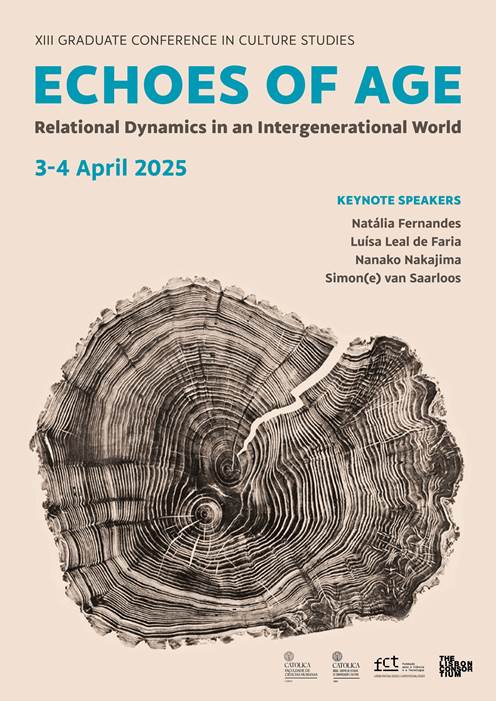
    The registration is open for the upcoming conference, Echoes of Age: Relational Dynamics in an Intergenerational World. This event will bring together artists writers, researchers and professionals to explore the evolving narratives of aging, generational interactions and cultural transformations.

    Conference Details:

    Date: April 3-4, 2025

    Location: Universidade Católica Portuguesa

    Programme:

    Register Here: https://fch.lisboa.ucp.pt/CECC/Echoes-of-age until March 15, 2025.

    Keynote Speakers:

    • Nanako Nakajima: Dance scholar and dramaturg. She is an Associate Professor in Dance Studies at Waseda University, Tokyo. Her publications include The Aging Body in Dance.
    • Luísa Leal de Faria: Full Professor of the Faculty of Human Sciences (FCH) at Universidade Católica Portuguesa (UCP), where she served as Vice-Rector between 2004 and 2012.
    • Simon(e) van Saarloos: Writer, artist and curator based between Oakland, California and Amsterdam, the Netherlands. Van Saarloos is the author of Against Ageism. A Queer Manifesto.
    • Natália Fernandes: Associate Professor with Qualification at the University of Minho, Institute of Education, Department of Social Sciences of Education. Her research area is the Sociology of Childhood.

    For more details, including the conference program, visit the website: echoesofage.wordpress.com contact us at echoesofage.conference@gmail.com for questions.

    Follow @Echoes_of_Age on Instagram for updates and highlights leading up to the conference!

    Registration Fees:

    The registration fee includes coffee breaks and conference materials. Spaces are limited, so we encourage you to register early to secure your spot.

    • Student/Academic Attendees: 85 €
    • CECC Researchers: Exempted from fees, but registration is mandatory.

    Looking forward to seeing you there!

  • Extended deadline: Echoes of Age – XIII Graduate Conference in Culture Studies 3–4 April 2025

    Extended deadline: Echoes of Age – XIII Graduate Conference in Culture Studies 3–4 April 2025

    Proposals for the “Echoes of Age” graduate conference can still be submitted until Wednesday 15 January, 2025.

    The XIII Graduate Conference in Culture Studies, “Echoes of Age” will take place on 3-4 April 2025. This conference aims to address what Simone de Beauvoir termed the “conspiracy of silence surrounding ageing,” examining biases and strategies to overcome intergenerational disparities. How can we foster respect and understanding among generations? How can we overcome generational gaps to promote social innovation and resilience? In what ways do generational differences present both challenges and opportunities for societal cohesion?

    You can find the full CfP here.

    echoesofage.conference@gmail.com.

  • CfP| Echoes of Age: Relational Dynamics in an Intergenerational World (3-4 April 2025)

    CfP| Echoes of Age: Relational Dynamics in an Intergenerational World (3-4 April 2025)

    The Call for Papers for the next Graduate Conference in Culture Studies is out!

    Organized by students from the PhD program in Culture Studies, the XIII Graduate Conference in Culture Studies – Echoes of Age: Relational Dynamics in an Intergenerational World will take place 3-4 April 2025.

    Abstracts for individual or joint papers and presentations as well as alternative interventions including artistic interventions, co-creative workshops, reading groups are welcome!

    https://echoesofage.wordpress.com/

    echoesofage.conference@gmail.com

  • CfP: Our Food-Webbed World: interdisciplinary culinary landscapes

    CfP: Our Food-Webbed World: interdisciplinary culinary landscapes

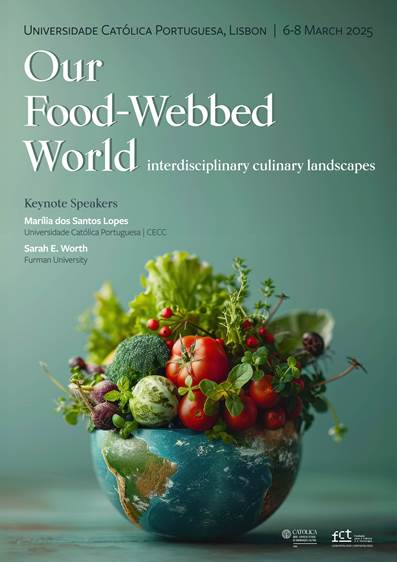
    Our Food-Webbed World: interdisciplinary culinary landscapes

    Universidade Católica Portuguesa, Lisbon, 6-8 March 2025

    This event brings together researchers from different scientific areas to generate cross-disciplinary debate on how food shapes our everyday lives at various levels of society and culture. Food practices such as production, consumption, and intangible food culture together form what is the most intricately connective web of human experience. Beginning from the primal need of an individual body while simultaneously demanding inter-reliance and community, we are undeniably in a food-webbed world. Despite this, food-related studies have traditionally been delegated to strictly separate academic spheres, which is why this conference aims to offer an opportunity for truly interdisciplinary dialogue.

    Our Food-Webbed World: interdisciplinary culinary landscapes runs for three days (March 6-8, 2025) at Universidade Católica Portuguesa and other venues in Lisbon, Portugal, and includes a series of keynote lectures, panel discussions, interactive workshops, and off-site excursions with curated culinary programming.

    At this multi-disciplinary and international forum, we address the essential role of food for communication and transmission of traditions, and the (re)establishment of peoples and communities throughout time. We are particularly interested in the relationship between food and processes of cultural transformation and change, as well as the centrality of food to/the impact of food on technology, migration, media and communications, political and economic development, social initiatives, and cultural and artistic expressions.

    Through this conference, we hope to share and discuss food practices with the awareness that all food-related studies can and should benefit from shared perspectives on how food is both an instrument and a vehicle of culture.

    We welcome contributions for paper sessions, interactive workshops, or presentation of case studies related to food studies from researchers with different backgrounds. The aim of this conference is to offer a shared experience through a unique approach based on bringing together theory and practice.

    Possible topics (although not exclusive):

    • Culinary histories on recipes or menus
    • Cookbooks and menus as narrative text / in translation
    • Food writing and journalism/ food in the news
    • Food in film, literature and fine arts
    • Food policies/ the politics/economics of food
    • Food and the senses
    • Food and memory or cognition
    • Industrial food practices production
    • Food and the environment
    • Food and social media/ food and influencers
    • Food and migration/ as vehicle for hospitality
    • Food and human rights and/or activism
    • Food with social impact/ the social impact of food
    • Food, health and nutrition
    • Food in/ and institutions (ex. Schools, hospitals, prisons)
    • Food and community
    • Food and religion/ food and ritual
    • Food and tourism

    Keynote speakers

    Marília dos Santos Lopes (Universidade Católica Portuguesa/ CECC)
    Sarah E. Worth (Furman University)

    Interactive Tasting Workshops

    Olive Oil: production, consumption, socio-ecological cultures in the Mediterranean
    Johnny Madge, olive oil and honey sommelier, gustatory educator and author  

    Wine:  Socio-political and cultural systems of consumption in Ancient Greece
    Sarah E. Worth, full professor of aesthetics, philosophy of food  

    Interdisciplinary Workshop

    CellAgri Portugal – the Portuguese Association for Cellular Agriculture

    Joaquim Cabral, distinguished full professor of bioengineering and biosciences (Instituto Superior Técnico), and President of CellAgri Portugal
    Carlos Rodrigues, coordinator of the Bioreactor and Biomaterial Technologies for Stem Cell Manufacturing Lab (Instituto Superior Técnico)

    Roundtable: “Food in Migration: diasporic cooking and futures of fusion”

    Speakers TBA

    Paper proposals

    Proposals should be sent to foodconf2025@gmail.com no later than October 31, 2024, and include:

    • Paper title
    • Abstract in English (max. 250 words)
    • Name, email address, institutional affiliation
    • Brief Bio (100 words)

    Applicants will be informed of their submission results by December 2, 2024.

    The registration is open only to those with an accepted abstract. Deadline to register is December 31, 2024.

    Paper sessions will run 1.5 hours. Each participant will have 20 minutes for speaking, followed by 10 minutes for Q&A. 

    All participants are expected to attend the full conference, for the benefit of knowledge-production and knowledge-exchange.

    Fees*

     Early birdNormal
    Senior researchers200€240€
    PhD researchers100€130€
    CECC full researcher20€
    CECC PhD researcher10€

    * The fees include coffee breaks, lunch, and conference materials. Early bird fees are valid until December 15, 2024.

    Organizing Committee

    Annimari Juvonen
    Márcia Dias Sousa
    Rissa Miller
    Verena Lindemann Lino

    Scientific Committee

    Adriana Martins | UCP
    Ana Margarida Abrantes | UCP
    Isabel Drumond Braga | FLUL
    Ana Isabel Buescu | NOVA de Lisboa
    Luísa Santos | UCP
    Sofia Pinto | UCP
    Peter Hanenberg |UCP
    Rissa Miller | UCP
    Márcia Dias Sousa | UCP
    Maria Graça da Silveira | Univ. dos Açores

  • Culture at War – Deadline for submissions March 14!

    Culture at War – Deadline for submissions March 14!

    CULTURE AT WAR

    Lisbon, June 24 – 29, 2024

    We are living in times of war. Now, more than ever, war occupies a central role in both national and international affairs and pervades various spheres of our societies and cultures. 

    The 21st century has been marked by violence of different varieties and levels. Having started with a massive terrorist event, the attacks of September 11, 2001, the last two decades have witnessed many examples of aggression that have come to dominate both the media and public discussion. Acts of terrorism of various kinds, revolutions and wars, with the conflicts in Ukraine and the Middle East among the most recent, are illustrative of contemporary warfare, its characteristics, and challenges. While new military technology such as high-tech weapons and attack drones promote more remote, noncontact operations, the ever-present media strive for immediacy and proximity and thus contribute to a new and distinctive experience of war. Their continuous, play-by-play coverage promotes the illusion of a 360º view and allows audiences to follow the events in near-real time. However, their omnipresence has also turned them into desirable instruments of warfare. They not only inform about the war but also have the ability to mobilize for/against it. Furthermore, the rise of social media and its pivotal role in both documenting conflicts and generating and disseminating misinformation cannot be disregarded. As military conflicts unfold, a parallel war is also fought between communication mechanisms. It can even be argued, with Paul Virilio (War and Cinema, 1989), that war, or its experience, is becoming increasingly a product of visual media construction.

    Wars are not circumscribed to military conflicts, though. Contention has become an intrinsic part of everyday life, leading to social and cultural movements that call out misguided practices, injustices, and violations of basic laws and rights. On the one hand, bottom-up mobilizations such as #MeToo, the gilets jaunes, or Fridays for Future, reveal a world in crisis, responding to systemic violence with dissent. On the other hand, the dismantling of structures of oppression by means of decolonizing processes clashes with the incapacity to effectively deal with past wrongdoings and the tendency to forget or avoid uncomfortable discussions. These movements may, at times, also represent a dynamic of destruction based on the collective readiness to criticize, denounce, hold accountable, and ultimately cancel what or who is considered to have behaved in an unacceptable way. 

    This culture of war, of diverging opinions and interests, extends also to the relationship between man and nature, and more specifically the ongoing environmental emergency. One rhetorical device used to stress the escalating effects of climate change is precisely the war metaphor (employed also in the context of the COVID-19 pandemic). The use of military language and the idea of a war against climate change, widely used in public speeches and in the media, is meant to spark a fighting spirit and incite action. There is, however, the risk of having the opposite effect if the enemy remains abstract, the message is not made understandable, and governments and individuals fail to take responsibility for the current situation. 

    The XIV Lisbon Summer School for the Study of Culture is dedicated to the study of the relationship between culture and war. Papers are welcome on the following topics, amongst others:

    • Culture and conflict 
    • Ancient and modern warfare 
    • Culture in modern warfare
    • War and the creation of modernity
    • The cultural construction of terror/terrorism
    • Rules of war and humanitarian law
    • The ethics of war
    • The forensics of war
    • Rituals of the fallen
    • Battlefields and landscapes of war
    • Media and war, media at war: (mis)communication, (mis)information, and fake news 
    • Representations of war 
    • Art and artists at war
    • Art and reparations
    • (De)Colonizing discourses and practices/asymmetric conflict
    • Conflict escalation and conflict resolution 
    • Cultural wars and language
    • Dialogue and tolerance/Soliloquy and intolerance 
    • Culture of violence 
    • Warrior culture: between heroes and villains 
    • War as metaphor 
    • Environmental emergency and war against climate change 
    • War-induced uncertainty and instability 
    • Epistemologies at war/theories at war

    We encourage proposals coming from the fields of culture studies, film and the visual arts, literary and translation studies, history, anthropology, media, and psychology, among others.

    Paper proposals

    Proposals should be sent to lxsummerschool@gmail.com no later than than February 29 March 14, 2024, and include paper title, abstract in English (max. 200 words), name, e-mail address, institutional affiliation, and a brief bio (max. 100 words) mentioning ongoing research.

    Applicants will be informed of the results of their submissions by by March 29 April 8, 2024.

    Full papers submission

    Presenters are required to send in full papers no later than May 31, 2024.

    The papers will then be circulated amongst the participants. In the slot allotted to each participant (30’), only 10’ may be used for a brief summary of the research piece. The Summer School is a place for networked exchange of ideas, and organizers wish to have as much time as possible for a structured discussion between participants. Therefore, in each slot, 10’ will be used for presentation, and 20’ for discussion.

    Registration fees

    Participants with paper – 300€ for the entire week (includes lectures, master classes, doctoral sessions, lunches and closing dinner)

    Participants without paper – 60€ per day (lunches and closing dinner not included)

    Fee waivers

    For The Lisbon Consortium students and CECC researchers, there is no registration fee.

    For other UCP students, students from institutions affiliated with the European Summer School in Cultural Studies (ESSCS), members of the European PhD-Net in Literary and Cultural Studies, and members of the Critical Humanities Network the registration fee is 80€.

    This edition of the Lisbon Summer School for the Study of Culture will function as the 2024 Critical Humanities Network Summer School.

    Organizing Committee

    • Isabel Capeloa Gil
    • Peter Hanenberg
    • Alexandra Lopes
    • Adriana Martins
    • Diana Gonçalves
    • Paulo de Campos Pinto
    • Rita Faria
    • Annimari Juvonen

    Assessment Committee

    • Peter Hanenberg
    • Alexandra Lopes
    • Adriana Martins
    • Diana Gonçalves
    • Paulo de Campos Pinto
    • Rita Faria
    • Ana Margarida Abrantes
    • Luísa Leal de Faria
    • Joana Moura
    • Rita Bueno Maia
    • Verena Lindemann Lino
    • Sofia Pinto
    • Luísa Santos
  • Cfp: XIV Lisbon Summer School for the Study of Culture – Culture at War

    Cfp: XIV Lisbon Summer School for the Study of Culture – Culture at War

    CULTURE AT WAR

    Lisbon, June 24 – 29, 2024

    Deadline for submissions: February 29, 2024

    We are living in times of war. Now, more than ever, war occupies a central role in both national and international affairs and pervades various spheres of our societies and cultures. 

    The 21st century has been marked by violence of different varieties and levels. Having started with a massive terrorist event, the attacks of September 11, 2001, the last two decades have witnessed many examples of aggression that have come to dominate both the media and public discussion. Acts of terrorism of various kinds, revolutions and wars, with the conflicts in Ukraine and the Middle East among the most recent, are illustrative of contemporary warfare, its characteristics, and challenges. While new military technology such as high-tech weapons and attack drones promote more remote, noncontact operations, the ever-present media strive for immediacy and proximity and thus contribute to a new and distinctive experience of war. Their continuous, play-by-play coverage promotes the illusion of a 360º view and allows audiences to follow the events in near-real time. However, their omnipresence has also turned them into desirable instruments of warfare. They not only inform about the war but also have the ability to mobilize for/against it. Furthermore, the rise of social media and its pivotal role in both documenting conflicts and generating and disseminating misinformation cannot be disregarded. As military conflicts unfold, a parallel war is also fought between communication mechanisms. It can even be argued, with Paul Virilio (War and Cinema, 1989), that war, or its experience, is becoming increasingly a product of visual media construction.

    Wars are not circumscribed to military conflicts, though. Contention has become an intrinsic part of everyday life, leading to social and cultural movements that call out misguided practices, injustices, and violations of basic laws and rights. On the one hand, bottom-up mobilizations such as #MeToo, the gilets jaunes, or Fridays for Future, reveal a world in crisis, responding to systemic violence with dissent. On the other hand, the dismantling of structures of oppression by means of decolonizing processes clashes with the incapacity to effectively deal with past wrongdoings and the tendency to forget or avoid uncomfortable discussions. These movements may, at times, also represent a dynamic of destruction based on the collective readiness to criticize, denounce, hold accountable, and ultimately cancel what or who is considered to have behaved in an unacceptable way. 

    This culture of war, of diverging opinions and interests, extends also to the relationship between man and nature, and more specifically the ongoing environmental emergency. One rhetorical device used to stress the escalating effects of climate change is precisely the war metaphor (employed also in the context of the COVID-19 pandemic). The use of military language and the idea of a war against climate change, widely used in public speeches and in the media, is meant to spark a fighting spirit and incite action. There is, however, the risk of having the opposite effect if the enemy remains abstract, the message is not made understandable, and governments and individuals fail to take responsibility for the current situation. 

    The XIV Lisbon Summer School for the Study of Culture is dedicated to the study of the relationship between culture and war. Papers are welcome on the following topics, amongst others:


    • Culture and conflict 
    • Ancient and modern warfare 
    • Culture in modern warfare
    • War and the creation of modernity
    • The cultural construction of terror/terrorism
    • Rules of war and humanitarian law
    • The ethics of war
    • The forensics of war
    • Rituals of the fallen
    • Battlefields and landscapes of war
    • Media and war, media at war: (mis)communication, (mis)information, and fake news 
    • Representations of war 
    • Art and artists at war
    • Art and reparations
    • (De)Colonizing discourses and practices/asymmetric conflict
    • Conflict escalation and conflict resolution 
    • Cultural wars and language
    • Dialogue and tolerance/Soliloquy and intolerance 
    • Culture of violence 
    • Warrior culture: between heroes and villains 
    • War as metaphor 
    • Environmental emergency and war against climate change 
    • War-induced uncertainty and instability 
    • Epistemologies at war/theories at war

    We encourage proposals coming from the fields of culture studies, film and the visual arts, literary and translation studies, history, anthropology, media, and psychology, among others.

    Paper proposals

    Proposals should be sent to lxsummerschool@gmail.com no later than February 29, 2024, and include paper title, abstract in English (max. 200 words), name, e-mail address, institutional affiliation, and a brief bio (max. 100 words) mentioning ongoing research.

    Applicants will be informed of the results of their submissions by March 29, 2024.

    Full papers submission

    Presenters are required to send in full papers no later than May 31, 2024.

    The papers will then be circulated amongst the participants. In the slot allotted to each participant (30’), only 10’ may be used for a brief summary of the research piece. The Summer School is a place for networked exchange of ideas, and organizers wish to have as much time as possible for a structured discussion between participants. Therefore, in each slot, 10’ will be used for presentation, and 20’ for discussion.

    Registration fees

    Participants with paper – 300€ for the entire week (includes lectures, master classes, doctoral sessions, lunches and closing dinner)

    Participants without paper – 60€ per day (lunches and closing dinner not included)

    Fee waivers

    For The Lisbon Consortium students and CECC researchers, there is no registration fee.

    For other UCP students, students from institutions affiliated with the European Summer School in Cultural Studies (ESSCS), members of the European PhD-Net in Literary and Cultural Studies, and members of the Critical Humanities Network the registration fee is 80€.

    This edition of the Lisbon Summer School for the Study of Culture will function as the 2024 Critical Humanities Network Summer School.

    Organizing Committee

    • Isabel Capeloa Gil
    • Peter Hanenberg
    • Alexandra Lopes
    • Adriana Martins
    • Diana Gonçalves
    • Paulo de Campos Pinto
    • Rita Faria
    • Annimari Juvonen

    Assessment Committee

    • Peter Hanenberg
    • Alexandra Lopes
    • Adriana Martins
    • Diana Gonçalves
    • Paulo de Campos Pinto
    • Rita Faria
    • Ana Margarida Abrantes
    • Luísa Leal de Faria
    • Joana Moura
    • Rita Bueno Maia
    • Verena Lindemann Lino
    • Sofia Pinto
    • Luísa Santos
  • Space Oddity – On Spatial Narratives

    Space Oddity – On Spatial Narratives

    XII Graduate Conference in Culture Studies
    25-27 January 2024

  • XIII Lisbon Summer School for the Study of Culture – FUTURE/FUTURES – extended deadline

    XIII Lisbon Summer School for the Study of Culture – FUTURE/FUTURES – extended deadline

    XIII Lisbon Summer School for the Study of Culture 

    FUTURE/FUTURES

    Lisbon, July 3 – July 8, 2023

    [extended] Deadline for submissions: February 28 March 17, 2023

    For centuries thinking about the future was basically an optimist and progress driven endeavor, aimed at advancing towards the best of possible worlds through the improvement of science and technology. 

    Throughout the 20th century, euphoria about progress slowly but steadily turned into discomfort, due to the growing awareness about scientific development’s immense capability to cause pain and infortune. The shortcomings and aporias of the present have strangely produced a new retrotopia, focused on reinventing the past and less on clearly conceiving of the future-to-be. This is caused by the globalization of indifference, the crisis of democratic states, the deepening of cultural and religious wars and the rising visibility of extreme violence, linked to terrorism and war. We are likewise faced with a resource crisis and an obvious planetary exhaustion, just as the fourth technological revolution forces us to question the future of work and hence of the very definition of the human as a homo laborans. 

    In view of the different rhythms, contexts and directions of our global communities, given the clear difference of access to basic commodities and even to the social and political right to have rights, given the uneven capability of individuals throughout the globe to shape the future to come, it is clear that future must be graphed in the plural, as futures that are culturally situated in distinct global realities. In addition, ‘futures’ has become a sort of a floating signifier swaying from prospective to finance, from science fiction to organizational theory, from anthropology to psychoanalysis.

    The XIII Lisbon Summer School for the Study of Culture is dedicated to the study of the representation of the future(s) as trope and idea. Papers are welcome on the following topics, amongst others:

    • Future or futures
    • Culture(s) of the future; culture(s) in the future
    • Imagining the future: representations in literature, cinema and the arts
    • Space and/in time
    • Science and technology: potential and risks for life in the future
    • Innovative tools, materials, systems and techniques
    • Cyberfutures
    • Memory and trauma: between past and future
    • (De)Colonizing the future
    • The future(s) of the Other
    • Speculation, prediction, anticipation and the production of possible futures
    • Futurist thought: ‘new’/’neo’, ‘re’
    • Dance of prefixes: from u- and dys-topia to retro-topia
    • The protractive or transformative quality of the future
    • The future of woke culture
    • Fear of the future and the fear of no future
    • Crisis, disaster, conflict, and the disruption of the future
    • Nostalgia, hope, and the promise of a brighter future
    • A more than human future: human, posthuman, nonhuman and other possibilities

    We encourage proposals coming from the fields of culture studies, film and the visual arts, literary and translation studies, history, anthropology, media and psychology, among others.

    Paper proposals

    Proposals should be sent to lxsummerschool@gmail.com no later than February 28 March 17, 2023 and include paper title, abstract in English (max. 200 words), name, e-mail address, institutional affiliation and a brief bio (max. 100 words) mentioning ongoing research.

    Applicants will be informed of the result of their submissions by March 31, 2023.

    Rules for presentation

    The organizing committee shall place presenters in small groups according to the research focus of their papers. They are advised to stay in these groups for the duration of the Summer School, so a structured exchange of ideas may be developed to its full potential.

    Full papers submission

    Presenters are required to send in full papers no later than May 31, 2023.

    The papers will then be circulated amongst the members of each research group.  In the slot allotted to each participant (30’), only 10’ may be used for a brief summary of the research piece. The Summer School is a place for networked exchange of ideas, and organizers wish to have as much time as possible for a structured discussion between participants. Therefore, in each slot, 10’ will be used for presentation, and 20’ for discussion.

    Registration fees

    Participants with paper – 300€ for the entire week (includes lectures, master classes, doctoral sessions, lunches and closing dinner)

    Participants without paper – 60€ per day (lunches and closing dinner not included)

    Fee waivers

    For The Lisbon Consortium students and CECC researchers, there is no registration fee.

    For students from institutions affiliated with the European Summer School in Cultural Studies (ESSCS), members of the Excellence Network in Cultural Studies and members of the Critical Humanities Network the registration fee is 80€.

    This Summer School is devised in close collaboration with the 2023 ESSCS on the topic “Bouncing Forward”. The ESSCS 2023 and the XIII Lisbon Summer School for the Study of Culture are intended as complementary Summer Schools investigating disparate elements of a common concern. Applicants, who wish to attend both Summer Schools, should indicate this in their application. A reduced participation fee will be available for those attending both events.

    Confirmed Speakers

    • Sandra Bermann (Princeton University)
    • Lucia Boldrini (Goldsmiths, University of London)
    • Marcelo Brodsky (Visual Artist)
    • Timothy Garton Ash (University of Oxford)
    • Richard Grusin (University of Wisconsin-Milwaukee)
    • William Hasselberger (Universidade Católica Portuguesa)
    • Daniel Innerarity (University of the Basque Country)
    • Adriana Martins (Universidade Católica Portuguesa)
    • Nuno Maulide (University of Vienna)
    • Kitty Millet (San Francisco State University)
    • Liedeke Plate (Radboud University)
    • Tiago Pitta e Cunha (Fundação Oceano Azul)
    • Anne Tomiche (Université Paris-Sorbonne)

    Organizing Committee

    • Isabel Capeloa Gil
    • Peter Hanenberg
    • Alexandra Lopes
    • Adriana Martins
    • Diana Gonçalves
    • Paulo de Campos Pinto
    • Rita Faria
    • Ana Margarida Abrantes
    • Joana Moura
    • Rita Bueno Maia
    • Sofia Pinto
    • Verena Lindemann Lino
  • VIII Lx Summer School: program now online

    cartaz final imagem.png

    The VIII Lisbon Summer School for the Study of Culture, on Cyber+ Cipher+Culture is almost starting! You can check the news and the program on the website

  • CALL FOR PAPERS: VIII Graduate Conference in Culture Studies

    viii graduate conference.png

    REPLACEMENT AND REPLACEABILITY IN CONTEMPORARY CULTURE

    VIII Graduate Conference in Culture Studies

    6–7 December 2018 | Universidade Católica Portuguesa – Lisbon


    Call for Papers

    We call for papers for the 8th Graduate Conference in Culture Studies. This edition will be on the theme of “Replacement and Replaceability in Contemporary Culture” and takes place in Lisbon on the 6th and 7th of December 2018. The conference is organized by The Lisbon Consortium in conjunction with the Research Centre for Communication and Culture at the Universidade Católica Portuguesa.

    We aim to discuss the ways in which the concept of ‘replacement’ can be understood and productively used for the study of contemporary culture. Replacement has been one of the central concepts in the study of culture for quite some time, and, at the risk of overstating this claim, one could say that replacement is a concern in all fields of knowledge dealing with the study of culture today. It is, however, rarely the central focus in academic discussion and this event aims to contribute to a more detailed analysis of the uses, misuses, and usefulness of this particular concept for the study of cultural objects.

    Hearing the words replacement and replaceability, one naturally wonders: Who or what is being replaced? Who is doing the replacing? What counts as replaceable? Is there a logic of replacement? What happens when bodies are deemed replaceable for other bodies? Or for machines? How does replacement communicate with other, related, concepts, such as translation, repetition, reiteration, quotation, citation, metaphor, metonymy, synechdoche, and displacement? And how does it acquire meaning in connection to other concepts like false-consciousness, workforce, precariousness, simulacrum, spectacle, and ideology? How can replacement or replaceability be made useful for the study of cultural objects? Which objects warrant their use? It is on these and related questions that we invite abstracts to be presented at our conference.


    Ideas for proposals

    -Replacement, technology and labor.

    – Replacement and the body.

    – Replacement and disability.

    Replacement and the queer body.

    Replacement and colonialism.

    Replacement and representation.

    Replacement and translation.

    Replacement and biopower.

    Replacement and the digital.

    Replacement by AI.

    Replacement and recognition.

    Replacement and knowledge production.

    Replacement and simulacrum.

    Replacement and death.

    Replacement and the archive.

    – Replacement and documentat

    Background

    Theoretical understandings of power tend to highlight the importance of controlled reproduction of human beings, or subjects, in order for power to function. One may think of a wide-ranging number of theorists here, from Karl Marx, through Louis Althusser, and on to Michel Foucault. In the study of bureaucratic modes of power exertion, documents can function as the irreplaceable expression of an identity or a right, as in the cases of identity cards, passports, and diplomas.

    In translation studies, the notion of translation as a specific act of replacement is of central concern. In media theory and the study of visual culture, the notion of representation can be understood as a moment in which the image replaces the ‘original.’ In literary studies, concepts such as metaphor and metonymy are examples of replacing one word for another, a procedure considered essential to the production of meaning through language.

    In Lacanian psychoanalysis, the mirror-stage functions as a scene in which the physical body is temporarily replaced by an imaginary double. Feminist- and queer theorists have often critiqued heterosexist and heteronormative approaches to otherness as failed, or attempted copies of heterosexual male life. In posthumanist discourses, the very notion of the human undergoes a moment of replacement by some kind of being that is no longer fully human and all too often celebrated as beyond the human in a teleological way. And post- and de-colonial theorists have read colonial activities of ‘Western powers’ as forced replacements of one culture for another.


    We invite proposals for contributions in the form of 20-minute presentations in which replacement or replaceability are used either as concepts of analysis, put into dialogue with a cultural object, or in which the concepts themselves come under theoretical scrutiny.

    Proposals should be no longer than 250 words and have to be sent to replacementconference2018@gmail.com no later than June 15th 2018.

    Your abstract will be peer reviewed and you will receive notification of acceptance as soon as possible thereafter, but no later than the end of July 2018.

    Upon acceptance you will be requested to register and provide some personal details to finalize your registration.

    The conference will be a two-day event, taking place at the Universidade Católica Portuguesa. It is scheduled to take place on the 6th and 7th of December 2018.


    Registration fee

    The Registration Fee is €50,00 (this includes lunch, coffee breaks and conference materials).

    For The Lisbon Consortium students and members of CECC, there is no registration fee.

    Organizing Committee

    Sara Magno, Jad Khairallah & Ilios Willemars


    For more information, updates and details, see replacementconference.wordpress.com/
  • 4 Cs first conference in images

    4 Cs first conference in images

    This slideshow requires JavaScript.

  • SAVE THE DATE: 4 Cs CONFERENCE

    SAVE THE DATE: 4 Cs CONFERENCE

    Conviviality and the Institutional is a two-day conference in the frame of 4Cs – From Conflict to Conviviality through Creativity and Culture, a cooperation project supported by the European Commission in the frame of Creative Europe – Culture Subprogramme. Coordinated by the Universidade Católica Portuguesa, 4Cs aims to explore how art and culture can constitute powerful resources to address the subject of conflict. A major focus will be on training and education. The programme includes exhibitions, artistic and research residencies, film screenings, mediation labs, workshops, conferences, publications, an online platform and a Summer School.

    Check the program here

    Free admission with registration and limited to the seats available.

    Please contact: fabiola.mauricio@fch.lisboa.ucp.pt

  • Interview with Michael Cronin by Rita Bueno Maia

    Michael Cronin was one of the keynote speakers of the VII Lisbon Summer School for the Study of Culture, on Global Translations. You can listen to his interview, on several subjects of his investigation and the fiel of Translation Studies, by Rita Bueno Maia.

  • Isabel Capeloa Gil: keynote speaker at CLE 2017

    Isabel Capeloa Gil: keynote speaker at CLE 2017

    “Emotional Necropolitics from Antigone to bin Laden” is the title of the lecture by Professor Isabel Capeloa Gil, at the Second Biennial Culture Literacy conference in Warsaw, 10-12 May 2017, a meeting under the subject of “(E)motion” hosted by Institute of Literary Research of the Polish Academy of Sciences.

    Burials are unquestionably rituals where private passions and public zones of intimacy come together, where private memorialization scenes interact with the organization of public sentiment, where affect is effectively ushered into the promotion of socially organized mourning practices. The talk looks at the cultural impact of burial denial on the affective experience of those other bodies who interact with the dead, the logistics of affect that organize or are organized by the social structure of feeling and the ways in which they promote a pedagogic or resistant affectivity. By addressing two representative case studies, Sophocles’ Antigone and the bin Laden affair, I wish to probe the manifold ways in which burial affects effectively matter. At stake are issues such as the governamentalization of the organic, the modalization of mourning, the mode of affect production and its interaction with the public technologies of affect. The production of an emotional necropolitics around the non-existing burial has social-political implications, negotiates cultural memory practices and articulates non-intentional modes of experience in their dealings with dominant ‘machinic assemblages’ of power (Grossberg). Of particular interest in this regard is the articulation of affective investment with erasure and the questioning of the role of aesthetics in the grey zone where burial prohibition is placed.

    “Emotional Necropolitics from Antigone to bin Laden”, Isabel Capeloa Gil

    More information about the conference HERE