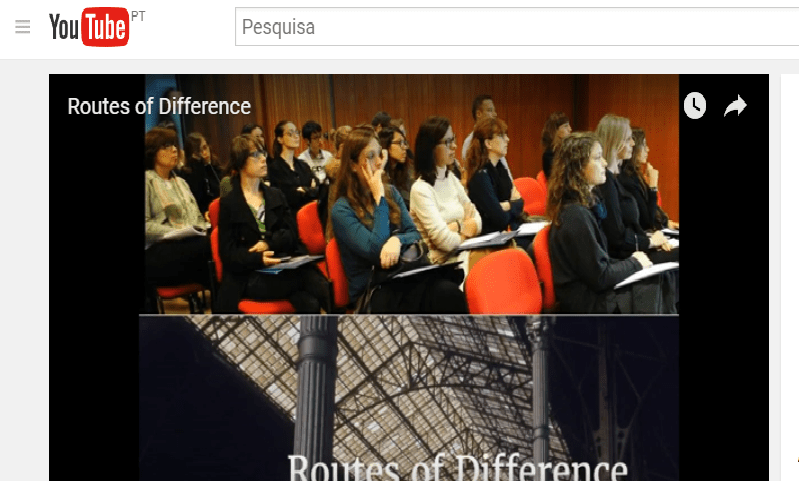
The workshop organized by PhD students from the Lisbon Consortium is titled “Donald Trump’s Political Reality: The Politics of Fakery and the Fakery of Politics”. It takes place on April 30, 2018 at the Universidade Católica Portuguesa.
https://trumpsfakeryofpolitics.wordpress.com/
Call for Participation – Workshop – The Lisbon Consortium
This workshop on politics in the time of Donald Trump’s presidency is organized by PhD students from the Lisbon Consortium. The aim is to think and discuss the notion of an emerging political field that can perhaps be characterized by the prevalence of claims of inauthenticity, fakeness, lies, semblance, virtuality and error. Claims of “Fake News” are constantly made by different agencies within the Trump administration and by the president himself as well. This notion of fakeness, often comes to stand for a supposed political strategy by Trump’s opponents, suggestive of a binary between the ‘real,’ ‘truthful,’ and ‘honest,’ on the one hand, and a supposed rhetorico-political strategy of discrediting this ‘truth’ on the other. ‘The media’ is turned into the political opponent, suggesting that unmediated, direct, and straight-forward speech by Trump – ironically, often by means of his Twitter account – provides ‘the people’ with a truth that is less fake, less political, and more pure.
Trump’s critics, at the same time, often use a similar rhetorics of fakery when it comes to criticizing this presidency. The common slogan “Not My President” performatively conjures up a connotation of a fake-presidency, a presidency that is not binding for all, one that can be disavowed at will. Indeed, there seems to be a rhetoric of crisis, of exceptionality, and of scandalousness, one that finds its grounding in the problematics of the political lie and distortion that are used by the Trump administration time and again to generate publicity and confusion.
This workshop aims at discussing the logic of fakery in the connection to mediation within the context of Trump’s politics. In his recent book Scatter 1. The Politics of Politics in Foucault, Heidegger, and Derrida, 2016, Geoffrey Bennington asks a question that can be summarized as follows “What if political rhetoric is unavoidable, an irreducible part of politics itself?” and in response, we want to ask: “What happens when fakery becomes the main strategy of political attack?” (Bennington 4). Following Jean-Jacques Baudrillard’s warning in, Simulacra and Simulation, that one should not all too readily read a political scandal as scandalous, and instead attempt to read it as part and parcel to a larger power structure that inscribes and overwrites the very notion of reality and the real, we ask: “What if Trump’s presidency is not a scandal?” (Baudrillard 12).
This workshop aims to analyze these problematics with an eye for an emerging field of political power that has both racist, sexist, heterosexist, and otherwise discriminatory elements, whilst at the same time promoting a classist economical agenda that marginalizes middle and low class Americans at the benefit of the extremely wealthy, big business, and high finance. A theoretical point of departure for our discussion will be that these two elements, economical state power on the one hand, and a logic of discrimination and racism on the other, should be analyzed in their connections rather than opposed to one another. Following Michel Foucault’s analyses of racism in connection to biopower, and with it to economy and capitalist State power, we suggest that an analysis of politics in the times of Trump should aim at a reading that pays attention to discrimination at the intersection of race, sex, gender, and class, and refuses to artificially oppose these elements of political strategy to each other (Foucault 259–261).
The organizers invite everyone who is interested to join and discuss these issues with us during a morning and afternoon program which will include presentations and a lot of time for discussion.
We call for proposals for ten minute presentations on themes related to the above. Proposals for presentations should be 300 words at the most and should be send to trumpsfakeryofpolitics[at]gmail[dot]com before March 15, 2018. The subject of your email should include your name and the words “proposal workshop Trump’s fakery of politics”. The organizers of the workshop will then notify you about the acceptance of your proposal as soon as possible.
The workshop will take place on April 30, 2018, at the Universidade Católica Portuguesa. More information about the location and exact times will follow.
- Donald Trump
- Truth/Fakery
- ‘fake-news’
- Simulacrum
- Political activism
- Fascism
- Biopower
- Classism
- Racism
- Virtuality