Blog
-
The University Day on public television
On February 4, Universidade Católica Portuguesa celebrated its day. In that context, the Rector Isabel Capeloa Gil and the Phd student Ilios Willemars gave interviews to the tv show “70×7”, at the public television RTP. You can watch it here:
http://www.rtp.pt/play/p59/e272180/70×7
-
5/5: 5 artists, 5 project rooms: students, artists and curatorship
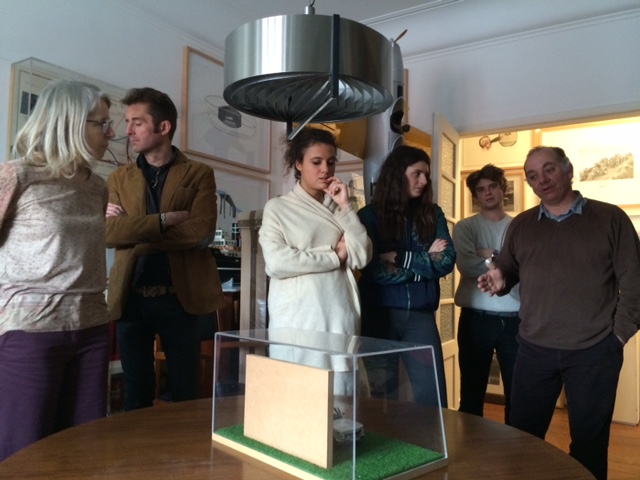
The project ‘5/5: 5 artists, 5 project rooms places together the students’ final projects for the Curatorship Lab’s first edition, inline with the international MA and PhD frameworks in Cultural Studies, under the signature of The Lisbon Consortium programme.
The project will exhibit Portuguese artists such as Miguel Palma, Luísa Jacinto, Teresa Braula Reis, João Biscainho and Paula Prates from the 3rd to the 18th of March. The exhibitions will take place at Carpe Diem Arte e Pesquisa and at Faculdade de Ciências Humanas – Universidade Católica Portuguesa, Lisbon.
For more information, please check the following links:
-
PhD project defense: January 27
Nataliya Hovorkova
PhD Project: A autocaricatura de Teixeira Cabral – identidade dinâmica, linguagem gráfica e funções de marca
January 27, 15h30
Room Exposições (2nd floor – Library Building) -

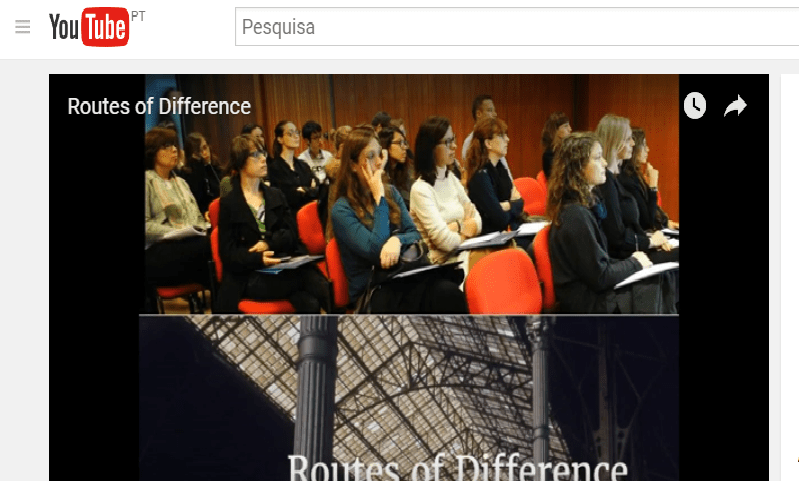
‘Routes of Difference’: VIDEO
The 6th Graduate Conference, one student led activity, took place at Universidade Católica Portuguesa 24-25th of November, 2016, with national and international speakers. Now you can check out the highlights.
-
Public Defense: MA dissertation
Joana Isabel Barroso de Jesus Hortas
Dissertation: Intervenção Urbana e Cultura: entre a intenção e o impacto. o caso do Largo do Intendente Pina Manique em Lisboa?
14h30
Room Sociedade Científica (1st floor, Library Building ) -

Arjun Appadurai at Católica
Tomorrow, Professor Arjun Appadurai will be at Universidade Católica, in the context of the 25th aniversary of the Refundation of the School of Human Sciences, and will present the lecture “Failure, Design and the Globalization of Risk”
The entrance is free but you have to register here: goo.gl/PELYZz
Arjun Appadurai is the Goddard Professor in Media, Culture and Communication at New York University, where he is also Senior Fellow at the Institute for Public Knowledge. He serves as Honorary Professor in the Department of Media and Communication, Erasmus University, Rotterdam, Tata Chair Professor at The Tata Institute for Social Sciences, Mumbai and as a Senior Research Partner at the Max-Planck Institute for Religious and Ethnic Diversity, Gottingen. He was previously Senior Advisor for Global Initiatives at The New School in New York City, where he also held a Distinguished Professorship as the John Dewey Distinguished Professor in the Social Sciences. Arjun Appadurai was the Provost and Vice President for Academic Affairs at The New School from 2004-2006. He was formerly the William K. Lanman Jr. Professor of International Studies, Professor of Anthropology, and Director of the Center on Cities and Globalization at Yale University. Appadurai is the founder and now the President of PUKAR (Partners for Urban Knowledge Action and Research), a non-profit organization based in and oriented to the city of Mumbai (India).
Professor Appadurai was born and educated in Bombay. He graduated from St. Xavier’s High School and took his Intermediate Arts degree from Elphinstone College before coming to the United States. He earned his B.A. from Brandeis University in 1967, and his M.A. (1973) and Ph.D. (1976) from The Committee on Social Thought at the University of Chicago.
During his academic career, he has also held professorial chairs at Yale University, the University of Chicago and the University of Pennsylvania, and has held visiting appointments at the École des Hautes Études en Sciences Sociales (Paris), the University of Delhi, the University of Michigan, the University of Amsterdam, the University of Iowa, Columbia University and New York University. He has authored numerous books and scholarly articles, including Fear of Small Numbers: An Essay on the Geography of Anger (Duke 2006) and Modernity at Large: Cultural Dimensions of Globalization, (Minnesota 1996; Oxford India 1997). His books have been translated into French, German, Spanish, Portuguese, Japanese, Chinese and Italian.
Arjun Appadurai has held numerous fellowships and scholarships and has received several scholarly honors, including residential fellowships at the Center for Advanced Study in the Behavioral Sciences in Palo Alto (California) and the Institute for Advanced Study in Princeton, and an Individual Research Fellowship from the Open Society Institute (New York). He was elected a Fellow of the American Academy of Arts and Sciences in 1997. In 2013, he was awarded an honorary doctorate by Erasmus University in the Netherlands.
He has also served as a consultant or advisor to a wide range of public and private organizations, including many major foundations (Ford, MacArthur, and Rockefeller); UNESCO; UNDP; the World Bank; the National Endowment for the Humanities; the National Science Foundation; and the Infosys Foundation. He currently serves on the Advisory Board for the Asian Art Initiative at the Solomon Guggenheim Museum and on the Scientific Advisory Board of the Forum D’Avignon in Paris.
Appadurai’s latest book, The Future as a Cultural Fact: Essays on the Global Condition was published by Verso in 2013.
In http://www.arjunappadurai.org/
-
‘Reading circles’ by PhD students of Culture Studies
This reading circle is organized by PhD students in Culture Studies at the Lisbon Consortium in Lisbon, Portugal. It is open to whoever is interested in taking part in discussing the readings that are decided on and announced on this website by the organizers of this circle.
The circle gathers weekly on Fridays in the canteen of the Economics Building at the Universidade Católica Portuguesa . For contact details and other practicalities, please go here.
We intend to formulate different ways of relating to text using the notion of surroundings as a productive point of entry. Realizing that it can be interpreted in many divergent and perhaps even contradictory ways, we do not suggest that this is either the only, best or final concept to draw on. We hope, however, that it will open up a space of discussion and reading in which we can come to terms with some of the more urgent political and conceptual issues in cultural analysis today.
-

International PhD: Progress Reports
The International Steering Committee of the FCT-International Doctoral Program in Culture Studies was in Lisbon last week, on November 7, to meet all INTDCS-FCT doctoral students and assess their progress. All FCT scholarship holders had to participate and present their ongoing work.
-
PhD Thesis Defense: Ana Fabíola Maurício
The Lisbon Consortium congratulates Ana Fabíola Maurício for successfully defending,on November 8, her doctoral thesis on ’30 Years of Culture, Art and Methamorphoss. The Modern Art Centre of the Calouste Gulbenkian Foundation and the Reshaping of Lisbon’s Culturalscape’ with the final result of summa cum laude by unanimous decision, in a double degree with Giessen University. Congratulations!
-

LxC Conversation Pieces: “Cadernos de Memórias”
Last Tuesday, October 25, the first LxC Conversation Pieces took place at the bookstore of Universidade Católica Portuguesa, bringing together the artists João Queiroz and Eduardo Salavisa (with an exhibition there) and Professor Marília Santos Lopes, to talk about drawing, writing, memory and traveling.
Photos: EMERGE
-
Exhibition CHINA NOW, curated by Helena Correia
The exhibition ‘CHINA NOW: Defying the Limits’, opens on the 27th October, 6:30pm, at the Oriente Museum in Lisbon,curated by Helena Silva Correia, Cultural Manager, Curator, Designer and PhD candidate in Cultural Studies at the Lisbon Consortium.

Curatorial Discourse: Helena Silva Correia
October, 2016Qui Jin, Du Zhenjun and Lifang presents us with a contemporary view of the numerous existing realities with which China confronts itself today, utilizing three visual and very different discourses; all with its’ incongruences, disparities and inequalities regarding issues with the environment, population growth, and China’s role in the era of Globalization. Whether they be, world(s) of cyberculture such as social media or socio-economical issues but also creative and artistic freedom, where the diffusion of images of the naked human body is still regarded as pornography.
The curatorial discourse is based on the Australian researcher and physic’s research, Graham Turner “Compares the Limits of Growth’ with the reality of 30 years ago” (2008) inspired this visual narrative of these three Chinese artists of today, through their work, present the ‘defying the environmental limits’, the search of the Chinese identity or the struggle for greater freedom of expression, all to reflect upon China’s role in the world today.
Fontes:
http://www.theguardian.com/commentisfree/2014/sep/02/limits-to-growth-was-right-new-research-shows-were-nearing-collapseClick to access Turner_Meadows_vs_historical_data.pdf
Click to access MSSI-ResearchPaper-4_Turner_2014.pdf
Cultural Citizenship_Qui Jin
‘Cultural Citizenship’ is based on the guarantee of cultural rights for all citizens but it goes further, to stimulate a generation towards a new political conscience “through the appropriation of culture as a right to fruition, experimentation, to information, to memory and participation”, in the words of the philosopher, Marilena Chauí.
Qui Jin approaches his theme of work inspired by the duality of his ‘cultural citizenship’. As Chinese artist, he constructs and imposes the encounter with the reinterpretation of western advertising and ‘pop culture’, utilizing Chinese iconography with references to Mao Tsé-Tung period, uses manly figures with cat heads, in order to create highly detailed pencil drawings, characteristic of ancestral Chinese art.
The solitary artist, Qui Jin calls himself “the man from the other mountains” where he grew up in China before living in Switzerland, from 1989. During his childhood and he lived through the Chinese Cultural Revolution, producing propaganda drawings for the local newspaper, in the Province of Shanghai. Today, his work is intrinsically autobiographical as he combines the realism with cultural references of the West with the Orient, concerned with the doctrinaire form of politics that occurred in China. Qiu utilizes mockery, scorn and defame to counterbalance the revolutionary fiction of his art. His artistic style could be described as ‘political pop’, due to the fact that he confronts the history of Chinese society through imagery while it dissolves itself in the western popular culture, creating a visual portrait of his own personal journey as an artist, living outside China.
The Limits of Growth_Du ZhenjunThe sustainable development concept appeared with the study developed by the United Nations Organization, with regard to climate change at the beginning of the decade of 1970, in response to humanities’ concerns facing social and environmental crisis, that confronted the world since the second half of the previous century. This concept searches to reconcile societies’ necessity towards economical development with the promotion of social development, and respect towards the environment.
Du Zhenjun presents us with a dystopian view of the profound social transformations that China has endured since the “Chinese Cultural Revolution” resorting to digital art and technology to create montages of great photographic detail with enormous visual richness, to translate the frenetic growth of globalized capitalism, over the last two decades – with repercussions on the environment, population growth, the growing scarcity of natural resources – water and food, or the more dramatic effects of global warming, such as the rise of sea levels or poor air quality.
With the Babel Towers of capitalism set in the background, is an allegory to the story of the Genesis, when mankind wanted to construct a city in the shape of a tower that could reach the heavens. God didn’t appreciate the idea and punished mankind by creating numerous languages, and spreading mankind across the World. Today, the World confronts itself with the frenetic economic growth generated by China which defies the limits of CO2 emissions everyday, consequently contributing to the rise of the Planet’s temperature, one may ask until when?Freedom of Expression_Li Fang
The Universal Declaration of 1948 constitutes ‘freedom of expression’ one of the fundamental human rights, and is part of Constitutions of all the democratic systems. This liberty supposes that all individuals have the right to express themselves without being discriminated by their opinions, as the article 19 from the Human Rights Letter on Freedom of Expression confers: “All have the right to freedom of expression and to opinion. This right includes the freedom to have opinions without interference and to search, receive and give information and ideas via any form of communication and without the concern of borders.”
Li Fang presents us her work utilizing the Human Rights theme — ‘freedom of expression’ which she produced in 2012. The impressionist representation of cyberspace depicts two episodes that Ai Weiwei, in which Li Fang also defies representation and the “mechanical representation” (Benjamin, 1934) contributing with another layer of information or the return of the virtual space to reality, of the limitations imposed by the Chinese authorities to Ai Weiwei’s art work, inevitably associated to the limits of repression and applied force in 2011 when the artist was detained.
In the same year Ai Weiwei posed naked with his four studio assistants, later diffusing the image via social media, generated a wave of indignation from the Chinese authorities, due to the fact that the image(s) placed in circulation were of naked figures. Ai Weiwei contested that “nudism isn’t pornography”. Consequently in the same month, the social media company Facebook decided to also censor the same image and disactivate the artist’s page.
Today, Ai Weiwei continues to fight for more transparency and freedom for the public domain in China, a theme in which Li Fang inspired to give continuity to the movement in honour of the fight for freedom of expression beyond the social spaces and internet’s chronological time(s), where social media companies such as Facebook, Twitter, Wikipedia and Youtube are blocked by the ‘Great Fire Wall of China”, and the largest search engine – Google, currently is unable to operate by the regime.More info here
-

“The Way we Work Now”: Irit Rogoff at Universidade Católica
Irit Rogoff’s lecture “The Way we Work Now”
Diffractions Lecture Series on “Creative Knowledge Practices”, with CECC and Lisbon Consortium
Lisbon, October 12 2016 -
Grant recipients. Congratulations!

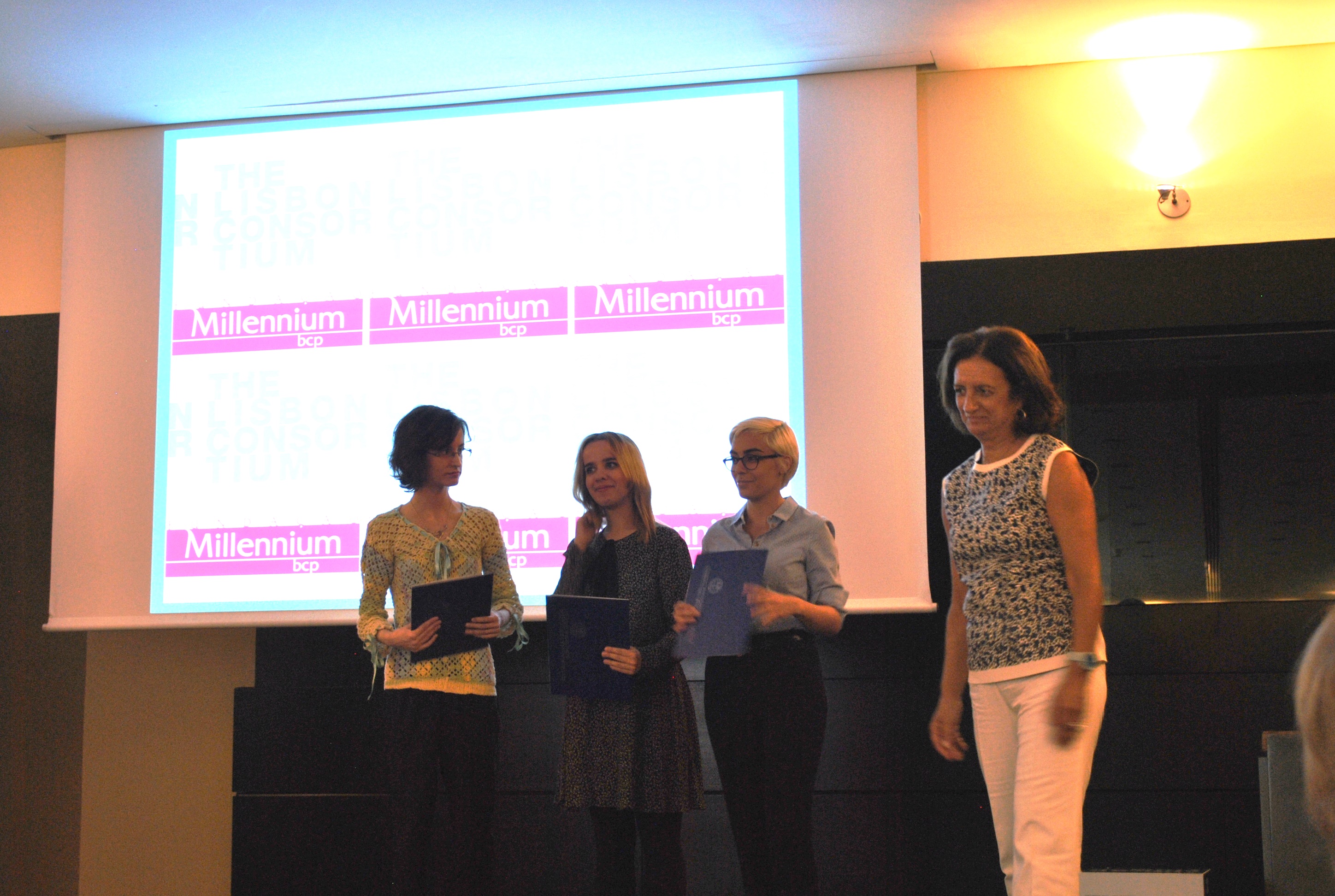
This year’s winners of the Millennium BCP Foundation Scholarship and EDP Foundation International Grant were announced on September 30 at the Opening Session of the Lisbon Consortium academic year.
The Millennium BCP Foundation Grant was awarded by Fátima Dias, representative of the Millennium BCP Foundation at the Curators Council of the Lisbon Consortium
The Millennium BCP Foundation Scholarship for the Lisbon Consortium aims at funding Portuguese students in the Culture Studies program through 3 scholarships. These scholarships consist in a reduction of full-tuition in the first two semesters, amounting to 1.750€.
This year’s winners of the Millennium BCP Foundation Scholarships are:
- Mafalda Barrela – first-year student of the Master’s Program in Culture Studies.
- Diana Oliveira – first-year student of the Master’s Program in Culture Studies.
- Diana Ferreira – first-year student of the Master’s Program in Culture Studies

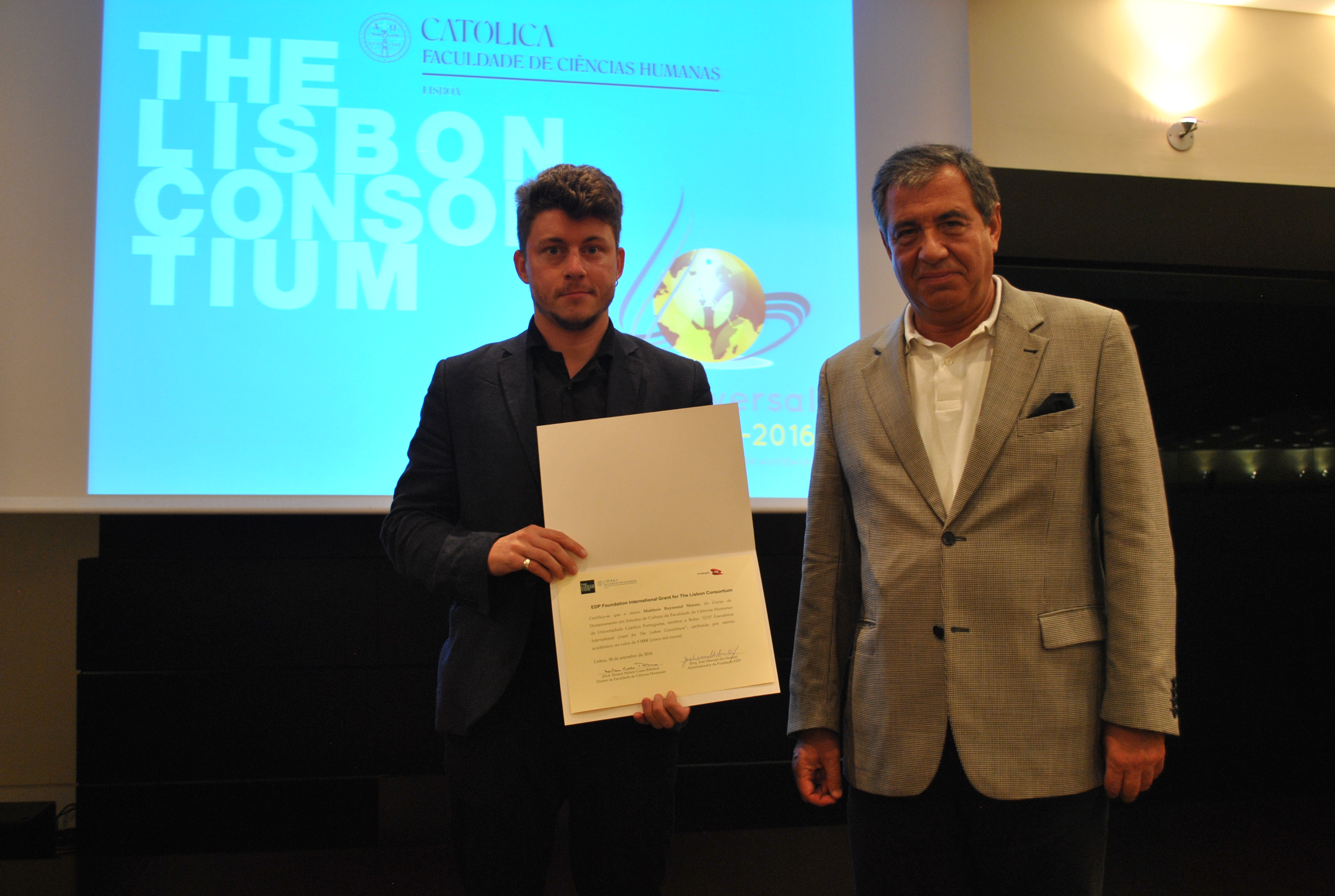
The EDP Foundation International Grant will be awarded by José Manuel dos Santos, Member of the Board of Directors and Cultural Director of the EDP Foundation and Member of the Curators Council of the Lisbon Consortium.
The EDP Foundation International Grant for the Lisbon Consortium aims at funding research conducted by an international PhD student in the Culture Studies program. The scholarship, in the amount of 5.000€, is destined to the payment of tuition fees.
This year’s winner of the EDP Foundation International Grant is:
- Matthew Mason – first-year student of the Doctoral Program in Culture Studies.
CONGRATULATIONS!
-

Opening session of the Lisbon Consortium
The open session of the academic year of the Lisbon Consortium was held last friday, September 30, at Centro Cultural de Belém, with the faculty, the old and the new students, the partners and Bill Fontana.
Welcome to the Lisbon Consortium!
-

Bill Fontana at the Lisbon Consortium

Photo: Stuart Davidson
The sound artist Bill Fontana is the special guest of the Lisbon Consortium opening session, due to take place on September 30, at 18h, Centro Cultural de Belém (Sala Almada Negreiros)
Bill Fontana (born USA 1947) is an American composer and artist who developed an international reputation for his pioneering experiments in sound. Since the early 70’s Fontana has used sound as a sculptural medium to interact with and transform our perceptions of visual and architectural spaces. He has realized sound sculptures and radio projects for museums and broadcast organizations around the world. His work has been exhibited at the Whitney Museum of American Art, the San Francisco Museum of Modern Art, the Museum Ludwig, Cologne, the Post Museum in Frankfurt, the Art History and Natural History Museums in Vienna, both Tate Modern and Tate Britain in London, the 48th Venice Biennale, the National Gallery of Victoria in Melbourne, the Art Gallery of NSE in Sydney and the new Kolumba Museum in Cologne. He has done major radio sound art projects for the BBC, the European Broadcast Union, the Australian Broadcasting Corporation, National Public Radio, West German Radio (WDR), Swedish Radio, Radio France and the Austrian State Radio.
Here, you can know more about his life and work:
-
Faculty ID Card

The academic year is about to start and the new students have already met some of the faculty members. Click here to check the ID CARD
-

International Doctoral program
Applications now closed for 2016-2017
Admission to the FCT-International Doctoral Program in Culture Studies 2016, see here intdcs-results
Download the Application handbooks: PhD_Application Guidelines_2016-2017
The International Doctoral Program in Culture Studies is a 4-year and dual-degree programme in Culture Studies awarded by the Catholic University of Portugal, the University of Giessen and the University of Copenhagen. It builds from different disciplines in the humanities and the social sciences, thereby assuming the interdisciplinarity of contemporary modes of knowledge production focused on problem-oriented and practice-based research.
Background – What is Culture Studies?
Culture Studies have come of age over the last two decades. Within the framework of the crisis in the humanities and the growing call for renewed arts-based forms of knowledge production, the study of culture has changed from being a frame for humanities’ disciplines into gaining prominence in its own right. Two developments triggered this change. On the one hand, the rise of cultural studies in the 1960’s drew attention to the social-political dimension of culture, to its ordinariness and the many ways in which power was blended into creation. On the other, over the course of the 1980’s a new metadiscipline Kulturwissenschaft (science of culture) drew on the interpretative skills of the humanities and the growing attention to forms of mediation in media studies to look at the multiple ways in which culture matters as driver of artistic creation and also address how societies represent themselves and view others, look at the past and prepare the future. Bringing together the sociological methodology that is proper to British cultural studies with the interpretative qualitative approach of Kulturwissenschaft, Culture Studies is by definition transdisciplinary. It has risen to become a problem-oriented metadiscipline, representing a new paradigm of integrated reflection on the artistic forms of expression of individuals and societies, across the visual arts, literature, cinema and the media.
Collaborative model
The program is born out of the commitment to develop a doctoral program that promotes both high level research training at the forefront of scientific interest and responds to the cultural sector’s growing call for highly qualified professionals. It is inspired by the ‘collaborative turn’ on two levels: firstly as a model of advanced research training that draws from artistic practice and cultural management to reflect on theory and in turn embeds practice in theoretically informed premises; secondly as a form of doctoral training that is transnational by definition, because the study of culture inevitably deals with diversity.The programme works on a feed-back loop model, allowing the research methods and theories it devises to be tested in institutional practice by means of internships, curating and other applied projects (i.e. audience research, implementation of new strategies in museum services) while bringing artists, curators and cultural managers to reflect on their practice within scholarly work. These new training formats are specifically directed at tapping into the innovative potential of creative practices and combining these with research agendas that are challenge-based and object-based rather than discipline-based in a traditional sense.
The program intends to inspire students to customize their curriculum and is committed to support work placement. It will provide doctoral students with methodological tools for cultural analysis, challenging them to revise phenomena that are either “invisible” or undervalued by contemporary societies while encouraging a look into the humanist tradition to deepen the understanding about the discourses and creations that have moulded cultural history. Consequently, it aims to promote original and internationally relevant research and to integrate doctoral students into multinational research teams. In addition, it will support knowledge transfer, urging students to take their work outside the seminar room and interact with professional realities other than academia.Mobility
As part of a tri-national network, students will benefit from up to two semesters at one of the partner institutions in order to conduct empirical or theoretical research. The stay abroad is part of the co-tutelle agreement and will also allow the candidate to work with the second supervisor. A work programme will be established for the duration of the stay at the partner institution. Within the framework of the many exchange agreements between the three partners universities, CECC and their international counterparts, candidates may apply for an additional stay as a visiting researcher, specially if these agreements are of particular importance to the research project.
Network
The Lisbon Consortium – Catholic University of Portugal
Program Director: Isabel Capeloa Gil
Graduate Center for the Study of Culture – University of Giessen
Program Director: Ansgar Nünning
Copenhagen Doctoral School in Cultural Studies – University of Copenhagen
Program Director: Frederik Tygstrup
External advisory committee
Andreas Huyssen (Columbia University, Villiard professor of Comparative Literature)
Mieke Bal (University of Amsterdam)
George Yúdice (University of Miami)
The program is entirely taught in English.
STRUCTURE
First Semester
Elective 1
Elective 2
Elective 3
-Publishing Strategies
-Managing Bibliographies
-Database Research
-Academic English-Career DevelopmentSecond Semester
Elective 4
Elective 5
Lisbon Summer School for the Study of Culture
Third and Fourth Semesters
Research Colloquium I and II
Dissertation Writing
Fifth to Eight Semester
Dissertation Writing
Elective Courses:
Methods for Cultural Analysis • World Literature • Visual Culture • Asian Visual Cultures • Cultural Entrepreneurship • Cultural Economics • Cultural & Creative Industries • Management of Cultural Projects • Culture and Globalization • Cyberculture • History of Film • Media, Society & Culture • Translation & Globalization • The Emergence of Asia and the Global Impact • East Asia: Tourism & Cultural Industries amongst others availabe at http://www.fch.lisboa.ucp.pt
Courses offered by the Department of Culture Studies are always offered in English. Coursed offered by other Departments are usually offered in Portuguese.
Academic English • Strategies for Publishing in English • Database research • Managing Bibliographies • Career Development
REQUEST INFORMATION
-

Master Degree
Applications now open for 2016-2017 ( February intakes)
Ranked #3 by the Eduniversal Worldwide Best Masters Ranking in Arts and Cultural Management, the Master Program in Culture Studies is aimed at graduate degree holders from the Humanities and Social Sciences, interested in a structured discussion of cultural phenomena in the global world.
This 2-year program has three specializations and is organized around a core course of theory and practice-based seminars. The first year is curricular and requires the completion of 60 ECTS. The second year is dedicated to the final assignment: dissertation, project, or internship. During the second year students also have to take a research seminar each semester to monitor their progression.
Please choose one specialization upon application.
The program is entirely taught in English.
SPECIALIZATIONS:
a. Management of the Arts and Culture
First Semester (30 ECTS)
Grad Labs
- Academic English
- Managing Bibliographies
- Database Research
- Publishing Strategies
- Career Development
Second Semester (30 ECTS)
Culture, Production and Creativity
Management of Cultural Projects
Lisbon Summer School for the Study of Culture
3rd and 4th Semesters
Research Colloquium I and II
Dissertation/Project/Internship
b. Performance and Creativity
First Semester
Cognition and Creativity
Grad Labs
- Academic English
- Managing Bibliographies
- Database Research
- Publishing Strategies
- Career Development
Elective course 1
Second Semester
Contemporary Culture and the Environment
Performance and Performativity
Lisbon Summer School for the Study of Culture
3rd and 4th Semesters
Research Colloquium I and II
Dissertation/Project/Internship
c. Literary Cultures
First Semester
Narrative and Culture
World Literature
- Academic English
- Managing Bibliographies
- Database Research
- Publishing Strategies
- Career Development
Second Semester
Culture and Literary Mediation
Elective Course 1
Lisbon Summer School for the Study of Culture
3rd and 4th Semesters
Research Colloquium I and II
Dissertation/Project/Internship
Elective courses: Choose from any course in the MA in Culture Studies or other MA Degrees at the School of Human Sciences.
Courses in Culture Studies are always taught in English. Courses offered by other Departments are mostly offered in Portuguese
REQUEST INFORMATION
-

Induction Week: 19-22 September
The start of a new program is always a very exciting moment, full of expectations. Yet, it can also be quite confusing and overwhelming. In order to help you settle in and show you what the Lisbon Consortium is all about, the Coordination of the Program has organized some special events and activities for the 2016-2017 cohort of students.The Induction Week will take place from Monday, September 19 to Thursday, September 22 and is mandatory for all new students.Please check the welcome_guide_2016_2017 This Guide gathers key, practical information about the University and the city so as to make you feel more at home and minimize the stress associated with new beginnings.
We wish you a very successful and productive year! -
Call for papers: VII Lisbon Summer School for the Study of Culture on Global Translations
VII Lisbon Summer School for the Study of Culture
Global Translations
Lisbon, June 26 – July 1, 2017
Deadline for submissions: January 30, 2017
Translation is a concept, and a practice, at the heart of contemporary experience. The legacies of the past, along with modern-day technology and worldviews, have allowed for, indeed have invited, the coming together of multiple identities, through various languages and a plurality of cultures. Nowadays, translation inhabits the world in new and irrevocably radical ways, and any definition of globalization – hegemonic, utopian or imaginary – must involve translation.
Etymologically meaning ‘the activity of carrying across’ (Tymockzo, 1999: 20), translation may be the actual epitome of the global world, particularly if one accepts the broadest definition of ‘globalization’, i.e., that ‘“globalization” refers to the processes by which more people across large distances become connected in more and different ways’ (Lechner and Boli, 2012: 1) – a ‘global village’ needs translation, and translation is, of course, never innocent, as linguistic translation can help imposing hegemony or promoting resistance. Thus, translation, or the rejection of it, has been used as a political tool in every meeting of others, be it in the colonial past or in the post-colonial or neo-colonial present.
Translation has always meant, to a greater or smaller extent, displacement, and is never a one-way process and always involves beings as well as goods-in-transit. This translatedness of people and things, either voluntary or forced, has come to change the world, in practical as well as conceptual terms. The 21st century may well prove to be the age of migration, with millions – of people, goods, ideas, dollars – getting translated every day. These are Appadurai’s ‘objects in motion’ (2001) in ‘a world in flows’ (1996). Reinforced by long-distance technology (media, transports, etc.) and overreaching hegemonies, translation becomes a metaphor for modern-day experience, and a practical and a conceptual tool to better negotiate the world around.
To understand how cultural phenomena are affected and shaped by translation is, therefore, a task for culture studies, as the recent ‘translation turn’ may attest (Bassnett, 1990; Bachmann-Medick, 2009). This turn in culture studies testifies to the crucial impact of ‘difference’ – be it in the sense of Paul Gilroy’s convivial cosmopolitan worldview (2004) or the rather more pessimistic take of Zygmunt Bauman’s ‘liquidity’ (1998, 2011) or of Appiah’s interrogative musings (2006) – has on the imaginings of culture, on cultural performativity, on the ability to negotiate meanings, values, beliefs and practices and potentially raising what be called ‘cosmopolitan empathy’ (Beck, 2006). ‘Cosmopolitanization’ as a process which ‘comprises the development of multiple loyalties as well as the increase in the diverse transnational forms of life’ (Beck, 2006: 9) must be inhabited by translation in a radically intimate way – a translation that is both an act of love and disruption, and that begins at home with oneself. As Emily Apter put it, ‘[c]ast as an act of love, and an act of disruption, translation becomes a means of repositioning the subject in the world and in history; a means of rendering self-knowledge foreign to itself; a way of denaturalizing citizens, taking them out of the comfort zone of national space, daily ritual, and pre-given domestic arrangements’ (2006: 6). Seen as such, every form of translation begins with self-translation.
The Summer School invites proposals by doctoral students and post-docs that address, though may not be not be strictly limited to, the topics below:• The globalization of art and art markets
• The monolingualization of economics and economic practices
• Migration as translation
• Cultural mediation and negotiation
• Fear and the absence of translation
• The invention of the ‘other’ in and through translation
• Translating ideas, methods, policies across the world
• (Un)Translatability and the rise of demotic media and politics
• (Translated) Identities in the global world
• Nationalism and the global village
• Self-translation and critical thinking in the global world
• Cosmopolitanism, cosmopolitanization, and globalizationConfirmed Keynote Speakers
- Michael Cronin (Dublin City University)
- Sandra Bermann (Princeton University)
- Alexandra Lopes (Universidade Católica Portuguesa)
- Uwe Wirth (Justus-Liebig University)
- Rui Carvalho Homem (Universidade do Porto)
- Loredana Polezzi (Cardiff University)
- Aamir Mufti (University of California, Los Angeles)
- Hanif Kureishi (British writer and filmmaker)
Master Classes
- Alison Ribeiro de Menezes (University of Warwick)
- Knut Ove Eliassen (Norwegian University of Science and Technology)
- Adriana Martins (Universidade Católica Portuguesa)
The Summer School will take place at several cultural institutions in Lisbon and will gather outstanding doctoral students and post-doctoral researchers from around the world. In the morning there will be lectures and master classes by invited keynote speakers. In the afternoon there will be paper presentations by doctoral students.
Paper proposals
Proposals should be sent to lxconsortium@gmail.com no later than January 30, 2017 and include paper title, abstract in English (200 words), name, e-mail address, institutional affiliation and a brief bio (max. 100 words) mentioning ongoing research.
Applicants will be informed of the result of their submissions in the beggining of March.Rules for presentation
The organizing committee shall place presenters in small groups according to the research focus of their papers. They are advised to stay in these groups for the duration of the Summer School, so a structured exchange of ideas may be developed to its full potential.Full papers submission
Presenters are required to send in full papers by May 30, 2017.The papers will then be circulated amongst the members of each research group and in the slot allotted to each participant (30’), only 10’ may be used for a brief summary of the research piece. The Summer School is a place of networked exchange of ideas and organizers wish to have as much time as possible for a structured discussion between participants. Ideally, in each slot, 10’ will be used for presentation, and 20’ for discussion.
Registration fees
Participants with paper – 265€ for the entire week (includes lectures, master classes, doctoral sessions, lunches and closing dinner)
Participants without paper – €50 per session/day | 165€ for the entire week (lectures and master classes only)Fee exemptions
For The Lisbon Consortium students, the students from Universities affiliated with the European Summer School in Cultural Studies and members of the Excellence Network in Cultural Studies there is no registration fee.Organizing Committee
• Isabel Capeloa Gil
• Peter Hanenberg
• Alexandra Lopes
• Paulo de Campos Pinto
• Diana Gonçalves
• Clara CaldeiraThe Lisbon Summer School for the Study of Culture is an annual meeting organized by the Lisbon Consortium, a collaborative research network between the Master and PhD programs in Culture Studies at Universidade Católica Portuguesa and the main cultural institutions in Lisbon.
The MA in Culture Studies is ranked no. 3 in the world by the Eduniversal Best Masters Ranking in Arts Management.
For further information, please contact us through lxconsortium@gmail.com